Division of Speech, Music and Hearing, KTH Royal Institute of Technology, Stockholm, Sweden.
Primates. 2024 Mar;65(2):81-88. doi: 10.1007/s10329-023-01107-3.
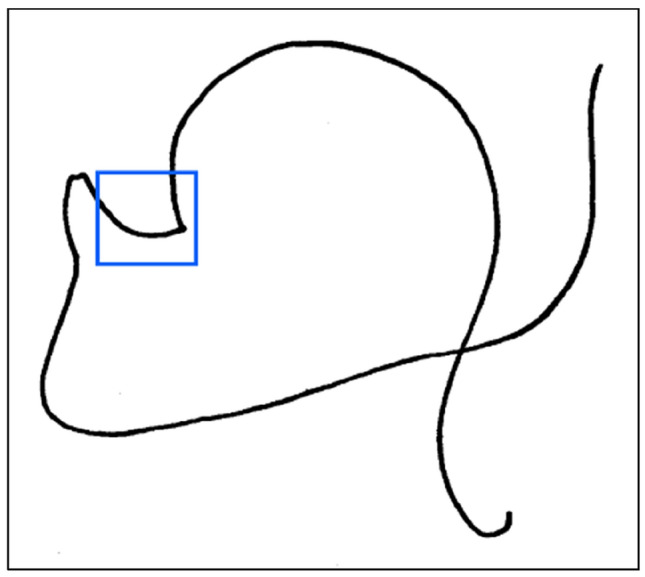
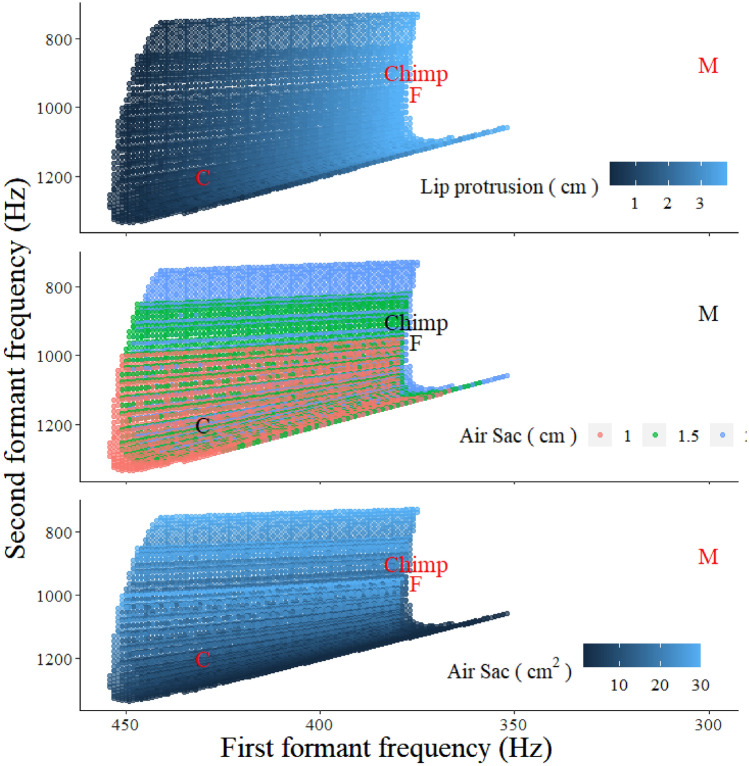
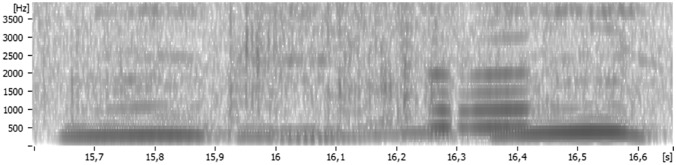
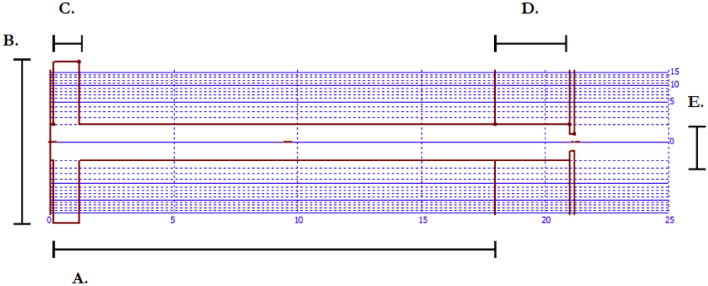
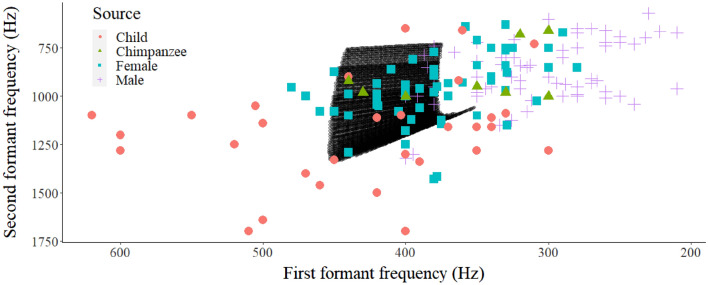
In human speech, the close back rounded vowel /u/ (the vowel in "boot") is articulated with the tongue arched toward the dorsal boundary of the hard palate, with the pharyngeal cavity open. Acoustic and perceptual properties of chimpanzee (Pan troglodytes) hoo's are similar to those of the human vowel /u/. However, the vocal tract morphology of chimpanzees likely limits their phonetic capabilities, so that it is unlikely, or even impossible, that their articulation is comparable to that of a human. To determine how qualities of the vowel /u/ may be achieved given the chimpanzee vocal tract, we calculated transfer functions of the vocal tract area for tube models of vocal tract configurations in which vocal tract length, length and area of a laryngeal air sac simulacrum, length of lip protrusion, and area of lip opening were systematically varied. The method described is principally acoustic; we make no claim as to the actual shape of the chimpanzee vocal tract during call production. Nonetheless, we demonstrate that it may be possible to achieve the acoustic and perceptual qualities of back vowels without a reconfigured human vocal tract. The results, while tentative, suggest that the production of hoo's by chimpanzees, while achieving comparable vowel-like qualities to the human /u/, may involve articulatory gestures that are beyond the range of the human articulators. The purpose of this study was to (1) stimulate further simulation research on great ape articulation, and (2) show that apparently vowel-like phenomena in nature are not necessarily indicative of evolutionary continuity per se.
在人类语音中,闭后圆唇元音 /u/(如“boot”中的元音)的发音是舌尖向后拱起抵住硬腭的后部,咽腔打开。黑猩猩(Pan troglodytes)的hoo 音的声学和感知特性与人类的元音 /u/ 相似。然而,黑猩猩的声道形态可能限制了它们的发音能力,因此它们的发音方式不太可能与人类的发音方式相似,甚至可能是不可能的。为了确定在黑猩猩声道的限制下如何实现元音 /u/ 的音质,我们计算了声道区域的传递函数,这些传递函数是通过对声道构型的管模型进行计算得到的,声道构型中系统地改变了声道长度、喉气囊模拟物的长度和面积、唇部突出长度以及唇部开口面积。所描述的方法主要是声学的;我们不声称在呼叫产生期间实际的黑猩猩声道的形状。尽管如此,我们证明了在不重新配置人类声道的情况下,可能实现后元音的声学和感知品质。虽然结果是初步的,但表明黑猩猩发出 hoo 音,虽然能达到与人类 /u/ 相似的元音品质,但可能涉及超出人类发音器官范围的发音动作。本研究的目的是:(1)激发对大型猿类发音的进一步模拟研究;(2)表明自然中明显的元音现象不一定本身就表明进化的连续性。