Swiss Tropical and Public Health Institute, Kreuzstrasse 2, 4123, Allschwil, Switzerland.
Universität Basel, Petersplatz, 1, P.O. Box, CH-4001, Basel, Switzerland.
Trials. 2023 Dec 19;24(1):814. doi: 10.1186/s13063-023-07839-3.
Violence against health care workers (HCWs) is a multifaceted issue entwined with broader social, cultural, and economic contexts. While it is a global phenomenon, in crisis settings, HCWs are exposed to exceptionally high rates of violence. We hypothesize that the implementation of a training on de-escalation of violence and of a code of conduct informed through participatory citizen science research would reduce the incidence and severity of episodes of violence in primary healthcare settings of rural Democratic Republic of Congo (DRC) and large hospitals in Baghdad, Iraq.
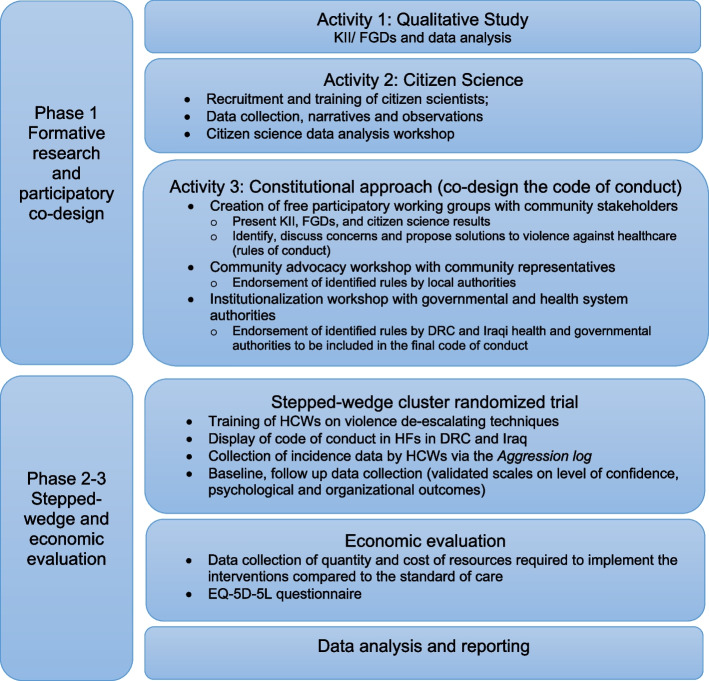
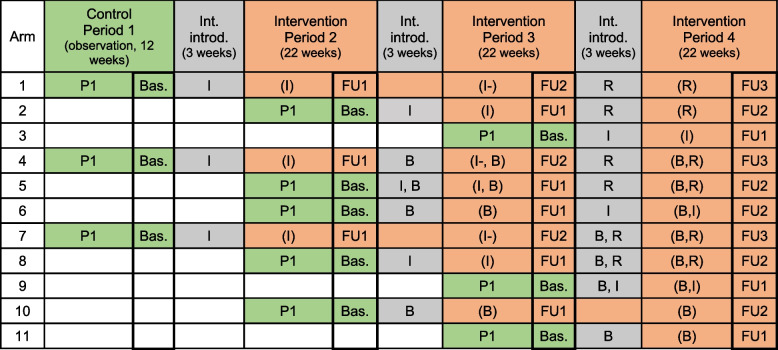
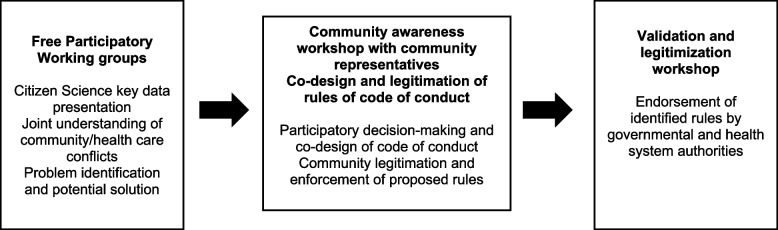
In an initial formative research phase, the study will use a transdisciplinary citizen science approach to inform the re-adaptation of a violence de-escalation training for HCWs and the content of a code of conduct for both HCWs and clients. Qualitative and citizen science methods will explore motivations, causes, and contributing factors that lead to violence against HCWs. Preliminary findings will inform participatory meetings aimed at co-developing local rules of conduct through in-depth discussion and input from various stakeholders, followed by a validation and legitimization process. The effectiveness of the two interventions will be evaluated through a stepped-wedge randomized-cluster trial (SW-RCT) design with 11 arms, measuring the frequency and severity of violence, as well as secondary outcomes such as post-traumatic stress disorder (PTSD), job burnout, empathy, or HCWs' quality of life at various points in time, alongside a cost-effectiveness study comparing the two strategies.
Violence against HCWs is a global issue, and it can be particularly severe in humanitarian contexts. However, there is limited evidence on effective and affordable approaches to address this problem. Understanding the context of community distrust and motivation for violence against HCWs will be critical for developing effective, tailored, and culturally appropriate responses, including a training on violence de-escalation and a community behavioral change approach to increase public trust in HCWs. This study aims therefore to compare the effectiveness and cost-effectiveness of different interventions to reduce violence against HCWs in two post-crisis settings, providing valuable evidence for future efforts to address this issue.
ClinicalTrial.gov Identifier NCT05419687. Prospectively registered on June 15, 2022.
针对医疗保健工作者(HCWs)的暴力行为是一个多方面的问题,与更广泛的社会、文化和经济背景交织在一起。虽然这是一个全球性现象,但在危机环境下,HCWs 面临着极高的暴力发生率。我们假设实施一项关于暴力降级的培训和一项通过参与式公民科学研究制定的行为准则,将减少刚果民主共和国(DRC)农村初级保健环境和伊拉克巴格达大型医院中 HCWs 遭受暴力事件的发生率和严重程度。
在初始形成性研究阶段,该研究将使用跨学科的公民科学方法为 HCWs 重新调整暴力降级培训以及 HCWs 和客户行为准则的内容提供信息。定性和公民科学方法将探讨导致针对 HCWs 的暴力行为的动机、原因和促成因素。初步研究结果将为参与式会议提供信息,旨在通过来自各利益相关者的深入讨论和投入,共同制定当地行为规则,并随后进行验证和合法化过程。这两项干预措施的有效性将通过 11 个臂的逐步楔形随机分组试验(SW-RCT)设计进行评估,测量暴力的频率和严重程度,以及 PTSD、工作倦怠、同理心或 HCWs 生活质量等次要结果,同时进行成本效益研究,比较这两种策略。
针对 HCWs 的暴力行为是一个全球性问题,在人道主义背景下可能尤为严重。然而,针对解决这一问题的有效且经济实惠的方法的证据有限。了解社区不信任和针对 HCWs 的暴力行为的动机的背景将对于制定有效的、量身定制的和文化上合适的应对措施至关重要,包括关于暴力降级的培训和增加公众对 HCWs 的信任的社区行为改变方法。因此,这项研究旨在比较两种后危机环境下减少针对 HCWs 的暴力行为的不同干预措施的有效性和成本效益,为未来解决这一问题提供有价值的证据。
ClinicalTrial.gov 标识符 NCT05419687。于 2022 年 6 月 15 日前瞻性注册。