Falb Kathryn L, Tanner Sophie, Ward Leora, Erksine Dorcas, Noble Eva, Assazenew Asham, Bakomere Theresita, Graybill Elizabeth, Lowry Carmen, Mallinga Pamela, Neiman Amy, Poulton Catherine, Robinette Katie, Sommer Marni, Stark Lindsay
International Rescue Committee, 122 E 42nd St, New York City, NY, 10168, USA.
International Rescue Committee, 3 Bloomsbury Place, London, WC1A 2QL, UK.
BMC Public Health. 2016 Mar 5;16:231. doi: 10.1186/s12889-016-2894-3.
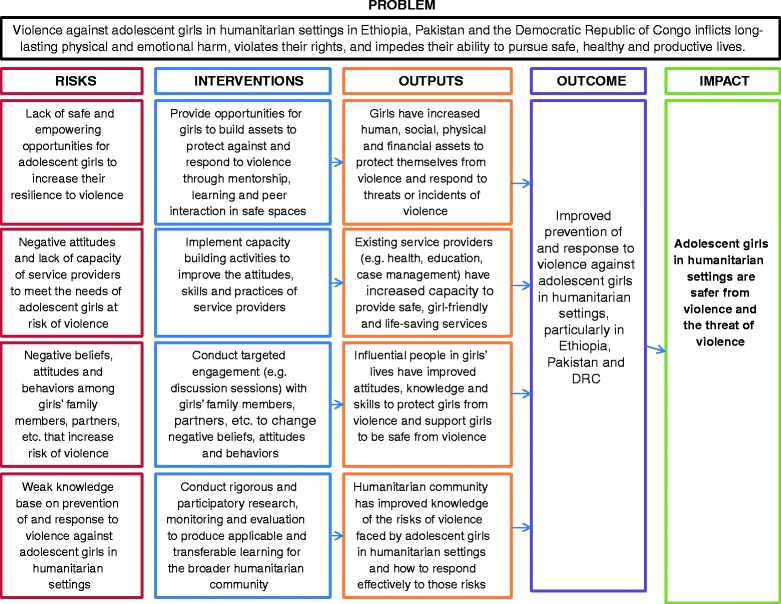
Violence against adolescent girls in humanitarian settings is of urgent concern given their additional vulnerabilities to violence and unique health and well-being needs that have largely been overlooked by the humanitarian community. In order to understand what works to prevent violence against adolescent girls, a multi-component curriculum-based safe spaces program (Creating Opportunities through Mentorship, Parental involvement and Safe Spaces - COMPASS) will be implemented and evaluated. The objectives of this multi-country study are to understand the feasibility, acceptability and effectiveness of COMPASS programming to prevent violence against adolescent girls in diverse humanitarian settings.
METHODS/DESIGN: Two wait-listed cluster-randomized controlled trials are being implemented in conflict-affected communities in eastern Democratic Republic of Congo (N = 886 girls aged 10-14 years) and in refugee camps in western Ethiopia (N = 919 girls aged 13-19 years). The intervention consists of structured facilitated sessions delivered in safe spaces by young female mentors, caregiver discussion groups, capacity-building activities with service providers, and community engagement. In Ethiopia, the research centers on the overall impact of COMPASS compared to a wait-list group. In DRC, the research objective is to understand the incremental effectiveness of the caregiver component in addition to the other COMPASS activities as compared to a wait-list group. The primary outcome is change in sexual violence. Secondary outcomes include decreased physical and emotional abuse, reduced early marriage, improved gender norms, and positive interpersonal relationships, among others. Qualitative methodologies seek to understand girls' perceptions of safety within their communities, key challenges they face, and to identify potential pathways of change.
These trials will add much needed evidence for the humanitarian community to meet the unique needs of adolescent girls and to promote their safety and well-being, as well as contributing to how multi-component empowerment programming for adolescent girls could be adapted across humanitarian settings.
Clinical Trials NCT02384642 (Registered: 2/24/15) & NCT02506543 (Registered: 7/19/15).
鉴于青少年女孩在人道主义环境中更容易遭受暴力侵害,且她们独特的健康和福祉需求在很大程度上被人道主义界忽视,针对她们的暴力行为令人深感忧虑。为了解哪些措施有助于预防针对青少年女孩的暴力行为,将实施并评估一项基于课程的多组成部分安全空间项目(通过指导、家长参与和安全空间创造机会——COMPASS)。这项多国研究的目的是了解COMPASS项目在不同人道主义环境中预防针对青少年女孩暴力行为的可行性、可接受性和有效性。
方法/设计:在刚果民主共和国东部受冲突影响的社区(N = 886名10 - 14岁女孩)和埃塞俄比亚西部的难民营(N = 919名13 - 19岁女孩)开展两项延迟入组的整群随机对照试验。干预措施包括由年轻女性导师在安全空间进行的结构化促进课程、照顾者讨论小组、与服务提供者的能力建设活动以及社区参与。在埃塞俄比亚,研究聚焦于COMPASS与延迟入组组相比的总体影响。在刚果民主共和国,研究目标是了解与延迟入组组相比,除COMPASS的其他活动外,照顾者部分的增量有效性。主要结局是性暴力的变化。次要结局包括身体和情感虐待减少、早婚率降低、性别规范改善以及积极的人际关系等。定性方法旨在了解女孩对其社区内安全的看法、她们面临的主要挑战,并确定潜在的改变途径。
这些试验将为人道主义界提供急需的证据,以满足青少年女孩的独特需求,促进她们的安全和福祉,同时也有助于了解如何在不同人道主义环境中调整针对青少年女孩的多组成部分赋权项目。
临床试验NCT02384642(注册时间:2015年2月24日)和NCT02506543(注册时间:2015年7月19日)。