Division of Public Health, University of Free State, Bloenfontein, South Africa.
Department of Health and Prevention, Kinshasa, Democratic Republic of the Congo.
BMC Infect Dis. 2023 Aug 8;23(1):519. doi: 10.1186/s12879-023-08494-4.
Healthcare workers (HCWs) are at the frontline of response to the COVID-19 pandemic. Protecting HCWs is of paramount importance to the World Health Organization (WHO). Outbreak investigation which is based on a critical assessment of core components of infection prevention and control (IPC) programs allows for the identification of different sources of exposure to the COVID-19 virus and for informing additional IPC recommendations. To date, the Democratic Republic of the Congo (DRC) is categorized as a high-risk country due to weaknesses in the health system, low capacity for diagnosis, socioeconomic characteristics of the population, and insufficient vaccination coverage.
To investigate the burden of COVID-19 among HCWs and identification of IPC gaps to reduce HCWs-associated infection at different levels (facilities, communities, and points of entry) following the WHO strategy for IPC program implementation during the first to the third wave of the pandemic.
A retrospective cohort study was conducted using the DRC National Department of Health (NDOH) database and WHO questionnaire suspected and confirmed COVID-19 cases among HCWs from 10/03/2020 to 22/06/2021. The investigation was conducted by a trained IPC response team to identify the sources of the exposures. The questionnaire included demographics, profession, types of interaction between HCWs and patients, and community-based questions regarding family members and other behaviors. These variables were assessed using a multimodal strategy framework. Knowledge and adherence to IPC gaps using WHO guidelines were performed for each COVID-19-positive or suspected HCW. WHO rapid Scorecard dashboard was conducted for evaluating healthcare facilities (HCFs) performance during the COVID-19 pandemic.
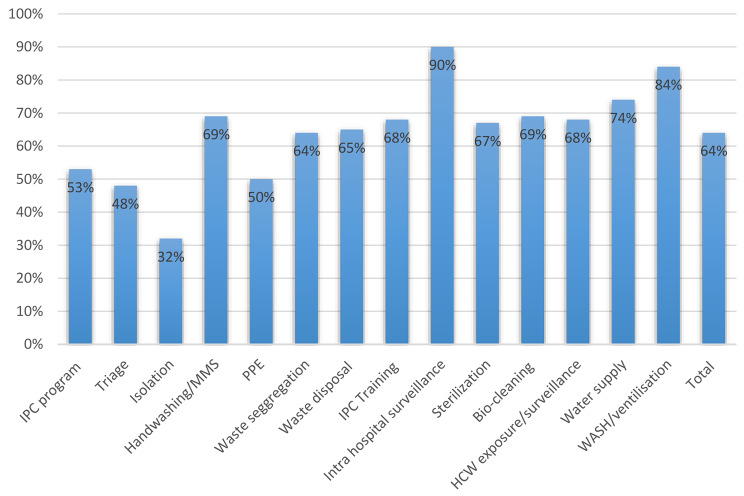
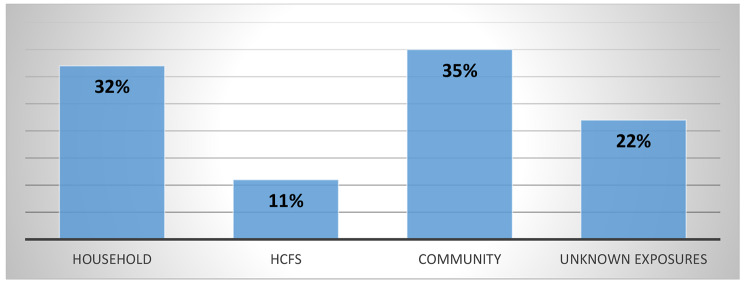
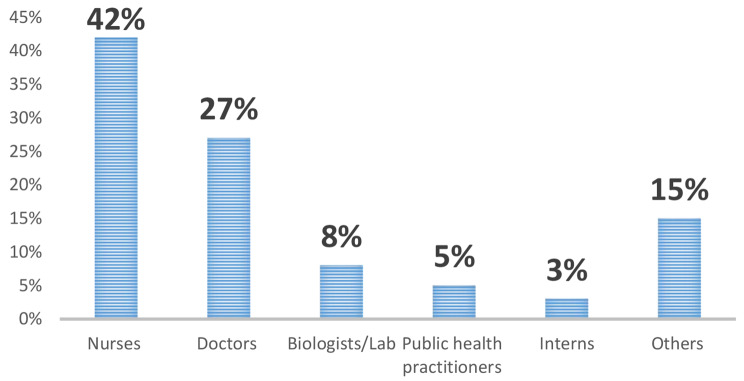
Cumulative incidence of positive HCWs was 809 /35,898(2.2%) from the first to the third wave of COVID-19 among 6 provinces of DRC. The distribution of the HCWs infected by COVID-19 was predominated by nurses (42%), doctors (27%), biologists (8%), environmental health practitioners (5%), interns (3%), and other categories (15%). Other categories included nutritionists, physiotherapists, midwives, pharmacists, and paramedics. The investigation revealed that about 32% of HCWs were infected from household contacts, 11% were infected by HCFs, 35% were infected in the community and 22% were infected from unknown exposures. The mean score of IPC performance for all evaluated HCFs was 27/42(64%). This shows that IPC performance was moderate. Lower or minimal performance was noted in the implementation of the IPC program at the national and facility level, triage and screening, isolation handwashing and multimodal strategies of hand hygiene, PPE availability, and rationale, waste segregation, waste disposal, sterilization, and training of HCWs.
This study revealed that the prevalence of HCWs who tested positive for the COVID-19 virus was high among frontline healthcare workers from 6 provinces of DRC. A high prevalence of nosocomial infection was correlated with insufficient IPC adherence in the context of COVID-19. Strategies to strengthen IPC capacity building and provide HCWs with sufficient PPE stocks and budgets may improve IPC performance in the Democratic Republic of the Congo. This will further allow for adherence to WHO recommendations for successful program implementation to minimize COVID-19 transmission in HCFs, communities, and public gatherings. And this may be transferable to other infectious diseases.
医护人员(HCWs)是应对 COVID-19 大流行的第一线人员。保护 HCWs 对世界卫生组织(WHO)至关重要。基于对感染预防和控制(IPC)计划核心要素的严格评估的暴发调查,可以确定接触 COVID-19 病毒的不同来源,并为其他 IPC 建议提供信息。迄今为止,由于卫生系统薄弱、诊断能力低、人口的社会经济特征以及疫苗接种覆盖率不足,刚果民主共和国(DRC)被归类为高风险国家。
根据世卫组织在大流行第一波至第三波期间实施 IPC 计划的战略,调查 HCWs 中 COVID-19 的负担,并确定 IPC 差距,以减少不同层面(设施、社区和入境点)的 HCWs 相关感染。
使用刚果民主共和国国家卫生部(NDOH)数据库和世卫组织问卷,对 2020 年 3 月 10 日至 2021 年 6 月 22 日期间的 10 个省份的疑似和确诊 COVID-19 医护人员进行了回顾性队列研究。由经过培训的 IPC 应对小组进行调查,以确定暴露源。问卷包括人口统计学、职业、HCWs 与患者之间的各种互动类型以及关于家庭成员和其他行为的社区问题。使用多模态策略框架评估这些变量。对每个 COVID-19 阳性或疑似 HCW 进行了使用世卫组织指南的 IPC 差距的知识和依从性评估。对医疗保健设施(HCFs)在 COVID-19 大流行期间的表现进行了世卫组织快速记分卡仪表板评估。
在刚果民主共和国的 6 个省份,从 COVID-19 的第一波到第三波,共有 35898 名 HCWs 中累计有 809 名(2.2%)呈阳性。感染 COVID-19 的 HCWs 分布主要是护士(42%)、医生(27%)、生物学家(8%)、环境卫生从业者(5%)、实习生(3%)和其他类别(15%)。其他类别包括营养师、物理治疗师、助产士、药剂师和护理人员。调查显示,约 32%的 HCWs 是从家庭接触者感染的,11%是从医疗机构感染的,35%是在社区感染的,22%是从未知接触感染的。所有评估的医疗机构的 IPC 绩效平均得分为 27/42(64%)。这表明 IPC 性能中等。在国家和设施层面、分诊和筛查、隔离洗手和手部卫生的多模态策略、个人防护装备的可用性和合理性、废物分类、废物处置、消毒和 HCWs 的培训等方面,IPC 方案的实施情况较差或较差。
这项研究表明,来自刚果民主共和国 6 个省份的一线医护人员中,COVID-19 病毒检测呈阳性的 HCWs 患病率很高。由于 COVID-19 期间对 IPC 的依从性不足,导致医院感染的高患病率。加强 IPC 能力建设并为 HCWs 提供充足的个人防护装备库存和预算的战略,可能会提高刚果民主共和国的 IPC 绩效。这将进一步促使遵守世卫组织的建议,以成功实施该计划,最大限度地减少医疗机构、社区和公众集会中的 COVID-19 传播。并且这可能适用于其他传染病。