Unidad de Investigación UNAM-INC, División de Investigación, Facultad de Medicina, Universidad Nacional Autónoma de México-Instituto Nacional de Cardiología "Ignacio Chávez,", Juan Badiano No. 1, Col. Belisario Domínguez, Sección XVI, Delegación Tlalpan, C.P. 14080, Ciudad de México, México.
Laboratorio de Estudios Epidemiológicos, Clínicos, Diseños Experimentales e Investigación, Facultad de Ciencias Químicas, Universidad Autónoma "Benito Juárez" de Oaxaca, Oaxaca, Mexico.
Parasitol Res. 2023 Dec 19;123(1):60. doi: 10.1007/s00436-023-08031-x.
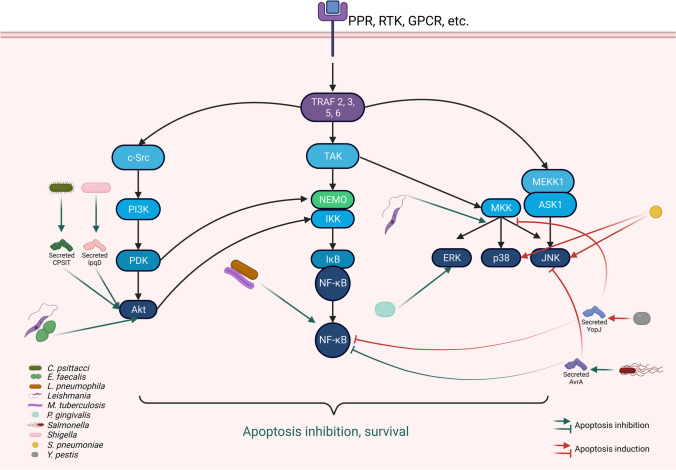
Apoptosis is a finely programmed process of cell death in which cells silently dismantle and actively participate in several operations such as immune response, differentiation, and cell growth. It can be initiated by three main pathways: the extrinsic, the perforin granzyme, and the intrinsic that culminate in the activation of several proteins in charge of tearing down the cell. On the other hand, apoptosis represents an ordeal for pathogens that live inside cells and maintain a strong dependency with them; thus, they have evolved multiple strategies to manipulate host cell apoptosis on their behalf. It has been widely documented that diverse intracellular bacteria, fungi, and parasites can interfere with most steps of the host cell apoptotic machinery to inhibit or induce apoptosis. Indeed, the inhibition of apoptosis is considered a virulence property shared by many intracellular pathogens to ensure productive replication. Some pathogens intervene at an early stage by interfering with the sensing of extracellular signals or transduction pathways. Others sense cellular stress or target the apoptosis regulator proteins of the Bcl-2 family or caspases. In many cases, the exact molecular mechanisms leading to the interference with the host cell apoptotic cascade are still unknown. However, intense research has been conducted to elucidate the strategies employed by intracellular pathogens to modulate host cell death. In this review, we summarize the main routes of activation of apoptosis and present several processes used by different bacteria, fungi, and parasites to modulate the apoptosis of their host cells.
细胞凋亡是一种细胞程序性死亡过程,细胞在其中无声地拆解,并积极参与免疫反应、分化和细胞生长等多种操作。它可以通过三种主要途径启动:外在途径、穿孔素颗粒酶途径和内在途径,这些途径最终激活负责摧毁细胞的几种蛋白质。另一方面,细胞凋亡对生活在细胞内并与细胞保持强烈依存关系的病原体来说是一场考验;因此,它们已经进化出多种策略来代表宿主细胞凋亡。有大量文献记录表明,多种细胞内细菌、真菌和寄生虫可以干扰宿主细胞凋亡机制的大多数步骤,以抑制或诱导凋亡。事实上,抑制细胞凋亡被认为是许多细胞内病原体的一种毒力特性,以确保有效的复制。一些病原体通过干扰细胞外信号的感应或转导途径在早期介入。其他病原体则感应细胞应激或靶向 Bcl-2 家族的凋亡调节蛋白或半胱天冬酶。在许多情况下,导致宿主细胞凋亡级联反应受到干扰的确切分子机制仍不清楚。然而,已经进行了大量研究来阐明细胞内病原体用来调节宿主细胞死亡的策略。在这篇综述中,我们总结了凋亡激活的主要途径,并介绍了几种不同细菌、真菌和寄生虫用来调节宿主细胞凋亡的过程。