Pinter A, Costanzo A, Khattri S, Smith S D, Carrascosa J M, Tada Y, Riedl E, Reich A, Brnabic A, Haustrup N, Lampropoulou A, Lipkovich I, Kadziola Z, Paul C, Schuster C
University Hospital Frankfurt, Frankfurt am Main, Germany.
Division of Dermatology, Humanitas Research Hospital, Pieve Emanuele, Milan, Italy.
Dermatol Ther (Heidelb). 2024 Jun;14(6):1479-1493. doi: 10.1007/s13555-023-01086-9. Epub 2023 Dec 19.
Given the chronic nature of psoriasis (PsO), more studies are needed that directly compare the effectiveness of different biologics over long observation periods. This study compares the effectiveness and durability through 12 months of anti-interleukin (IL)-17A biologics relative to other approved biologics in patients with moderate-to-severe psoriasis in a real-world setting.
The Psoriasis Study of Health Outcomes (PSoHO) is an ongoing 3-year, prospective, non-interventional cohort study of 1981 adults with chronic moderate-to-severe plaque psoriasis initiating or switching to a new biologic. The study compares the effectiveness of anti-IL-17A biologics with other approved biologics and provides pairwise comparisons of seven individual biologics versus ixekizumab. The primary outcome was defined as the proportion of patients who had at least a 90% improvement in Psoriasis Area and Severity Index score (PASI90) and/or a score of 0 or 1 in static Physician Global Assessment (sPGA). Secondary objective comparisons included the proportion of patients who achieved PASI90, PASI100, a Dermatology Life Quality Index (DLQI) score of 0 or 1, and three different measures of durability of treatment response. Unadjusted response rates are presented alongside the primary analysis, which uses frequentist model averaging (FMA) to evaluate the adjusted comparative effectiveness.
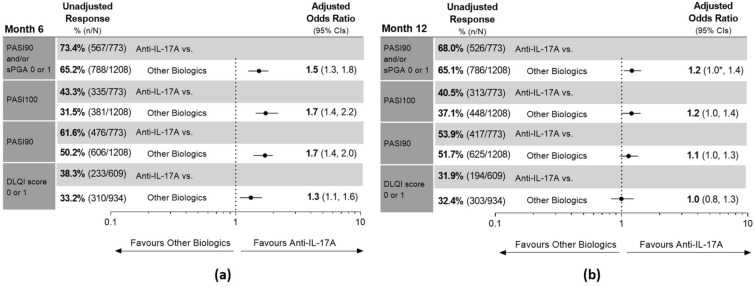
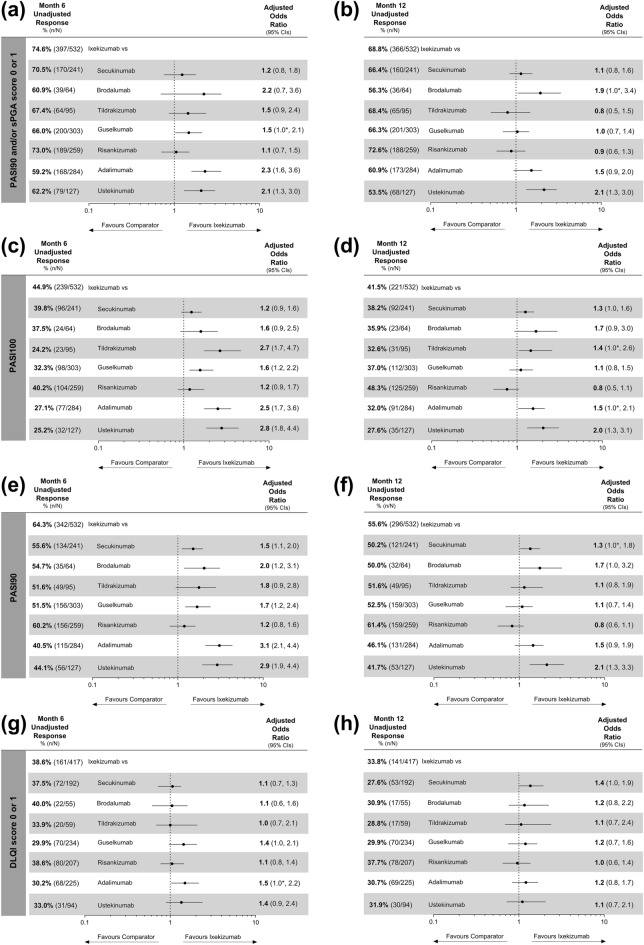
Compared to the other biologics cohort, the anti-IL-17A cohort had a higher response rate (68.0% vs. 65.1%) and significantly higher odds of achieving the primary outcome at month 12. The two cohorts had similar response rates for PASI100 (40.5% and 37.1%) and PASI90 (53.9% and 51.7%) at month 12, with no significant differences between the cohorts in the adjusted analyses. At month 12, the response rates across the individual biologics were 53.5-72.6% for the primary outcome, 27.6-48.3% for PASI100, and 41.7-61.4% for PASI90.
These results show the comparative effectiveness of biologics at 6 and 12 months in the real-world setting.
鉴于银屑病(PsO)的慢性病程,需要更多研究在较长观察期内直接比较不同生物制剂的疗效。本研究在真实世界环境中,比较了抗白细胞介素(IL)-17A生物制剂与其他已批准生物制剂在中度至重度银屑病患者中12个月的疗效和持久性。
银屑病健康结局研究(PSoHO)是一项正在进行的为期3年的前瞻性、非干预性队列研究,纳入1981例开始使用或换用新生物制剂的慢性中度至重度斑块状银屑病成人患者。该研究比较了抗IL-17A生物制剂与其他已批准生物制剂的疗效,并对七种个体生物制剂与司库奇尤单抗进行了两两比较。主要结局定义为银屑病面积和严重程度指数评分(PASI90)至少改善90%和/或静态医师整体评估(sPGA)评分为0或1的患者比例。次要目标比较包括达到PASI90、PASI100、皮肤病生活质量指数(DLQI)评分为0或1的患者比例,以及治疗反应持久性的三种不同测量指标。未调整的反应率与主要分析一起呈现,主要分析使用频率主义模型平均法(FMA)来评估调整后的比较疗效。
与其他生物制剂队列相比,抗IL-17A队列的反应率更高(68.0%对65.1%),且在第12个月达到主要结局的几率显著更高。两个队列在第12个月时PASI100(40.5%和37.1%)和PASI90(53.9%和51.7%)的反应率相似,在调整分析中各队列之间无显著差异。在第12个月时,各个体生物制剂的主要结局反应率为53.5 - 72.6%,PASI100为27.6 - 48.3%,PASI90为41.7 - 61.4%。
这些结果显示了生物制剂在真实世界环境中6个月和12个月时的比较疗效。