Department of Gastrointestinal Cancer Research Institute, Tongji Hospital, Huazhong University of Science and Technology, Wuhan 430030, China.
Department of Protein Chemistry and Proteinomics Facility at Technology Center for Protein Sciences, Tsinghua University, Beijing 100084, China.
Proc Natl Acad Sci U S A. 2023 Dec 26;120(52):e2305684120. doi: 10.1073/pnas.2305684120. Epub 2023 Dec 19.
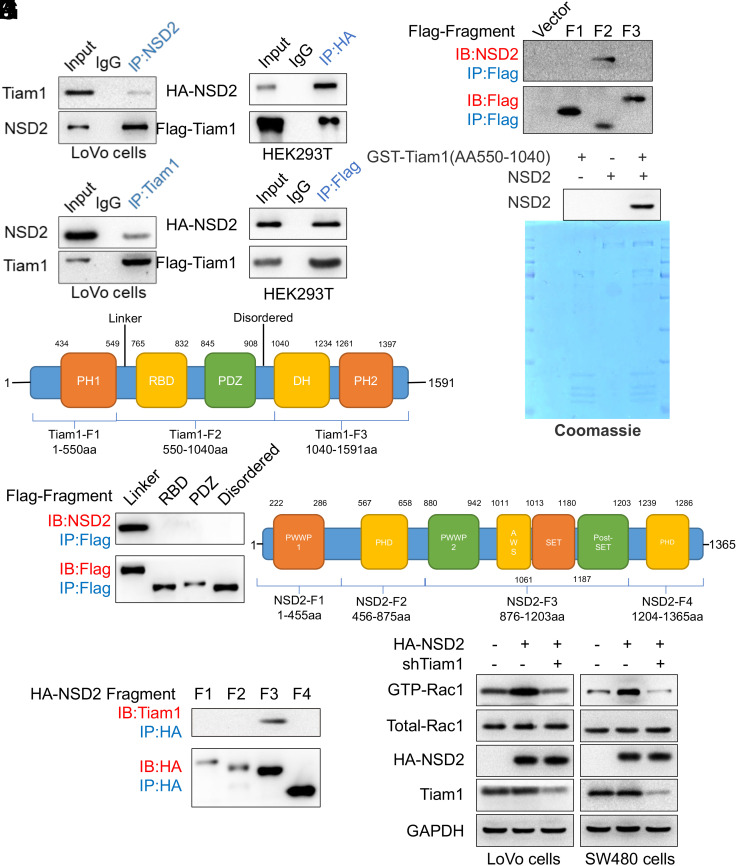
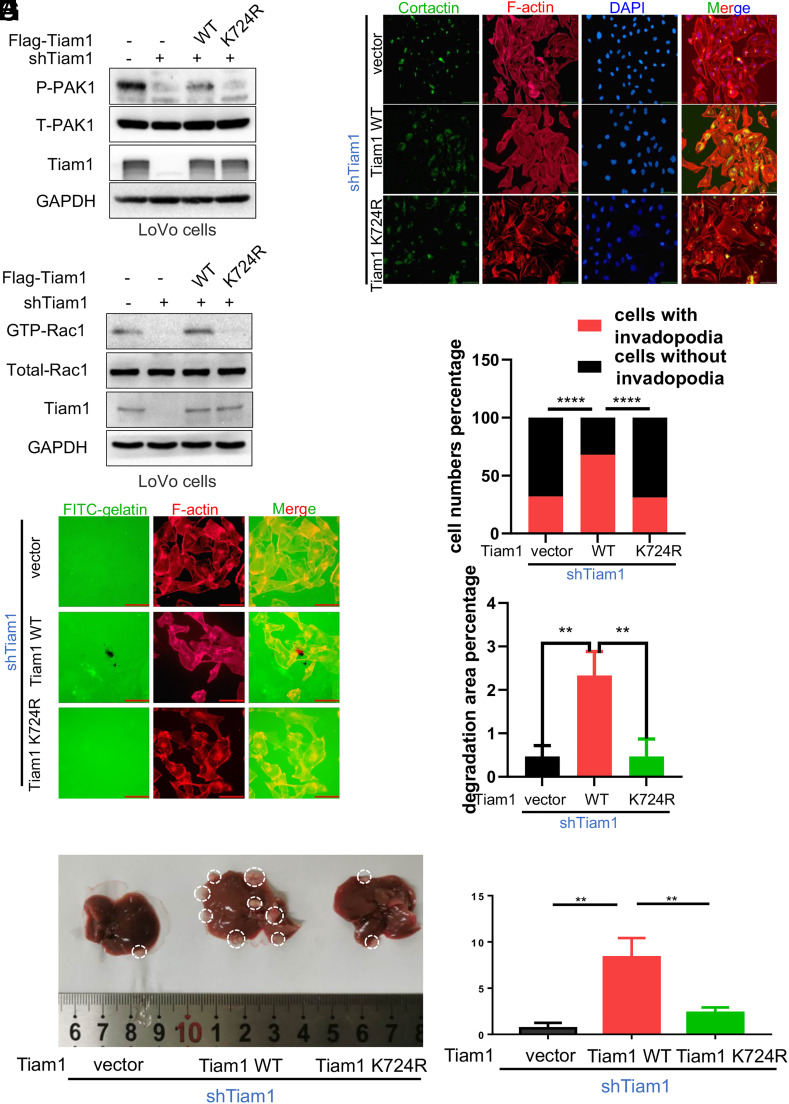
Metastasis is a major cause of cancer therapy failure and mortality. However, targeting metastatic seeding and colonization remains a significant challenge. In this study, we identified NSD2, a histone methyltransferase responsible for dimethylating histone 3 at lysine 36, as being overexpressed in metastatic tumors. Our findings suggest that NSD2 overexpression enhances tumor metastasis both in vitro and in vivo. Further analysis revealed that NSD2 promotes tumor metastasis by activating Rac1 signaling. Mechanistically, NSD2 combines with and activates Tiam1 (T lymphoma invasion and metastasis 1) and promotes Rac1 signaling by methylating Tiam1 at K724. In vivo and in vitro studies revealed that Tiam1 K724 methylation could be a predictive factor for cancer prognosis and a potential target for metastasis inhibition. Furthermore, we have developed inhibitory peptide which was proved to inhibit tumor metastasis through blocking the interaction between NSD2 and Tiam1. Our results demonstrate that NSD2-methylated Tiam1 promotes Rac1 signaling and cancer metastasis. These results provide insights into the inhibition of tumor metastasis.
转移是癌症治疗失败和死亡的主要原因。然而,针对转移性播种和定植仍然是一个重大挑战。在这项研究中,我们鉴定了 NSD2,一种负责组蛋白 H3 在赖氨酸 36 处二甲基化的组蛋白甲基转移酶,在转移性肿瘤中过度表达。我们的研究结果表明,NSD2 过表达增强了肿瘤在体外和体内的转移。进一步的分析表明,NSD2 通过激活 Rac1 信号促进肿瘤转移。在机制上,NSD2 与 Tiam1(T 淋巴瘤侵袭和转移 1)结合并激活 Tiam1,通过甲基化 Tiam1 的 K724 促进 Rac1 信号。体内和体外研究表明,Tiam1 的 K724 甲基化可能是癌症预后的预测因子和转移抑制的潜在靶点。此外,我们已经开发出抑制肽,通过阻断 NSD2 和 Tiam1 之间的相互作用,被证明可以抑制肿瘤转移。我们的结果表明,NSD2 甲基化的 Tiam1 促进 Rac1 信号和癌症转移。这些结果为抑制肿瘤转移提供了新的思路。