Pattern Recognition & Bioinformatics, Department of Intelligent Systems, Faculty EEMCS, Delft University of Technology, Delft, The Netherlands.
Holland Proton Therapy Center (HollandPTC), Delft, The Netherlands.
Bioinformatics. 2024 Jan 2;40(1). doi: 10.1093/bioinformatics/btad764.
Anti-cancer therapies based on synthetic lethality (SL) exploit tumour vulnerabilities for treatment with reduced side effects, by targeting a gene that is jointly essential with another whose function is lost. Computational prediction is key to expedite SL screening, yet existing methods are vulnerable to prevalent selection bias in SL data and reliant on cancer or tissue type-specific omics, which can be scarce. Notably, sequence similarity remains underexplored as a proxy for related gene function and joint essentiality.
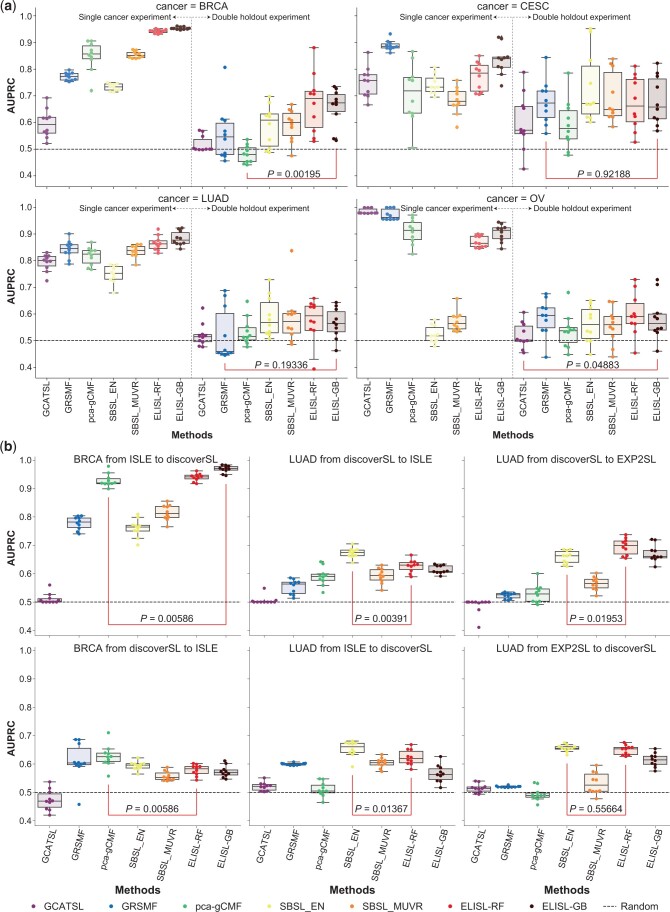
We propose ELISL, Early-Late Integrated SL prediction with forest ensembles, using context-free protein sequence embeddings and context-specific omics from cell lines and tissue. Across eight cancer types, ELISL showed superior robustness to selection bias and recovery of known SL genes, as well as promising cross-cancer predictions. Co-occurring mutations in a BRCA gene and ELISL-predicted pairs from the HH, FGF, WNT, or NEIL gene families were associated with longer patient survival times, revealing therapeutic potential.
Data: 10.6084/m9.figshare.23607558 & Code: github.com/joanagoncalveslab/ELISL.
基于合成致死(SL)的抗癌疗法通过靶向共同必需的基因来治疗肿瘤的脆弱性,而这些基因的功能丧失。计算预测是加速 SL 筛选的关键,但现有的方法容易受到 SL 数据中普遍存在的选择偏差的影响,并且依赖于癌症或组织类型特异性的组学,而这些组学可能很稀缺。值得注意的是,序列相似性仍然作为相关基因功能和共同必需性的替代物未得到充分探索。
我们提出了 ELISL,即使用无上下文的蛋白质序列嵌入和来自细胞系和组织的上下文特定的组学进行早期-晚期综合 SL 预测的森林集成。在八种癌症类型中,ELISL 表现出对选择偏差的更强稳健性和对已知 SL 基因的恢复能力,以及有前途的跨癌预测。BRCA 基因中的共发生突变和 HH、FGF、WNT 或 NEIL 基因家族中 ELISL 预测的对与患者生存时间延长相关,揭示了治疗潜力。
数据:10.6084/m9.figshare.23607558 & 代码:github.com/joanagoncalveslab/ELISL。