• 文献检索
  • 文档翻译
  • 深度研究
  • 学术资讯
  • Suppr Zotero 插件Zotero 插件
  • 邀请有礼
  • 套餐&价格
  • 历史记录
应用&插件
Suppr Zotero 插件Zotero 插件浏览器插件Mac 客户端Windows 客户端微信小程序
定价
高级版会员购买积分包购买API积分包
服务
文献检索文档翻译深度研究API 文档MCP 服务
关于我们
关于 Suppr公司介绍联系我们用户协议隐私条款
关注我们

Suppr 超能文献

核心技术专利:CN118964589B侵权必究
粤ICP备2023148730 号-1Suppr @ 2026

文献检索

告别复杂PubMed语法,用中文像聊天一样搜索,搜遍4000万医学文献。AI智能推荐,让科研检索更轻松。

立即免费搜索

文件翻译

保留排版,准确专业,支持PDF/Word/PPT等文件格式,支持 12+语言互译。

免费翻译文档

深度研究

AI帮你快速写综述,25分钟生成高质量综述,智能提取关键信息,辅助科研写作。

立即免费体验

神经调节通气辅助与压力支持用于急性呼吸窘迫综合征患者的保护性机械通气:一项随机交叉试验

Neurally adjusted ventilatory assist vs. pressure support to deliver protective mechanical ventilation in patients with acute respiratory distress syndrome: a randomized crossover trial.

作者信息

Diniz-Silva Fabia, Moriya Henrique T, Alencar Adriano M, Amato Marcelo B P, Carvalho Carlos R R, Ferreira Juliana C

机构信息

Divisao de Pneumologia, Instituto do Coracao, Hospital das Clinicas HCFMUSP, Faculdade de Medicina, Universidade de Sao Paulo, SP, BR, Av. Dr. Enéas de Carvalho Aguiar, 44, 5 andar, bloco 2, sala 1, São Paulo, SP, CEP 05403900, Brazil.

Biomedical Engineering Laboratory, Escola Politécnica da USP, Av. Prof. Luciano Gualberto, trav. 3, 158, Cidade Universitária, São Paulo, SP, CEP 05586-0600, Brazil.

出版信息

Ann Intensive Care. 2020 Feb 10;10(1):18. doi: 10.1186/s13613-020-0638-0.

DOI:10.1186/s13613-020-0638-0
PMID:32040785
原文链接:https://pmc.ncbi.nlm.nih.gov/articles/PMC7010869/
Abstract

BACKGROUND

Protective mechanical ventilation is recommended for patients with acute respiratory distress syndrome (ARDS), but it usually requires controlled ventilation and sedation. Using neurally adjusted ventilatory assist (NAVA) or pressure support ventilation (PSV) could have additional benefits, including the use of lower sedative doses, improved patient-ventilator interaction and shortened duration of mechanical ventilation. We designed a pilot study to assess the feasibility of keeping tidal volume (V) at protective levels with NAVA and PSV in patients with ARDS.

METHODS

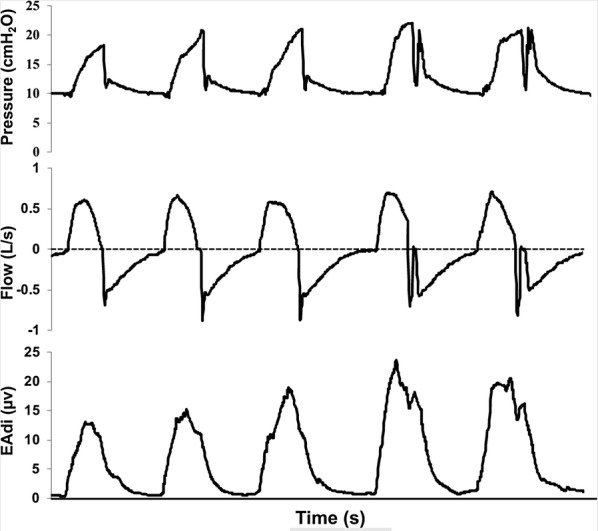
We conducted a prospective randomized crossover trial in five ICUs from a university hospital in Brazil and included patients with ARDS transitioning from controlled ventilation to partial ventilatory support. NAVA and PSV were applied in random order, for 15 min each, followed by 3 h in NAVA. Flow, peak airway pressure (Paw) and electrical activity of the diaphragm (EAdi) were captured from the ventilator, and a software (Matlab, Mathworks, USA), automatically detected inspiratory efforts and calculated respiratory rate (RR) and V. Asynchrony events detection was based on waveform analysis.

RESULTS

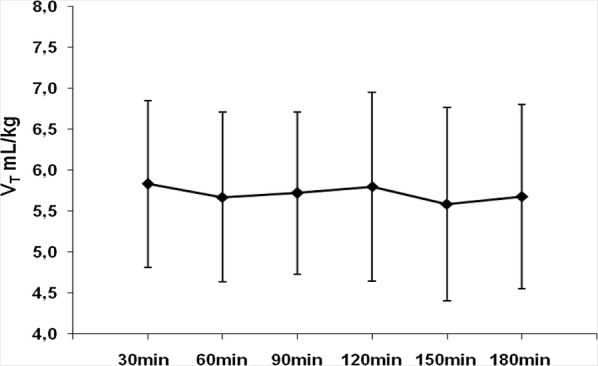
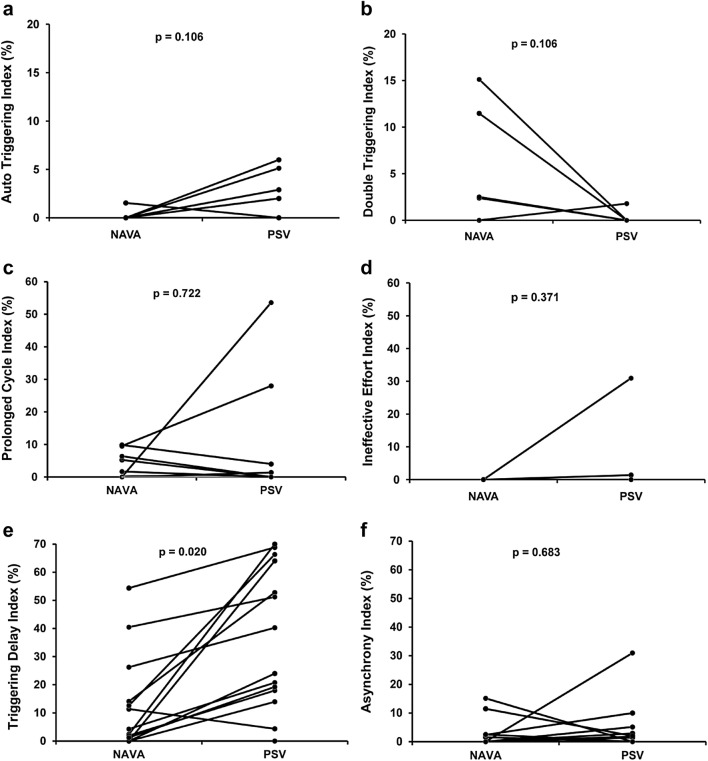
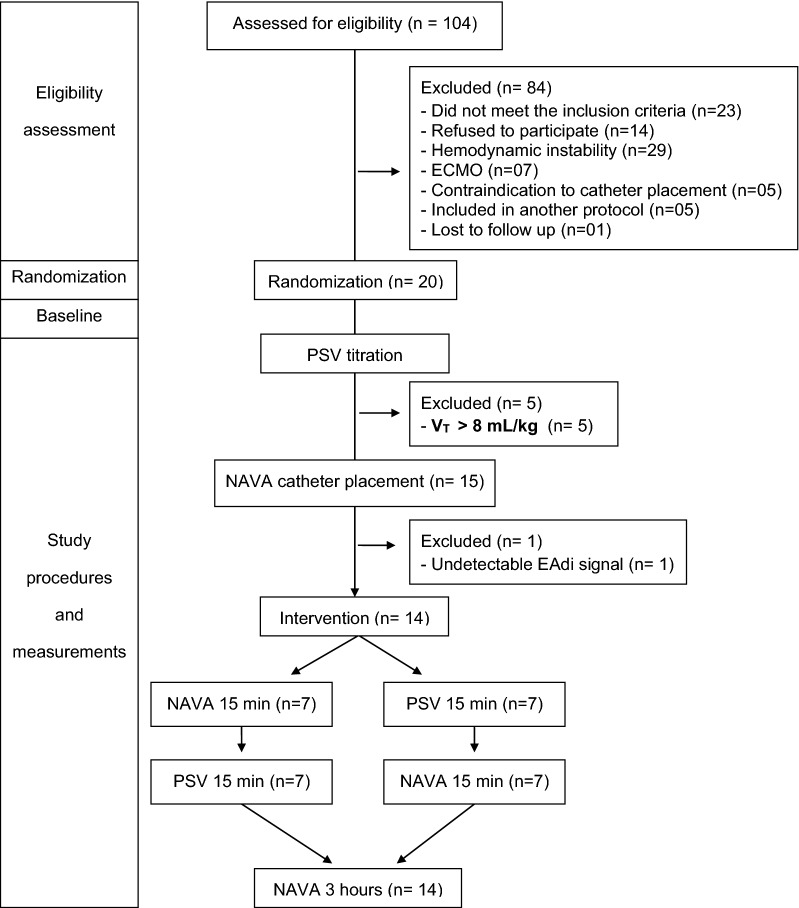
We randomized 20 patients, but the protocol was interrupted for five (25%) patients for whom we were unable to maintain V below 6.5 mL/kg in PSV due to strong inspiratory efforts and for one patient for whom we could not detect EAdi signal. For the 14 patients who completed the protocol, V was 5.8 ± 1.1 mL/kg for NAVA and 5.6 ± 1.0 mL/kg for PSV (p = 0.455) and there were no differences in RR (24 ± 7 for NAVA and 23 ± 7 for PSV, p = 0.661). Paw was greater in NAVA (21 ± 3 cmHO) than in PSV (19 ± 3 cmHO, p = 0.001). Most patients were under continuous sedation during the study. NAVA reduced triggering delay compared to PSV (p = 0.020) and the median asynchrony Index was 0.7% (0-2.7) in PSV and 0% (0-2.2) in NAVA (p = 0.6835).

CONCLUSIONS

It was feasible to keep V in protective levels with NAVA and PSV for 75% of the patients. NAVA resulted in similar V, RR and Paw compared to PSV. Our findings suggest that partial ventilatory assistance with NAVA and PSV is feasible as a protective ventilation strategy in selected ARDS patients under continuous sedation. Trial registration ClinicalTrials.gov (NCT01519258). Registered 26 January 2012, https://clinicaltrials.gov/ct2/show/NCT01519258.

摘要

背景

对于急性呼吸窘迫综合征(ARDS)患者,推荐采用保护性机械通气,但通常需要控制通气和镇静。使用神经调节通气辅助(NAVA)或压力支持通气(PSV)可能有额外益处,包括使用较低的镇静剂量、改善患者与呼吸机的相互作用以及缩短机械通气时间。我们设计了一项前瞻性研究,以评估在ARDS患者中使用NAVA和PSV将潮气量(V)维持在保护水平的可行性。

方法

我们在巴西一家大学医院的五个重症监护病房进行了一项前瞻性随机交叉试验,纳入从控制通气过渡到部分通气支持的ARDS患者。NAVA和PSV按随机顺序应用,各持续15分钟,随后进行3小时的NAVA通气。从呼吸机获取流量、气道峰压(Paw)和膈肌电活动(EAdi),并使用软件(美国Mathworks公司的Matlab)自动检测吸气努力并计算呼吸频率(RR)和V。基于波形分析检测不同步事件。

结果

我们将20例患者随机分组,但该方案因5例(2 * 5%)患者而中断,这5例患者由于强烈的吸气努力,我们无法在PSV中将V维持在6.5 mL/kg以下,还有1例患者我们无法检测到EAdi信号。对于完成该方案的14例患者,NAVA时V为5.8±1.1 mL/kg,PSV时V为5.6±1.0 mL/kg(p = 0.455),RR无差异(NAVA时为24±7,PSV时为23±7,p = 0.661)。NAVA时的Paw(21±3 cmH₂O)高于PSV时(19±3 cmH₂O,p = 0.001)。在研究期间,大多数患者接受持续镇静。与PSV相比,NAVA减少了触发延迟(p = 0.020),PSV时不同步指数中位数为0.7%(0 - 2.7),NAVA时为0%(0 - 2.2)(p = 0.6835)。

结论

对于75%的患者,使用NAVA和PSV将V维持在保护水平是可行的。与PSV相比,NAVA导致的V、RR和Paw相似。我们的研究结果表明,在持续镇静的特定ARDS患者中,采用NAVA和PSV进行部分通气辅助作为一种保护性通气策略是可行的。试验注册ClinicalTrials.gov(NCT01519258)。于2012年1月26日注册,https://clinicaltrials.gov/ct2/show/NCT01519258 。
https://cdn.ncbi.nlm.nih.gov/pmc/blobs/723d/7010869/11ae108da8d9/13613_2020_638_Fig4_HTML.jpg
https://cdn.ncbi.nlm.nih.gov/pmc/blobs/723d/7010869/a842f7c9dc3f/13613_2020_638_Fig1_HTML.jpg
https://cdn.ncbi.nlm.nih.gov/pmc/blobs/723d/7010869/d9c875914725/13613_2020_638_Fig2_HTML.jpg
https://cdn.ncbi.nlm.nih.gov/pmc/blobs/723d/7010869/d9da476aa079/13613_2020_638_Fig3_HTML.jpg
https://cdn.ncbi.nlm.nih.gov/pmc/blobs/723d/7010869/11ae108da8d9/13613_2020_638_Fig4_HTML.jpg
https://cdn.ncbi.nlm.nih.gov/pmc/blobs/723d/7010869/a842f7c9dc3f/13613_2020_638_Fig1_HTML.jpg
https://cdn.ncbi.nlm.nih.gov/pmc/blobs/723d/7010869/d9c875914725/13613_2020_638_Fig2_HTML.jpg
https://cdn.ncbi.nlm.nih.gov/pmc/blobs/723d/7010869/d9da476aa079/13613_2020_638_Fig3_HTML.jpg
https://cdn.ncbi.nlm.nih.gov/pmc/blobs/723d/7010869/11ae108da8d9/13613_2020_638_Fig4_HTML.jpg

相似文献

1
Neurally adjusted ventilatory assist vs. pressure support to deliver protective mechanical ventilation in patients with acute respiratory distress syndrome: a randomized crossover trial.神经调节通气辅助与压力支持用于急性呼吸窘迫综合征患者的保护性机械通气:一项随机交叉试验
Ann Intensive Care. 2020 Feb 10;10(1):18. doi: 10.1186/s13613-020-0638-0.
2
Neurally Adjusted Ventilatory Assist (NAVA) or Pressure Support Ventilation (PSV) during spontaneous breathing trials in critically ill patients: a crossover trial.神经调节辅助通气(NAVA)或压力支持通气(PSV)在危重症患者自主呼吸试验中的应用:一项交叉试验。
BMC Pulm Med. 2017 Nov 7;17(1):139. doi: 10.1186/s12890-017-0484-5.
3
Neurally adjusted ventilatory assist and proportional assist ventilation both improve patient-ventilator interaction.神经调节通气辅助和比例辅助通气均能改善患者与呼吸机的相互作用。
Crit Care. 2015 Feb 25;19(1):56. doi: 10.1186/s13054-015-0763-6.
4
Physiologic response to varying levels of pressure support and neurally adjusted ventilatory assist in patients with acute respiratory failure.急性呼吸衰竭患者对不同水平压力支持和神经调节通气辅助的生理反应。
Intensive Care Med. 2008 Nov;34(11):2010-8. doi: 10.1007/s00134-008-1208-3. Epub 2008 Jul 16.
5
Patient-Ventilator Synchrony in Neurally-Adjusted Ventilatory Assist and Variable Pressure Support Ventilation.神经调节通气辅助和可变压力支持通气中的患者-呼吸机同步性。
Respir Care. 2022 May;67(5):503-509. doi: 10.4187/respcare.08921. Epub 2022 Feb 28.
6
[Effects of neurally adjusted ventilatory assist on patient-ventilator synchrony in patients with acute respiratory distress syndrome].[神经调节通气辅助对急性呼吸窘迫综合征患者人机同步性的影响]
Zhonghua Jie He He Hu Xi Za Zhi. 2009 Jul;32(7):508-12.
7
Severe diaphragmatic dysfunction with preserved activity of accessory respiratory muscles in a critically ill child: a case report of failure of neurally adjusted ventilatory assist (NAVA) and successful support with pressure support ventilation (PSV).严重膈肌功能障碍伴辅助呼吸肌活动正常的危重症患儿:神经调节辅助通气(NAVA)失败和压力支持通气(PSV)成功支持的病例报告。
BMC Pediatr. 2019 May 17;19(1):155. doi: 10.1186/s12887-019-1527-2.
8
[Effect of different mechanical ventilation modes on patient-ventilator synchrony and diaphragm function in rabbit model of acute respiratory distress syndrome].[不同机械通气模式对急性呼吸窘迫综合征兔模型中患者-呼吸机同步性及膈肌功能的影响]
Zhonghua Yi Xue Za Zhi. 2020 Jun 2;100(21):1662-1667. doi: 10.3760/cma.j.cn112137-20191113-02469.
9
Neurally adjusted ventilatory assist vs pressure support ventilation for noninvasive ventilation during acute respiratory failure: a crossover physiologic study.神经调节辅助通气与压力支持通气在急性呼吸衰竭时用于无创通气的比较:一项交叉生理研究。
Chest. 2013 Jan;143(1):30-36. doi: 10.1378/chest.12-0424.
10
[Study on patient-ventilator synchrony of neurally adjusted ventilatory assist ventilation in severe neurological diseases patients with tracheotomy].[神经调节通气辅助通气在重度神经系统疾病气管切开患者中的患者-呼吸机同步性研究]
Zhonghua Wei Zhong Bing Ji Jiu Yi Xue. 2020 May;32(5):575-580. doi: 10.3760/cma.j.cn121430-20200427-00341.

引用本文的文献

1
Neurally adjusted ventilatory assist in critical care patients with and without obesity: a prospective randomized crossover study.神经调节通气辅助应用于有肥胖和无肥胖的重症患者:一项前瞻性随机交叉研究。
Ann Intensive Care. 2025 Aug 29;15(1):128. doi: 10.1186/s13613-025-01552-x.
2
Neurally adjusted ventilatory assisted ventilation compared to pressure support during post-operative weaning of hepatic patients undergoing major abdominal surgeries: a randomized control trial.在接受大型腹部手术的肝病患者术后撤机过程中,神经调节通气辅助通气与压力支持通气的比较:一项随机对照试验。
BMC Anesthesiol. 2025 Jun 26;25(1):297. doi: 10.1186/s12871-025-03159-y.
3

本文引用的文献

1
Predictors of asynchronies during assisted ventilation and its impact on clinical outcomes: The EPISYNC cohort study.辅助通气期间的失同步预测因素及其对临床结局的影响:EPISYNC 队列研究。
J Crit Care. 2020 Jun;57:30-35. doi: 10.1016/j.jcrc.2020.01.023. Epub 2020 Jan 21.
2
Early Neuromuscular Blockade in the Acute Respiratory Distress Syndrome.急性呼吸窘迫综合征的早期神经肌肉阻滞。
N Engl J Med. 2019 May 23;380(21):1997-2008. doi: 10.1056/NEJMoa1901686. Epub 2019 May 19.
3
Global Critical Care: Moving Forward in Resource-Limited Settings.
Challenges in Transitioning from Controlled to Assisted Ventilation in Acute Respiratory Distress Syndrome (ARDS) Management.
急性呼吸窘迫综合征(ARDS)管理中从控制通气转换为辅助通气的挑战。
J Clin Med. 2024 Dec 2;13(23):7333. doi: 10.3390/jcm13237333.
4
Adherence to low tidal volume in the transition to spontaneous ventilation in patients with acute respiratory failure in intensive care units in Latin America (SPIRAL): a study protocol.在拉丁美洲的重症监护病房中急性呼吸衰竭患者向自主通气过渡时遵循低潮气量(SPIRAL):研究方案。
Crit Care Sci. 2024 Aug 12;36:e20240044en. doi: 10.62675/2965-2774.20240044-en. eCollection 2024.
5
[Ventilation concepts under extracorporeal membrane oxygenation (ECMO) in acute respiratory distress syndrome (ARDS)].[急性呼吸窘迫综合征(ARDS)体外膜肺氧合(ECMO)下的通气概念]
Anaesthesiologie. 2024 May;73(5):352-362. doi: 10.1007/s00101-024-01407-3.
6
Effects of closed loop ventilation on ventilator settings, patient outcomes and ICU staff workloads - a systematic review.闭环通气对呼吸机设置、患者结局和 ICU 工作人员工作量的影响——系统评价。
Eur J Anaesthesiol. 2024 Jun 1;41(6):438-446. doi: 10.1097/EJA.0000000000001972. Epub 2024 Mar 4.
7
The predictive value of neurally adjusted ventilatory assist indexes for the prognosis of patients with severe cerebral hemorrhage.神经调节辅助通气指数对重症脑出血患者预后的预测价值。
Eur J Med Res. 2024 Jan 3;29(1):7. doi: 10.1186/s40001-023-01601-w.
8
Early spontaneous breathing for acute respiratory distress syndrome in individuals with COVID-19.COVID-19 相关急性呼吸窘迫综合征患者的早期自主呼吸。
Cochrane Database Syst Rev. 2022 Jun 29;6(6):CD015077. doi: 10.1002/14651858.CD015077.
9
Neurally Adjusted Ventilatory Assist in Acute Respiratory Failure-A Narrative Review.急性呼吸衰竭中神经调节通气辅助——一项叙述性综述
J Clin Med. 2022 Mar 28;11(7):1863. doi: 10.3390/jcm11071863.
10
Blastomycosis-Induced Acute Respiratory Distress Syndrome.芽生菌病所致急性呼吸窘迫综合征
Cureus. 2022 Feb 14;14(2):e22207. doi: 10.7759/cureus.22207. eCollection 2022 Feb.
全球危重病护理:在资源有限的环境中向前迈进。
Ann Glob Health. 2019 Jan 22;85(1):3. doi: 10.5334/aogh.2413.
4
Patient-ventilator asynchrony.患者-呼吸机不同步。
J Bras Pneumol. 2018 Jul-Aug;44(4):321-333. doi: 10.1590/S1806-37562017000000185. Epub 2018 Jul 6.
5
Double Cycling During Mechanical Ventilation: Frequency, Mechanisms, and Physiologic Implications.机械通气中的双重循环:频率、机制和生理意义。
Crit Care Med. 2018 Sep;46(9):1385-1392. doi: 10.1097/CCM.0000000000003256.
6
Acute Respiratory Distress Syndrome: Advances in Diagnosis and Treatment.急性呼吸窘迫综合征:诊断与治疗的进展。
JAMA. 2018 Feb 20;319(7):698-710. doi: 10.1001/jama.2017.21907.
7
The Association Between Ventilator Dyssynchrony, Delivered Tidal Volume, and Sedation Using a Novel Automated Ventilator Dyssynchrony Detection Algorithm.新型自动化呼吸机失同步检测算法与呼吸机失同步、潮气量输送和镇静的关系。
Crit Care Med. 2018 Feb;46(2):e151-e157. doi: 10.1097/CCM.0000000000002849.
8
Patient-ventilator asynchrony during conventional mechanical ventilation in children.儿童常规机械通气期间的患者-呼吸机不同步
Ann Intensive Care. 2017 Dec 20;7(1):122. doi: 10.1186/s13613-017-0344-8.
9
Neurally Adjusted Ventilatory Assist (NAVA) or Pressure Support Ventilation (PSV) during spontaneous breathing trials in critically ill patients: a crossover trial.神经调节辅助通气(NAVA)或压力支持通气(PSV)在危重症患者自主呼吸试验中的应用:一项交叉试验。
BMC Pulm Med. 2017 Nov 7;17(1):139. doi: 10.1186/s12890-017-0484-5.
10
Respiratory support in patients with acute respiratory distress syndrome: an expert opinion.急性呼吸窘迫综合征患者的呼吸支持:专家意见。
Crit Care. 2017 Sep 12;21(1):240. doi: 10.1186/s13054-017-1820-0.