Verrey Jacob, Ariel Barak, Harinam Vincent, Dillon Luke
Institute of Criminology, University of Cambridge, Sidgwick Ave, Cambridge, CB3 9DA, UK.
Institute of Criminology, The Hebrew University of Jerusalem Mt. Scopus, 9190501, Jerusalem, Israel.
Sci Rep. 2023 Dec 21;13(1):22932. doi: 10.1038/s41598-023-50274-2.
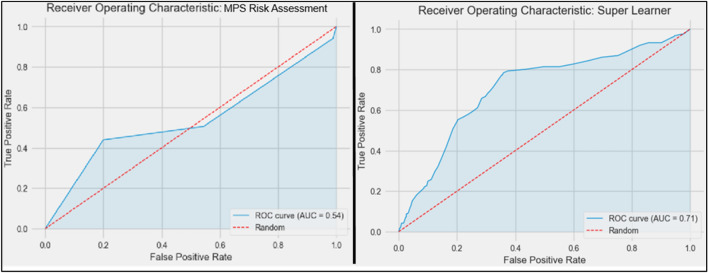
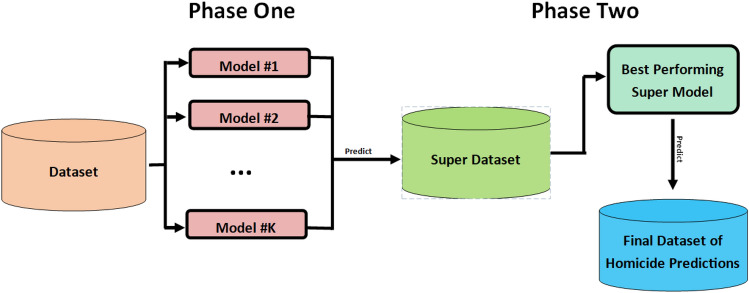
We explore the feasibility of using machine learning on a police dataset to forecast domestic homicides. Existing forecasting instruments based on ordinary statistical instruments focus on non-fatal revictimization, produce outputs with limited predictive validity, or both. We implement a "super learner," a machine learning paradigm that incorporates roughly a dozen machine learning models to increase the recall and AUC of forecasting using any one model. We purposely incorporate police records only, rather than multiple data sources, to illustrate the practice utility of the super learner, as additional datasets are often unavailable due to confidentiality considerations. Using London Metropolitan Police Service data, our model outperforms all extant domestic homicide forecasting tools: the super learner detects 77.64% of homicides, with a precision score of 18.61% and a 71.04% Area Under the Curve (AUC), which, collectively and severely, are assessed as "excellent." Implications for theory, research, and practice are discussed.
我们探讨了在警方数据集上使用机器学习来预测家庭凶杀案的可行性。现有的基于普通统计工具的预测手段侧重于非致命的再次受害情况,产生的预测结果有效性有限,或两者皆有。我们实施了一种“超级学习器”,这是一种机器学习范式,它整合了大约十二种机器学习模型,以提高使用任何单一模型进行预测的召回率和曲线下面积(AUC)。我们特意仅纳入警方记录,而非多个数据源,以说明超级学习器的实际效用,因为出于保密考虑,通常无法获取额外的数据集。使用伦敦警察厅的数据,我们的模型优于所有现有的家庭凶杀案预测工具:超级学习器能检测出77.64%的凶杀案,精确率得分为18.61%,曲线下面积(AUC)为71.04%,总体而言,这些指标被严格评估为“优秀”。我们还讨论了其对理论、研究和实践的影响。