
皮肤利什曼病病原体()感染人类和野生啮齿动物的发病率
Incidence of Human and Free-Ranging Wild Rodent Infections with () , Aetiological Agent of Cutaneous Leishmaniasis.
作者信息
Courtenay Orin, Marinho-Júnior José F, Brito Maria Edileuza F, Monteiro Juliana F C L S, Shaw Jeffrey J, Brandão-Filho Sinval P
机构信息
Zeeman Institute for Systems Biology & Infectious Disease Epidemiology Research, and School of Life Sciences, University of Warwick, Coventry CV8 2PB, UK.
Departament of Immunology, Instituto Aggeu Magalhães/FIOCRUZ, Cidade Universitária, Recife 50740-465, PE, Brazil.
出版信息
Pathogens. 2023 Nov 28;12(12):1395. doi: 10.3390/pathogens12121395.
BACKGROUND
Human and wild rodent infection rates with () are needed to differentiate transmission pathways in anthropogenically altered habitats.
METHODS
Human participants in northeast Brazil were tested by the leishmanin skin test (LST) and inspected for lesions/scars characteristic of American clinical leishmaniasis (ACL). Molecular (PCR/qPCR) test records of free-ranging rodents were available from a concurrent capture-mark-recapture study. Force of Infection (λ) and recovery (ρ) rates were estimated from cross-sectional and longitudinal datasets.
RESULTS
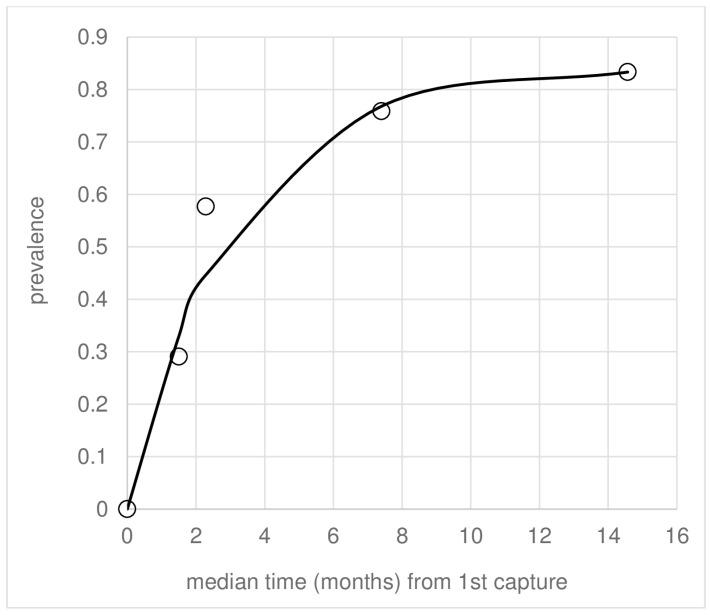
Cumulative prevalences of human LST+ves and ACL scar+ves were 0.343-0.563 ( = 503 participants) and 0.122-0.475 ( = 503), respectively. Active ACL lesions were not detected. Annual rates of LST conversions were λ = 0.03-0.15 and ρ = 0.02-0.07. The probability of infection was independent of sex and associated with increasing age in addition to the period of exposure. Rodents ( = 596 individuals of 6 species) showed high rates of exclusively asymptomatic infection (λ = 0.222/month) and potential infectiousness to the sand fly vector. Spatially concurrent rodent and household human infection prevalences were correlated.
CONCLUSIONS
Human exposure to () continues to be high despite the substantial drop in reported ACL cases in recent years. Spill-over transmission risk to humans from rodents in peridomestic habitats is likely supported by a rodent infection/transmission corridor linking houses, plantations, and the Atlantic Forest.
背景
需要了解人类和野生啮齿动物感染()的比率,以区分人为改变的栖息地中的传播途径。
方法
对巴西东北部的人类参与者进行利什曼原虫皮肤试验(LST),并检查是否有美国临床利什曼病(ACL)的特征性病变/疤痕。同时进行的标记重捕研究提供了自由放养啮齿动物的分子(PCR/qPCR)检测记录。从横断面和纵向数据集中估计感染力(λ)和恢复率(ρ)。
结果
人类LST阳性伴水疱和ACL疤痕伴水疱的累积患病率分别为0.343 - 0.563(n = 503名参与者)和0.122 - 0.475(n = 503)。未检测到活动性ACL病变。LST转换的年发生率为λ = 0.03 - 0.15,ρ = 0.02 - 0.07。感染概率与性别无关,除暴露期外还与年龄增长有关。啮齿动物(6个物种的596只个体)显示出高比例的无症状感染(λ = 0.222/月)以及对沙蝇媒介的潜在传染性。空间上同时存在的啮齿动物和家庭人类感染患病率相关。
结论
尽管近年来报告的ACL病例大幅下降,但人类接触()的情况仍然很高。家庭周边栖息地的啮齿动物向人类的溢出传播风险可能由连接房屋、种植园和大西洋森林的啮齿动物感染/传播通道所支持。


 Zotero 插件