Department of Immunology, Instituto Aggeu Magalhães/FIOCRUZ, Cidade Universitária, Recife, Pernambuco, Brazil.
Department of Parasitology, Institute of Biomedical Sciences, University of São Paulo, São Paulo, São Paulo, Brazil.
PLoS Negl Trop Dis. 2023 Jan 30;17(1):e0010996. doi: 10.1371/journal.pntd.0010996. eCollection 2023 Jan.
The epidemiological significance of wildlife infections with aetiological agents causing human infectious diseases is largely determined by their infection status, contact potential with humans (via vectors for vector-borne diseases), and their infectiousness to maintain onward transmission. This study quantified these parameters in wild and synanthropic naturally infected rodent populations in an endemic region of tegumentary leishmaniasis in northeast Brazil.
Capture-mark-recapture (CMR) of rodents was conducted over 27 months in domestic/peri domestic environs, household plantations and nearby Atlantic Forest (9,920 single trap nights). Rodent clinical samples (blood and ear tissue) were tested for infection by conventional PCR and quantitative PCR (qPCR) for Leishmania (Viannia) braziliensis, and xenodiagnosis to measure infectiousness to the local sand fly vector.
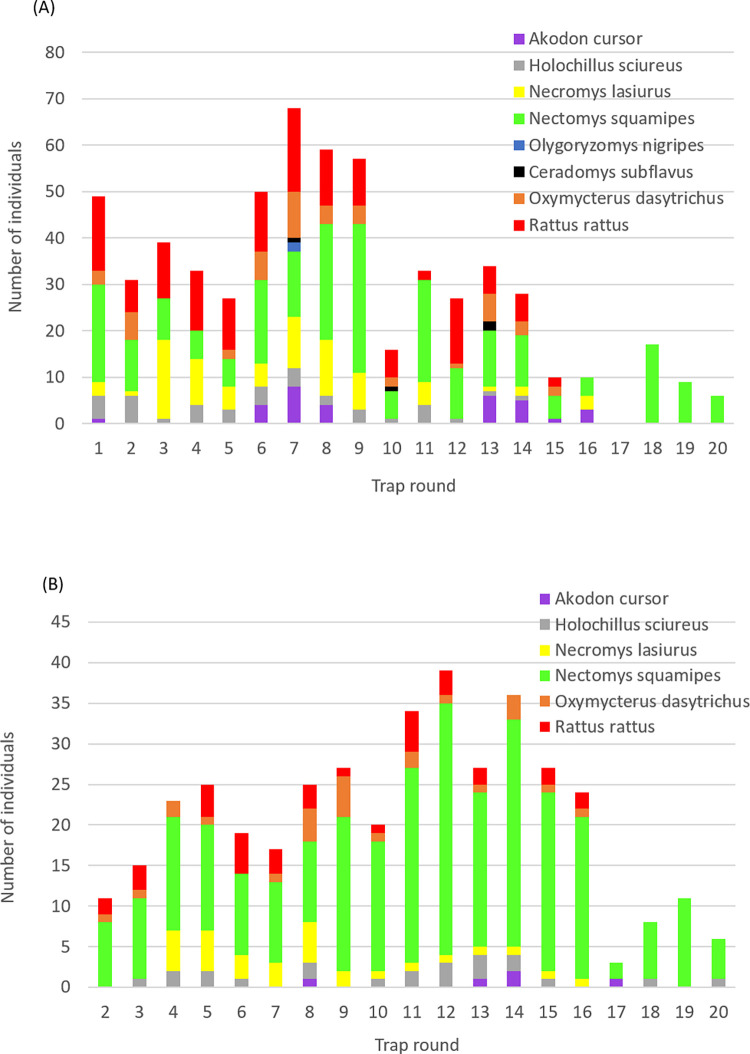
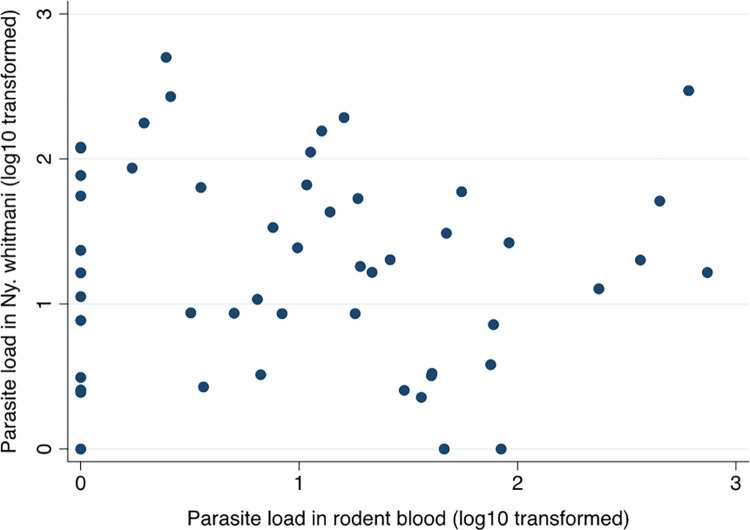
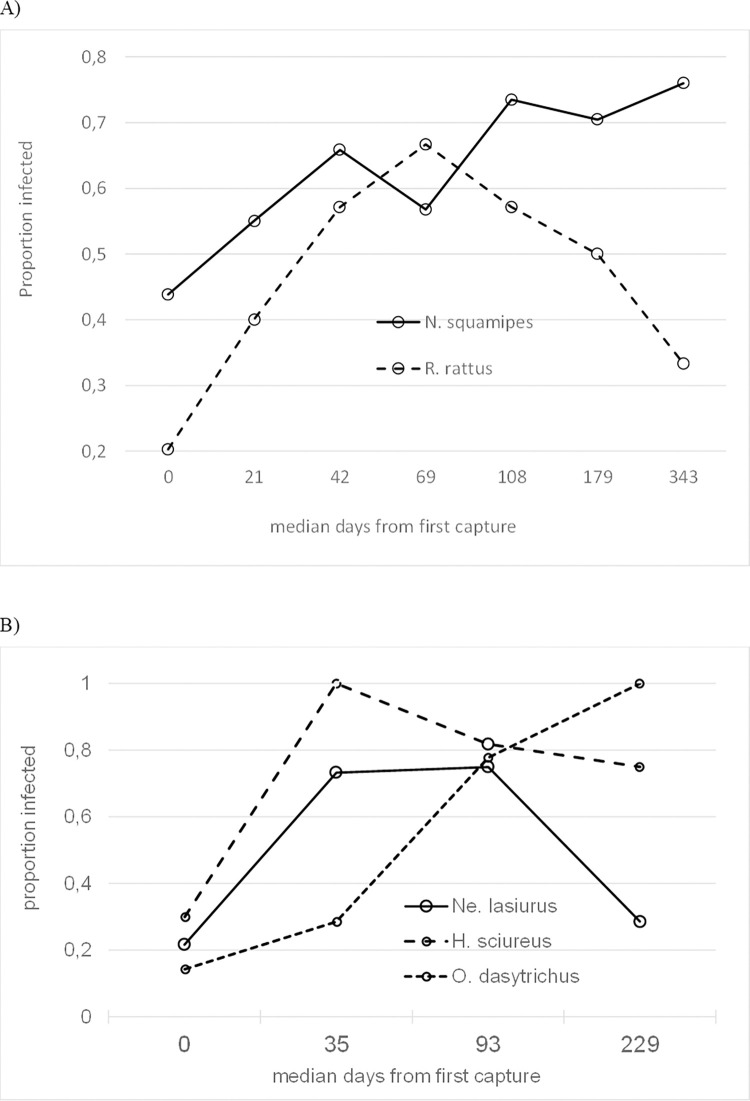
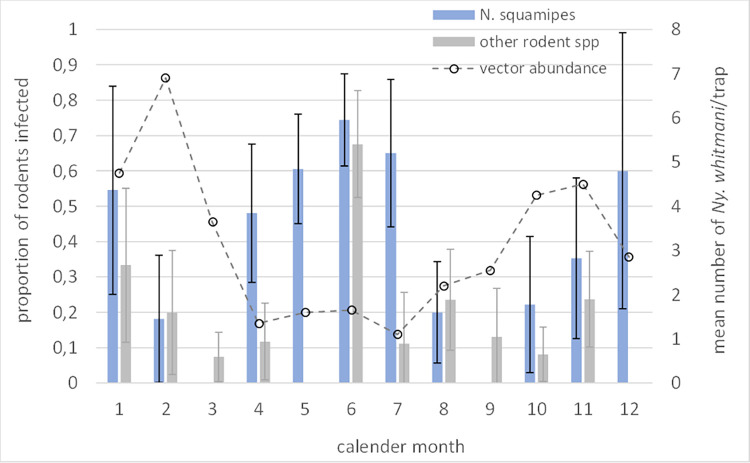
A total 603 individuals of 8 rodent species were (re)captured on 1,051 occasions. The most abundant species were Nectomys squamipes (245 individuals, 41% of the total catch), Rattus rattus (148, 25%), and Necromys lasiurus (83, 14%). All species were captured in greater relative frequencies in plantations; R. rattus was the only species captured in all three habitats including in and around houses. Four species, comprising 22.6% of individuals captured at least twice, were geolocated in more than one habitat type; 78.6% were infected with L. (V.) braziliensis, facilitating inter-species and inter-habitat transmission. Species specific period prevalence ranged between 0%-62% being significantly higher in N. squamipes (54-62%) and Hollochillus sciureus (43-47%). Xenodiagnosis was performed on 41 occasions exposing 1,879 Nyssomyia whitmani sand flies to five rodent species (37 individuals). Similar mean levels of infectiousness amongst the more common rodent species were observed. Longitudinal xenodiagnosis of the N. squamipes population revealed a persistent level of infectiousness over 13 months follow-up, infecting a median 48% (IQR: 30.1%-64.2%) of exposed blood-fed vectors. The proportion of exposed flies infected was greater in the low compared to in the high seasonal period of vector abundance. L. (V.) braziliensis parasite loads in rodent blood quantified by qPCR were similar across rodent species but did not represent a reliable quantitative marker of infectiousness to sand flies. The standardised risk of rodent infection in plantations was 70.3% relative to 11.3% and 18.4% in peri domestic and forest habitats respectively. R. rattus was the only exception to this trend indicating greatest risk in the peri domestic environment.
The results support the view that a collective assemblage of wild and synanthropic rodent species is an important wild reservoir of L. (V.) braziliensis in this region, with N. squamipes and R. rattus probably playing a key role in transmission within and between habitat types and rodent species. Rodents, and by implication humans, are at risk of infection in all sampled habitats, but more so in homestead plantations. These conclusions are based on one of the longest CMR study of small rodents in an American Tegumentary Leishmaniasis (ATL) foci.
引起人类传染病的病原体在野生动物中的感染情况在很大程度上取决于它们的感染状况、与人类的接触潜力(通过媒介传播疾病的媒介),以及它们维持传播的传染性。本研究在巴西东北部皮肤利什曼病流行地区,对野生和半野生自然感染的啮齿动物种群进行了这些参数的量化。
在 27 个月的时间里,在家庭/周边环境、家庭种植园和附近的大西洋森林中(9920 个单陷阱夜)对啮齿动物进行捕获-标记-重捕(CMR)。对啮齿动物临床样本(血液和耳组织)进行了常规 PCR 和定量 PCR(qPCR)检测利什曼原虫(Viannia)巴西种感染情况,并进行了异种诊断,以测量对当地沙蝇媒介的传染性。
共捕获了 8 种啮齿动物的 603 只个体,共 1051 次。最丰富的物种是 Nectomys squamipes(245 只,占总捕获量的 41%)、Rattus rattus(148 只,25%)和 Necromys lasiurus(83 只,14%)。所有物种在种植园中捕获的相对频率更高;R. rattus 是唯一一种在所有三种栖息地(包括房屋内外)都能捕获的物种。有四种物种,占至少两次捕获的个体的 22.6%,被定位在多种栖息地类型中;78.6%感染了 L.(V.)巴西种,促进了种间和栖息地间的传播。物种特异性的期流行率在 0%-62%之间,在 N. squamipes(54-62%)和 Hollochillus sciureus(43-47%)中显著更高。对 41 次异种诊断暴露了 5 种啮齿动物(37 只)给 1879 只 Nyssomyia whitmani 沙蝇。观察到更常见的啮齿动物物种之间具有相似的平均传染性水平。对 N. squamipes 种群的纵向异种诊断显示,在 13 个月的随访中,持续存在感染水平,感染中位数为 48%(IQR:30.1%-64.2%)的暴露血源媒介。在低丰度时期,暴露的苍蝇感染比例高于高丰度时期。用 qPCR 定量检测啮齿动物血液中的 L.(V.)巴西种寄生虫载量在啮齿动物物种之间相似,但不能作为沙蝇感染的可靠定量标志物。与周围环境相比,在种植园中的啮齿动物感染风险更高,分别为 70.3%、11.3%和 18.4%。R. rattus 是这种趋势的唯一例外,表明在周围环境中风险最大。
结果支持这样一种观点,即野生和半野生啮齿动物的集体组合是该地区 L.(V.)巴西种的一个重要野生动物宿主,N. squamipes 和 R. rattus 可能在种内和种间以及栖息地类型和啮齿动物物种之间的传播中发挥关键作用。啮齿动物,因此也包括人类,在所有采样的栖息地中都有感染的风险,但在家庭种植园中风险更大。这些结论是基于对巴西东北部皮肤利什曼病(ATL)焦点地区的小啮齿动物进行的最长时间的 CMR 研究之一得出的。