
Leishmania braziliensis 在整个新热带地区的进化基因组学。
Evolutionary genomics of Leishmania braziliensis across the neotropical realm.
机构信息
Department of Biomedical Sciences, Institute of Tropical Medicine, Antwerp, Belgium.
Department of Microbiology, Immunology and Transplantation, Rega Institute for Medical Research, Katholieke Universiteit Leuven, Leuven, Belgium.
出版信息
Commun Biol. 2024 Nov 28;7(1):1587. doi: 10.1038/s42003-024-07278-z.
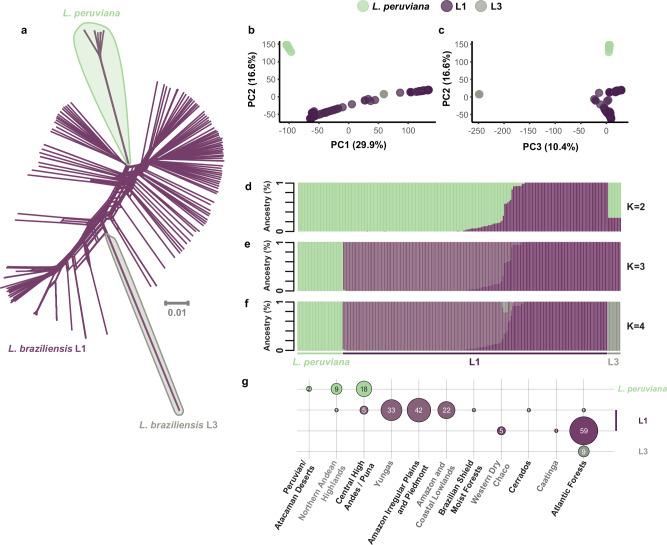
The Neotropical realm, one of the most biodiverse regions on Earth, houses a broad range of zoonoses that pose serious public health threats. Protozoan parasites of the Leishmania (Viannia) braziliensis clade cause zoonotic leishmaniasis in Latin America with clinical symptoms ranging from simple cutaneous to destructive, disfiguring mucosal lesions. We present the first comprehensive genome-wide continental study including 257 cultivated isolates representing most of the geographical distribution of this major human pathogen. The L. braziliensis clade is genetically highly heterogeneous, consisting of divergent parasite groups that are associated with different environments and vary greatly in diversity. Apart from several small ecologically isolated groups with little diversity, our sampling identifies two major parasite groups, one associated with the Amazon and the other with the Atlantic Forest biomes. These groups show different recombination histories, as suggested by high levels of heterozygosity and effective population sizes in the Amazonian group in contrast to high levels of linkage and clonality in the Atlantic group. We argue that these differences are linked to strong eco-epidemiological differences between the two regions. In contrast to geographically focused studies, our study provides a broad understanding of the molecular epidemiology of zoonotic parasites circulating in tropical America.
新热带界是地球上生物多样性最丰富的地区之一,拥有广泛的人畜共患病原体,对公共卫生构成严重威胁。属于 Leishmania (Viannia) braziliensis 进化枝的原生动物寄生虫在拉丁美洲引起了人畜共患的利什曼病,其临床症状从简单的皮肤病变到破坏性的、毁容性的黏膜病变不等。我们首次进行了全大陆范围的综合基因组研究,包括 257 株培养分离株,代表了这种主要人类病原体的大部分地理分布。L. braziliensis 进化枝在遗传上高度异质,由与不同环境相关的不同寄生虫群组成,多样性差异很大。除了一些多样性很小的小型生态隔离群外,我们的采样确定了两个主要的寄生虫群,一个与亚马逊地区有关,另一个与大西洋森林生物群落有关。这些群体显示出不同的重组历史,这表明亚马逊群体的杂合度和有效种群大小较高,而大西洋群体的连锁和克隆性较高。我们认为这些差异与两个地区之间强烈的生态流行病学差异有关。与以地理位置为重点的研究不同,我们的研究提供了对在热带美洲循环的人畜共患病寄生虫的分子流行病学的广泛理解。




 Zotero 插件