Faculty of Odontology, Malmö University, Malmö, Sweden.
Department of Oral and Maxillofacial Surgery and Oral Medicine, Faculty of Odontology, Malmö University, Carl Gustafs Väg 34, 214 21, Malmö, Sweden.
Clin Oral Investig. 2023 Dec 23;28(1):15. doi: 10.1007/s00784-023-05401-8.
To assess the clinical outcomes of zirconia dental implants based on an updated systematic literature review.
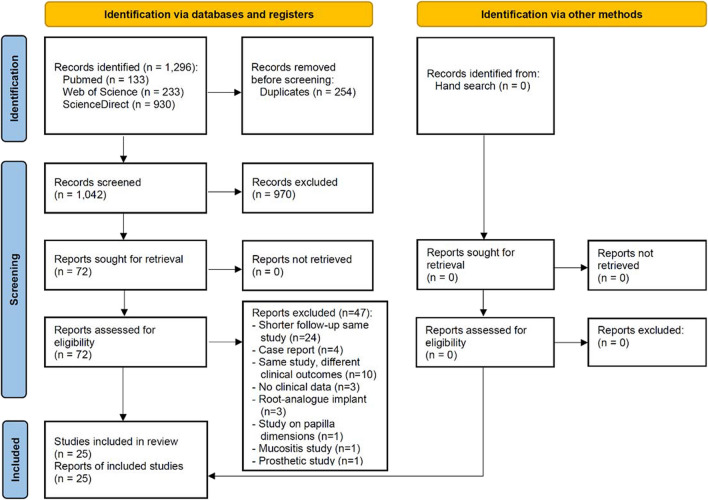
An electronic search was performed in three databases, last updated in June 2023, supplemented by hand searching. The eligibility criteria were clinical studies reporting patients rehabilitated with zirconia implants. The cumulative survival rate (CSR) of implants was calculated. A meta-analysis for marginal bone loss (MBL) under different follow-up times and a meta-regression assessing the relationship between mean MBL and follow-up were done.
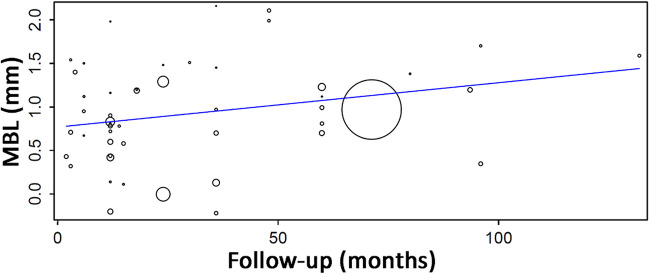
Twenty-five studies were included (4017 implants, 2083 patients). Seven studies had follow-up longer than 60 months. 172 implants failed, after a mean of 12.0 ± 16.1 months (min-max 0.3-86.0), of which 47 early failures, and 26 due to implant fracture, the majority in narrow-diameter implants. The 10-year CSR was 95.1%. Implants with coronal part prepared by drills presented statistically significant lower survival than non-prepared implants (p < 0.001). Two-piece implants presented lower survival than one-piece implants (p = 0.017). Implants discontinued from the market presented lower survival than the commercially available ones (p < 0.001). The difference in survival was not significant between implants in maxilla and mandible (p = 0.637). The mean MBL fluctuated between 0.632 and 2.060 mm over long periods of observation (up until 132 months). There was an estimated MBL increase of 0.005 mm per additional month of follow-up.
Zirconia implants present high 10-year CSR and short-term low MBL. The review was registered in PROSPERO (CRD42022342055).
The clinical outcomes observed for zirconia dental implants are very promising, although these have not yet been extensively studied as titanium alloy implants.
通过最新的系统文献回顾评估氧化锆牙科种植体的临床结果。
在三个数据库中进行电子检索,最后一次更新时间为 2023 年 6 月,补充手动检索。纳入标准为报告采用氧化锆种植体修复患者的临床研究。计算种植体的累积生存率(CSR)。对不同随访时间的边缘骨丧失(MBL)进行荟萃分析,并进行荟萃回归评估平均 MBL 与随访时间之间的关系。
共纳入 25 项研究(4017 枚种植体,2083 例患者)。7 项研究的随访时间超过 60 个月。172 枚种植体失败,平均随访 12.0±16.1 个月(最短 0.3 最长 86.0),其中 47 枚为早期失败,26 枚为种植体折断,大多数发生在窄直径种植体中。10 年 CSR 为 95.1%。经钻头制备的种植体颈部部分与未经制备的种植体相比,生存率有显著差异(p<0.001)。两段式种植体与一体式种植体相比,生存率较低(p=0.017)。已退出市场的种植体与市售种植体相比,生存率较低(p<0.001)。上颌和下颌种植体的生存率无显著差异(p=0.637)。在长时间的观察中(最长至 132 个月),MBL 均值在 0.632 至 2.060mm 之间波动。随访时间每增加一个月,预计 MBL 增加 0.005mm。
氧化锆种植体具有 10 年高 CSR 和短期低 MBL。本研究已在 PROSPERO(CRD42022342055)注册。
氧化锆牙科种植体的临床结果非常有前景,尽管与钛合金种植体相比,这些研究尚未广泛开展。