Revel-Vilk Shoshana, Zimran Ari, Istaiti Majdolen, Azani Liat, Shalev Varda, Chodick Gabriel, Manor Orly, Paltiel Ora
Gaucher Unit, Shaare Zedek Medical Center, Jerusalem 9103102, Israel.
Faculty of Medicine, The Hebrew University of Jerusalem, Ein Kerem, Jerusalem 9112102, Israel.
J Clin Med. 2023 Dec 15;12(24):7707. doi: 10.3390/jcm12247707.
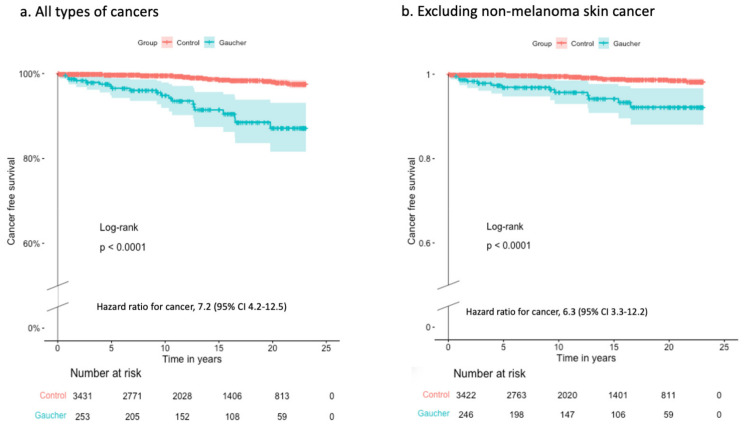
The association between GD and cancer has been uncertain due to ascertainment bias in previously published studies. We analyzed cancer incidence using the Maccabi Healthcare Service (MHS) electronic health records among 264 patients with GD compared to 3440 matched controls. We ascertained cancers diagnosed before and after the index date (i.e., the first documentation of GD in cases and the corresponding date for controls). Before the index date, cancers were diagnosed in 18 individuals, with 11 (4.2%) in the GD group and 7 (0.2%) in the control group. After the index date, cancers were diagnosed in 57 individuals, with 20 (7.9%) in the GD group and 37 (1.1%) in the control group, with a median follow-up of almost 13 years in both groups. The most common cancers diagnosed in GD were non-melanoma skin cancer (NMSC) and hematological malignancies, with a clustering of diagnoses around the time of GD diagnosis. The incidence of cancers (excluding MNSC) was 4.1 (95% CI 2.2-7.1) and 0.7 (95% CI 0.4-0.9) per 1000 patient-years in the GD and control groups, respectively, with an incidence rate ratio of 6.37 (95% CI 3-12.7). Patients with GD underwent more cancer screening tests than their counterparts in the control group. While our study revealed an increased occurrence of cancers in patients with GD, this finding might be partly attributed to the more rigorous surveillance procedures employed in this patient population.
由于既往发表研究中存在的确诊偏倚,格雷夫斯病(GD)与癌症之间的关联一直不明确。我们使用马卡比医疗服务公司(MHS)的电子健康记录,分析了264例GD患者与3440例匹配对照的癌症发病率。我们确定了在索引日期之前和之后诊断的癌症(即病例中GD的首次记录日期以及对照的相应日期)。在索引日期之前,18人被诊断出患有癌症,其中GD组11人(4.2%),对照组7人(0.2%)。索引日期之后,57人被诊断出患有癌症,其中GD组20人(7.9%),对照组37人(1.1%),两组的中位随访时间均近13年。GD患者中最常见的癌症是非黑色素瘤皮肤癌(NMSC)和血液系统恶性肿瘤,在GD诊断前后诊断呈聚集性。GD组和对照组癌症(不包括MNSC)的发病率分别为每1000患者年4.1(95%CI 2.2 - 7.1)和0.7(95%CI 0.4 - 0.9),发病率比为6.37(95%CI 3 - 12.7)。GD患者比对照组接受了更多的癌症筛查测试。虽然我们的研究显示GD患者癌症发生率增加,但这一发现可能部分归因于该患者群体采用了更严格的监测程序。