Grupo Español de Enfermedades de Depósito Lisosomal, Sociedad Española de Hematología y Hemoterapia, (GEEDL), Zaragoza, Spain.
Hospital del Mar Institut Hospital del Mar d'Investigacions Mèdiques, Barcelona, Spain.
Orphanet J Rare Dis. 2020 Sep 22;15(1):256. doi: 10.1186/s13023-020-01520-7.
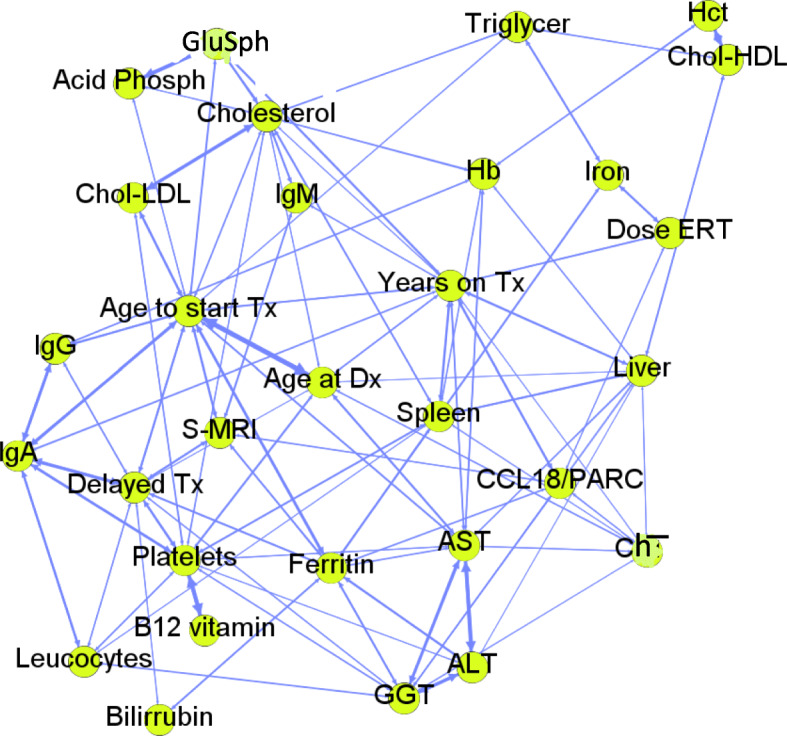
Since enzyme replacement therapy for Gaucher disease (MIM#230800) has become available, both awareness of and the natural history of the disease have changed. However, there remain unmet needs such as the identification of patients at risk of developing bone crisis during therapy and late complications such as cancer or parkinsonism. The Spanish Gaucher Disease Registry has worked since 1993 to compile demographic, clinical, genetic, analytical, imaging and follow-up data from more than 400 patients. The aims of this study were to discover correlations between patients' characteristics at diagnosis and to identify risk features for the development of late complications; for this a machine learning approach involving correlation networks and decision trees analyses was applied.
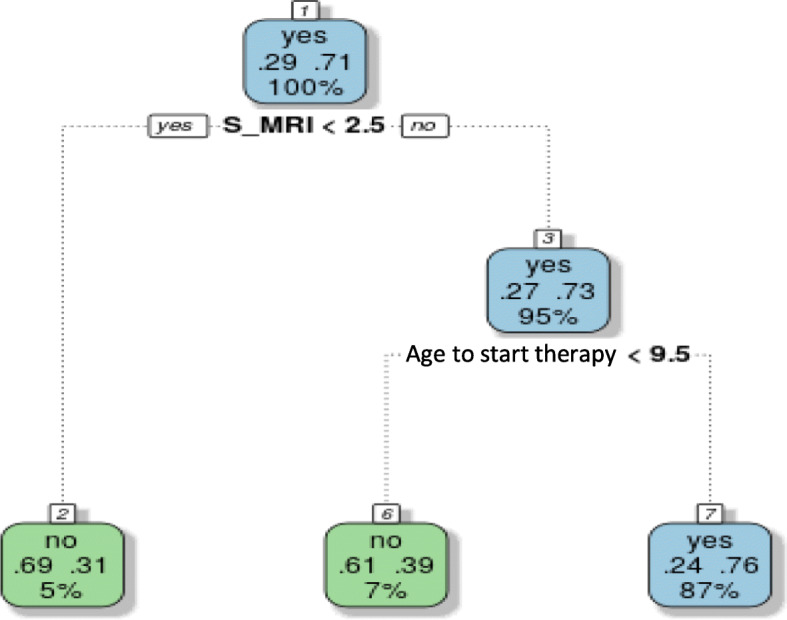
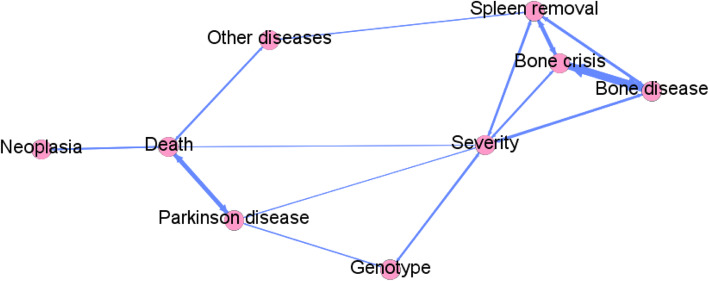
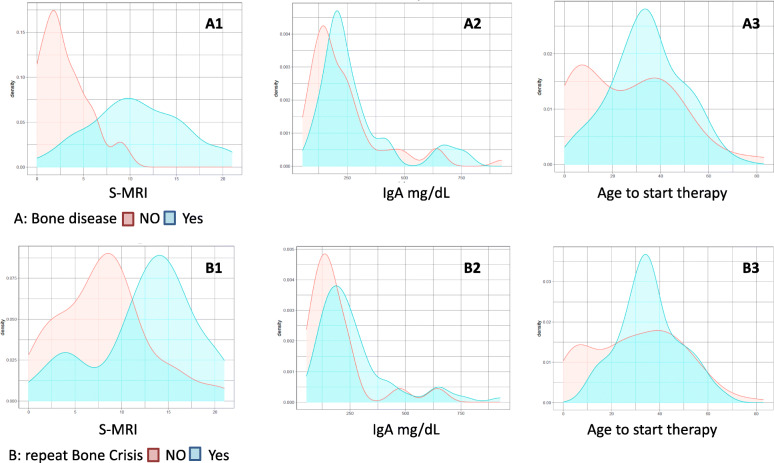
A total of 358 patients, 340 type 1 Gaucher disease and 18 type 3 cases were selected. 18% were splenectomyzed and 39% had advanced bone disease. 81% of cases carried heterozygous genotype. 47% of them were diagnosed before the year 2000. Mean age at diagnosis and therapy were 28 and 31.5 years old (y.o.) respectively. 4% developed monoclonal gammopathy undetermined significance or Parkinson Disease, 6% cancer, and 10% died before this study. Previous splenectomy correlates with the development of skeletal complications and severe bone disease (p = 0.005); serum levels of IgA, delayed age at start therapy (> 9.5 y.o. since diagnosis) also correlates with severe bone disease at diagnosis and with the incidence of bone crisis during therapy. High IgG (> 1750 mg/dL) levels and age over 60 y.o. at diagnosis were found to be related with the development of cancer. When modelling the decision tree, patients with a delayed diagnosis and therapy were the most severe and with higher risk of complications.
Our work confirms previous observations, highlights the importance of early diagnosis and therapy and identifies new risk features such as high IgA and IgG levels for long-term complications.
自从戈谢病(MIM#230800)的酶替代疗法问世以来,人们对该病的认识和自然史都发生了变化。然而,仍存在一些未满足的需求,例如在治疗期间识别有发生骨危机风险的患者以及癌症或帕金森病等晚期并发症。西班牙戈谢病登记处自 1993 年以来一直致力于收集来自 400 多名患者的人口统计学、临床、遗传、分析、影像学和随访数据。本研究的目的是发现诊断时患者特征之间的相关性,并确定发生晚期并发症的风险特征;为此,应用了涉及相关网络和决策树分析的机器学习方法。
共选择了 358 名患者,其中 340 名 1 型戈谢病和 18 名 3 型病例。18%的患者接受了脾切除术,39%的患者患有晚期骨病。81%的病例为杂合基因型。其中 47%的患者在 2000 年之前被诊断。诊断和治疗时的平均年龄分别为 28 和 31.5 岁。4%的患者发展为意义未明的单克隆丙种球蛋白血症或帕金森病,6%的患者患有癌症,10%的患者在本研究之前死亡。既往脾切除术与骨骼并发症和严重骨病的发展相关(p=0.005);血清 IgA 水平、开始治疗的延迟年龄(自诊断以来>9.5 岁)也与诊断时的严重骨病和治疗期间骨危机的发生相关。高 IgG(>1750mg/dL)水平和诊断时年龄超过 60 岁与癌症的发生相关。在构建决策树时,诊断和治疗延迟的患者病情最严重,并发症风险最高。
我们的工作证实了之前的观察结果,强调了早期诊断和治疗的重要性,并确定了新的风险特征,如高 IgA 和 IgG 水平与长期并发症相关。