Institute of Biochemistry, Albert-Ludwigs-Universität Freiburg, Albertstrasse 21, 79104 Freiburg im Breisgau, Germany.
Molecules. 2023 Dec 5;28(24):7959. doi: 10.3390/molecules28247959.
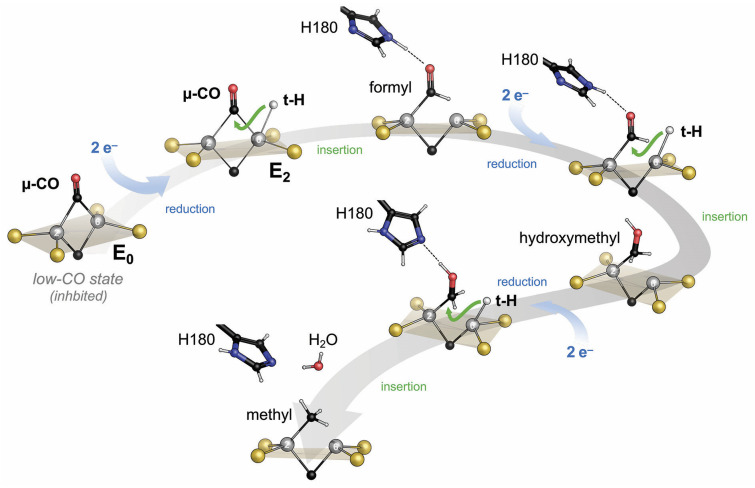
Only a single enzyme system-nitrogenase-carries out the conversion of atmospheric N into bioavailable ammonium, an essential prerequisite for all organismic life. The reduction of this inert substrate at ambient conditions poses unique catalytic challenges that strain our mechanistic understanding even after decades of intense research. Structural biology has added its part to this greater tapestry, and in this review, I provide a personal (and highly biased) summary of the parts of the story to which I had the privilege to contribute. It focuses on the crystallographic analysis of the three isoforms of nitrogenases at high resolution and the binding of ligands and inhibitors to the active-site cofactors of the enzyme. In conjunction with the wealth of available biochemical, biophysical, and spectroscopic data on the protein, this has led us to a mechanistic hypothesis based on an elementary mechanism of repetitive hydride formation and insertion.
只有一个单一的酶系统——固氮酶——将大气中的氮转化为生物可用的铵,这是所有生物体生命的必要前提。在环境条件下还原这种惰性底物带来了独特的催化挑战,即使经过几十年的深入研究,我们对其机制的理解仍然存在很大的差距。结构生物学为这个更大的研究领域做出了贡献,在这篇综述中,我对我有幸参与的部分内容进行了个人(且存在高度偏见)的总结。它重点介绍了三种固氮酶同工酶的高分辨率晶体学分析,以及配体和抑制剂与酶活性部位辅因子的结合。结合大量现有的关于该蛋白质的生化、生物物理和光谱学数据,这使我们提出了一个基于重复氢化物形成和插入基本机制的机械假说。