Benalcázar-Jalkh Ernesto B, Bergamo Edmara T P, Campos Tiago M B, Coelho Paulo G, Sailer Irena, Yamaguchi Satoshi, Alves Larissa M M, Witek Lukasz, Tebcherani Sérgio M, Bonfante Estevam A
Department of Prosthodontics and Periodontology, Bauru School of Dentistry, University of São Paulo, Bauru 17012-901, SP, Brazil.
Biomaterials Division, NYU Dentistry, New York, NY 10010, USA.
Materials (Basel). 2023 Dec 7;16(24):7541. doi: 10.3390/ma16247541.
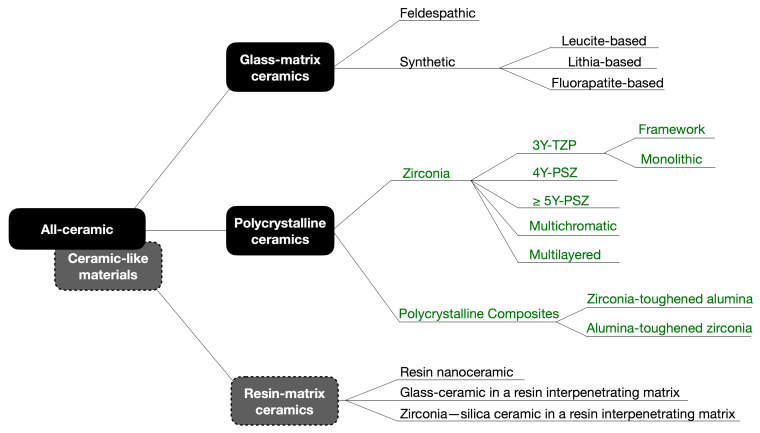
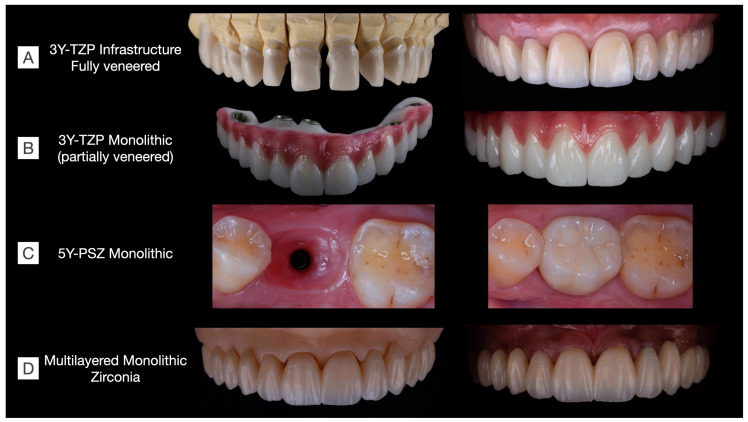
Dental zirconias have been broadly utilized in dentistry due to their high mechanical properties and biocompatibility. Although initially introduced in dentistry as an infrastructure material, the high rate of technical complications related to veneered porcelain has led to significant efforts to improve the optical properties of dental zirconias, allowing for its monolithic indication. Modifications in the composition, processing methods/parameters, and the increase in the yttrium content and cubic phase have been presented as viable options to improve zirconias' translucency. However, concerns regarding the hydrothermal stability of partially stabilized zirconia and the trade-off observed between optical and mechanical properties resulting from the increased cubic content remain issues of concern. While the significant developments in polycrystalline ceramics have led to a wide diversity of zirconia materials with different compositions, properties, and clinical indications, the implementation of strong, esthetic, and sufficiently stable materials for long-span fixed dental prostheses has not been completely achieved. Alternatives, including advanced polycrystalline composites, functionally graded structures, and nanosized zirconia, have been proposed as promising pathways to obtain high-strength, hydrothermally stable biomaterials. Considering the evolution of zirconia ceramics in dentistry, this manuscript aims to present a critical perspective as well as an update to previous classifications of dental restorative ceramics, focusing on polycrystalline ceramics, their properties, indications, and performance.
牙科氧化锆因其高机械性能和生物相容性而在牙科领域得到广泛应用。尽管最初作为一种基础材料引入牙科,但与贴面瓷相关的技术并发症发生率较高,这促使人们做出了巨大努力来改善牙科氧化锆的光学性能,使其能够用于全瓷修复。改变成分、加工方法/参数以及增加钇含量和立方相,已被视为提高氧化锆透明度的可行选择。然而,部分稳定氧化锆的水热稳定性问题以及因立方相含量增加而在光学和机械性能之间观察到的权衡,仍然是令人担忧的问题。虽然多晶陶瓷的重大发展导致了具有不同成分、性能和临床适应症的多种氧化锆材料,但尚未完全实现用于长跨度固定义齿的高强度、美观且足够稳定的材料的应用。包括先进的多晶复合材料、功能梯度结构和纳米氧化锆在内的替代材料,已被提议作为获得高强度、水热稳定生物材料的有前途的途径。考虑到牙科氧化锆陶瓷的发展,本文旨在提出批判性观点,并更新以前对牙科修复陶瓷的分类,重点关注多晶陶瓷、它们的性能、适应症和性能表现。