Tunklová Barbora, Šerá Božena, Šrámková Petra, Ďurčányová Sandra, Šerý Michal, Kováčik Dušan, Zahoranová Anna, Hnilička František
Department of Botany and Plant Physiology, Faculty of Agrobiology, Food and Natural Resources, Czech University of Life Sciences Prague, Kamýcká 129, 165 00 Prague, Czech Republic.
Department of Environmental Ecology and Landscape Management, Faculty of Natural Sciences, Comenius University in Bratislava, Ilkovičova 6, 842 15 Bratislava, Slovakia.
Plants (Basel). 2023 Dec 15;12(24):4172. doi: 10.3390/plants12244172.
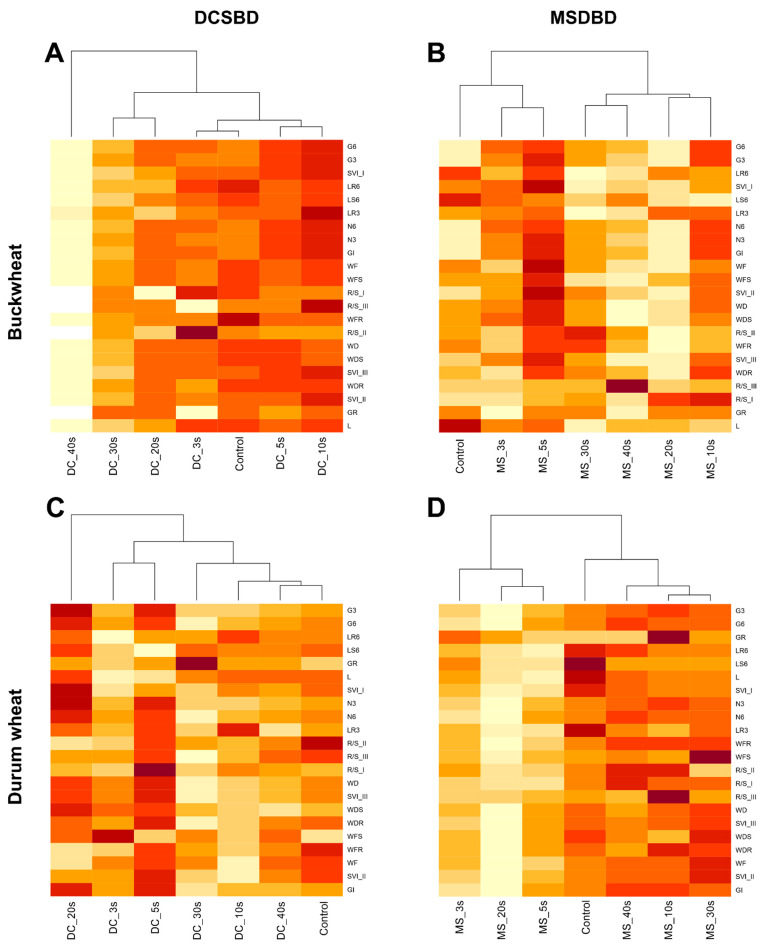
The grains of durum wheat ( Desf.) and achenes of common buckwheat ( Moench) were tested after treatment with two sources of non-thermal atmospheric pressure plasma (DCSBD, MSDBD) with different treatment times (0, 3, 5, 10, 20, 30, and 40 s). The effect of these treatments was monitored with regard to the seed surface diagnostics (water contact angle-WCA, chemical changes by Fourier transform infrared spectroscopy-FTIR); twenty parameters associated with germination and initial seed growth were monitored. A study of the wettability confirmed a decrease in WCA values indicating an increase in surface energy and hydrophilicity depending on the type of seed, plasma source, and treatment time. Surface analysis by attenuated total reflectance FTIR (ATR-FTIR) showed no obvious changes in the chemical bonds on the surface of the plasma-treated seeds, which confirms the non-destructive effect of the plasma on the chemical composition of the seed shell. A multivariate analysis of the data showed many positive trends (not statistically significant) in germination and initial growth parameters. The repeated results for germination rate and root/shoot dry matter ratio indicate the tendency of plants to invest in underground organs. Durum wheat required longer treatment times with non-thermal plasma (10 s, 20 s) for germination and early growth, whereas buckwheat required shorter times (5 s, 10 s). The responses of durum wheat grains to the two non-thermal plasma sources used were equal. In contrast, the responses of buckwheat achenes were more favorable to MSDBD treatment than to DCSBD.
用两种不同处理时间(0、3、5、10、20、30和40秒)的非热大气压等离子体(DCSBD、MSDBD)处理硬粒小麦(Desf.)的谷粒和普通荞麦(Moench)的瘦果后进行测试。监测这些处理对种子表面诊断(水接触角 - WCA、傅里叶变换红外光谱 - FTIR化学变化)的影响;监测与发芽和种子初期生长相关的20个参数。润湿性研究证实,WCA值降低,表明根据种子类型、等离子体源和处理时间,表面能和亲水性增加。衰减全反射FTIR(ATR - FTIR)表面分析表明,经等离子体处理的种子表面化学键无明显变化,这证实了等离子体对种壳化学成分的无损作用。数据的多变量分析显示,发芽和初期生长参数有许多积极趋势(无统计学意义)。发芽率和根/茎干物质比的重复结果表明植物倾向于向地下器官投入。硬粒小麦发芽和早期生长需要用非热等离子体处理更长时间(10秒、20秒),而荞麦需要更短时间(5秒、10秒)。硬粒小麦谷粒对所用两种非热等离子体源的反应相同。相比之下,荞麦瘦果对MSDBD处理的反应比对DCSBD处理更有利。