Robb Sheri L, Stegenga Kristin, Perkins Susan M, Stump Timothy E, Moody Karen M, Henley Amanda K, MacLean Jessica, Jacob Seethal A, Delgado David, Haut Paul R
Indiana University, Indianapolis, IN, USA.
Children's Mercy, Kansas City, MO, USA.
Integr Cancer Ther. 2023 Jan-Dec;22:15347354231218266. doi: 10.1177/15347354231218266.
This trial examined the effects of proximal/distal mediators and moderators of an Active Music Engagement (AME) intervention on young child/parent distress, quality of life, and family function outcomes.
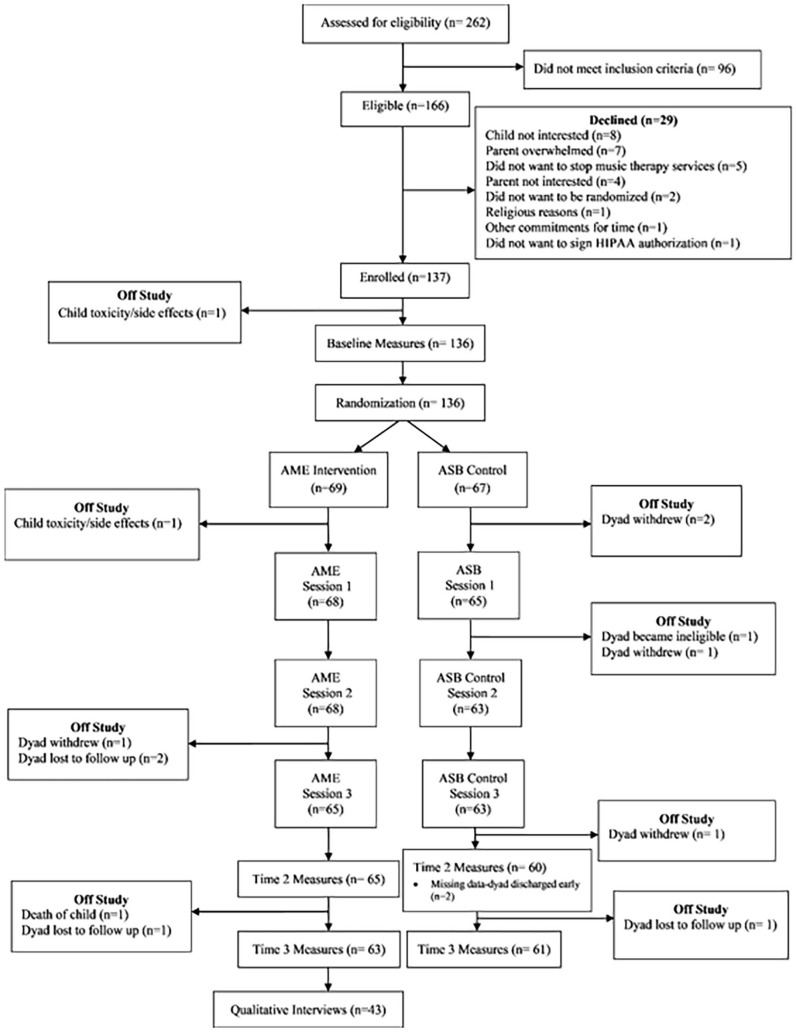
Child/parent dyads (n = 125) were randomized to AME or Audio-storybooks attention control condition. Each group received 3 sessions with a credentialed music therapist for 3 consecutive days with data collection at baseline, post-intervention (T2), and 30-days later (T3). Potential proximal mediators included within session child and parent engagement. Potential distal mediators included changes in perceived family normalcy, parent self-efficacy, and independent use of play materials. Potential moderators included parent/child distress with prior hospitalizations, parent traumatic stress screener (PCL-6), and child age. Outcomes included child emotional distress and quality of life; parent emotion, traumatic stress symptoms (IES-R), well-being; and family function. Mediation effects were estimated using ANCOVA, with indirect effects estimated using the percentile bootstrap approach. Moderation effects were tested by including appropriate interaction terms in models.
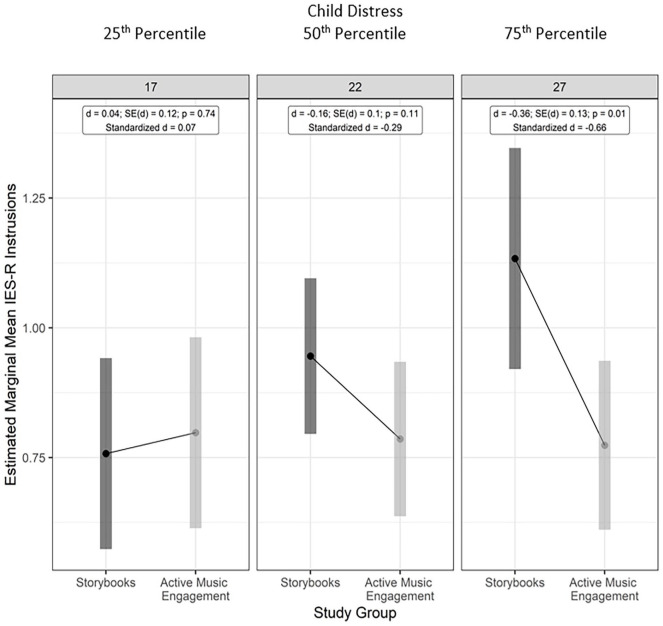
No significant mediation effects were observed. Child distress with prior hospitalizations moderated AME effects for IES-R intrusion subscale scores at T2 ( = .01) and avoidance subscale scores at T3 ( = .007). Traumatic stress screener scores (PCL-6) moderated intervention effects for IES-R hyperarousal subscale scores at T2 ( = .01). There were no moderation effects for child age.
AME is a promising intervention for mitigating traumatic stress symptoms and supporting well-being in parents of children with cancer, particularly for parents who screen high for traumatic stress and whose children are more highly distressed with hospitalization.
本试验研究了主动音乐参与(AME)干预的近端/远端调节因素和中介因素对幼儿/家长痛苦、生活质量和家庭功能结果的影响。
将儿童/家长二元组(n = 125)随机分为AME组或有声故事书注意力控制组。每组连续3天接受3次由有资质的音乐治疗师进行的治疗,并在基线、干预后(T2)和30天后(T3)收集数据。潜在的近端中介因素包括治疗过程中儿童和家长的参与度。潜在的远端中介因素包括感知到的家庭正常度、家长自我效能感和游戏材料的独立使用情况的变化。潜在的调节因素包括有既往住院史的家长/儿童痛苦、家长创伤应激筛查量表(PCL-6)和儿童年龄。结果包括儿童情绪痛苦和生活质量;家长情绪、创伤应激症状(IES-R)、幸福感;以及家庭功能。使用协方差分析估计中介效应,使用百分位数Bootstrap方法估计间接效应。通过在模型中纳入适当的交互项来检验调节效应。
未观察到显著的中介效应。有既往住院史的儿童痛苦对T2时IES-R侵入性子量表得分(p = 0.01)和T3时回避性子量表得分(p = 0.007)的AME效应有调节作用。创伤应激筛查量表得分(PCL-6)对T2时IES-R过度唤醒子量表得分的干预效应有调节作用(p = 0.01)。儿童年龄无调节效应。
AME是一种有前景的干预措施,可减轻癌症患儿家长的创伤应激症状并支持其幸福感,特别是对于创伤应激筛查得分高且其子女因住院而痛苦程度更高的家长。