The Edinburgh Cell Wall Group, Institute of Molecular Plant Sciences, The University of Edinburgh, Daniel Rutherford Building, The King's Buildings, Edinburgh, UK.
EastChem School of Chemistry, The University of Edinburgh, Edinburgh, UK.
Physiol Plant. 2023 Nov-Dec;175(6):e14079. doi: 10.1111/ppl.14079.
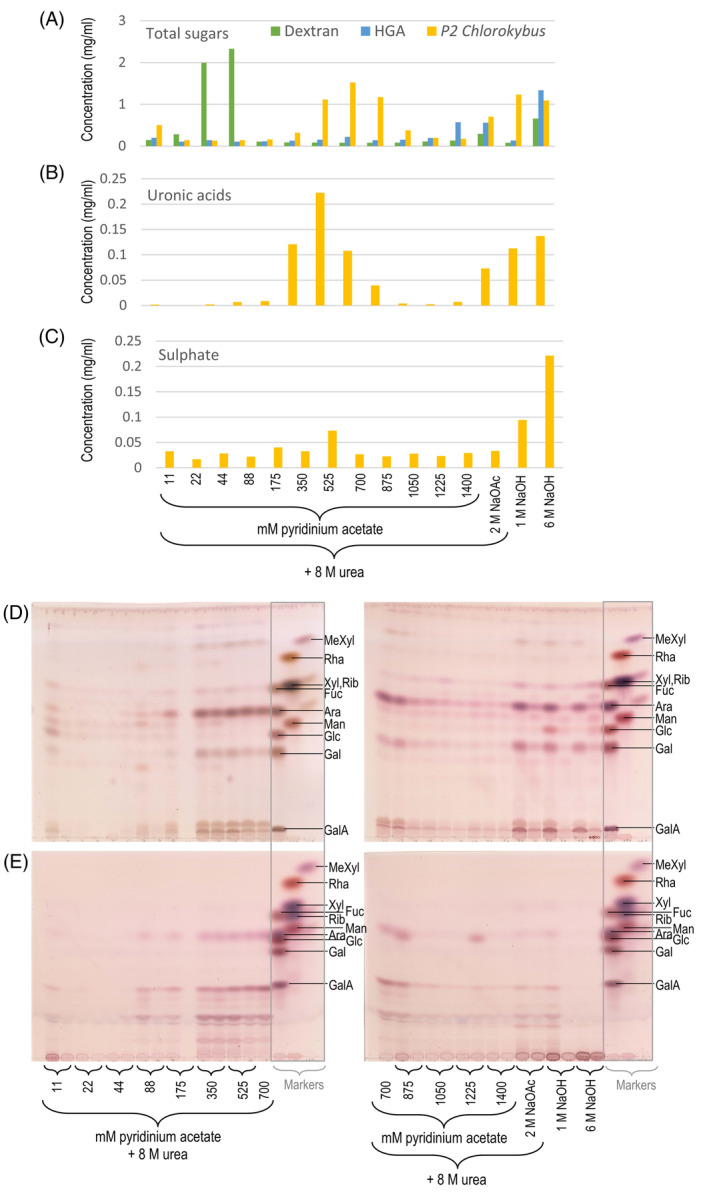
All land-plant cell walls possess hemicelluloses, cellulose and anionic pectin. The walls of their cousins, the charophytic algae, exhibit some similarities to land plants' but also major differences. Charophyte 'pectins' are extractable by conventional land-plant methods, although they differ significantly in composition. Here, we explore 'pectins' of an early-diverging charophyte, Chlorokybus atmophyticus, characterising the anionic polysaccharides that may be comparable to 'pectins' in other streptophytes. Chlorokybus 'pectin' was anionic and upon acid hydrolysis gave GlcA, GalA and sulphate, plus neutral sugars (Ara≈Glc>Gal>Xyl); Rha was undetectable. Most Gal was the l-enantiomer. A relatively acid-resistant disaccharide was characterised as β-d-GlcA-(1→4)-l-Gal. Two Chlorokybus 'pectin' fractions, separable by anion-exchange chromatography, had similar sugar compositions but different sulphate-ester contents. No sugars were released from Chlorokybus 'pectin' by several endo-hydrolases [(1,5)-α-l-arabinanase, (1,4)-β-d-galactanase, (1,4)-β-d-xylanase, endo-polygalacturonase] and exo-hydrolases [α- and β-d-galactosidases, α-(1,6)-d-xylosidase]. 'Driselase', which hydrolyses most land-plant cell wall polysaccharides to mono- and disaccharides, released no sugars except traces of starch-derived Glc. Thus, the Ara, Gal, Xyl and GalA of Chlorokybus 'pectin' were not non-reducing termini with configurations familiar from land-plant polysaccharides (α-l-Araf, α- and β-d-Galp, α- and β-d-Xylp and α-d-GalpA), nor mid-chain residues of α-(1→5)-l-arabinan, β-(1→4)-d-galactan, β-(1→4)-d-xylan or α-(1→4)-d-galacturonan. In conclusion, Chlorokybus possesses anionic 'pectic' polysaccharides, possibly fulfilling pectic roles but differing fundamentally from land-plant pectin. Thus, the evolution of land-plant pectin since the last common ancestor of Chlorokybus and land plants is a long and meandering path involving loss of sulphate, most l-Gal and most d-GlcA; re-configuration of Ara, Xyl and GalA; and gain of Rha.
所有陆生植物细胞壁都含有半纤维素、纤维素和阴离子果胶。它们的远亲石莼藻类的细胞壁与陆生植物的细胞壁有一些相似之处,但也有很大的不同。石莼藻类的“果胶”可以用传统的陆生植物方法提取,尽管它们在组成上有很大的不同。在这里,我们研究了一种早期分化的石莼藻类,Chlorokybus atmophyticus 的“果胶”,其特征是阴离子多糖,可能与其他木贼类植物中的“果胶”相当。Chlorokybus“果胶”是阴离子的,经酸水解后得到 GlcA、GalA 和硫酸盐,以及中性糖(Ara≈Glc>Gal>Xyl;Rha 检测不到)。大多数 Gal 是 l-对映体。一种相对耐酸的二糖被鉴定为β-d-GlcA-(1→4)-l-Gal。通过阴离子交换层析可分离的两种 Chlorokybus“果胶”级分具有相似的糖组成,但硫酸盐酯含量不同。几种内切水解酶[(1,5)-α-l-阿拉伯聚糖酶、(1,4)-β-d-半乳糖苷酶、(1,4)-β-d-木聚糖酶、内切多聚半乳糖醛酸酶]和外切水解酶[α-和β-d-半乳糖苷酶、α-(1,6)-d-木糖苷酶]都不能从 Chlorokybus“果胶”中释放出糖,只有痕量的淀粉衍生的 Glc 被释放出来。因此,Chlorokybus“果胶”的 Ara、Gal、Xyl 和 GalA 不是陆生植物多糖中常见的非还原末端构型(α-l-Araf、α-和β-d-Galp、α-和β-d-Xylp 和α-d-GalpA),也不是α-(1→5)-l-阿拉伯聚糖、β-(1→4)-d-半乳糖苷、β-(1→4)-d-木聚糖或α-(1→4)-d-半乳糖醛酸的中链残基。总之,Chlorokybus 拥有阴离子“果胶”多糖,可能具有果胶作用,但与陆生植物的果胶有根本的不同。因此,自从 Chlorokybus 和陆生植物的最后共同祖先以来,陆生植物果胶的进化是一条漫长而曲折的道路,涉及到硫酸盐、大多数 l-Gal 和大多数 d-GlcA 的丧失;Ara、Xyl 和 GalA 的重新配置;以及 Rha 的获得。