Centre Pasteur du Cameroun, Yaounde, Cameroon.
Department of Microbiology, Faculty of Science, University of Yaounde 1, Yaounde, Cameroon.
PLoS Negl Trop Dis. 2023 Dec 27;17(12):e0011553. doi: 10.1371/journal.pntd.0011553. eCollection 2023 Dec.
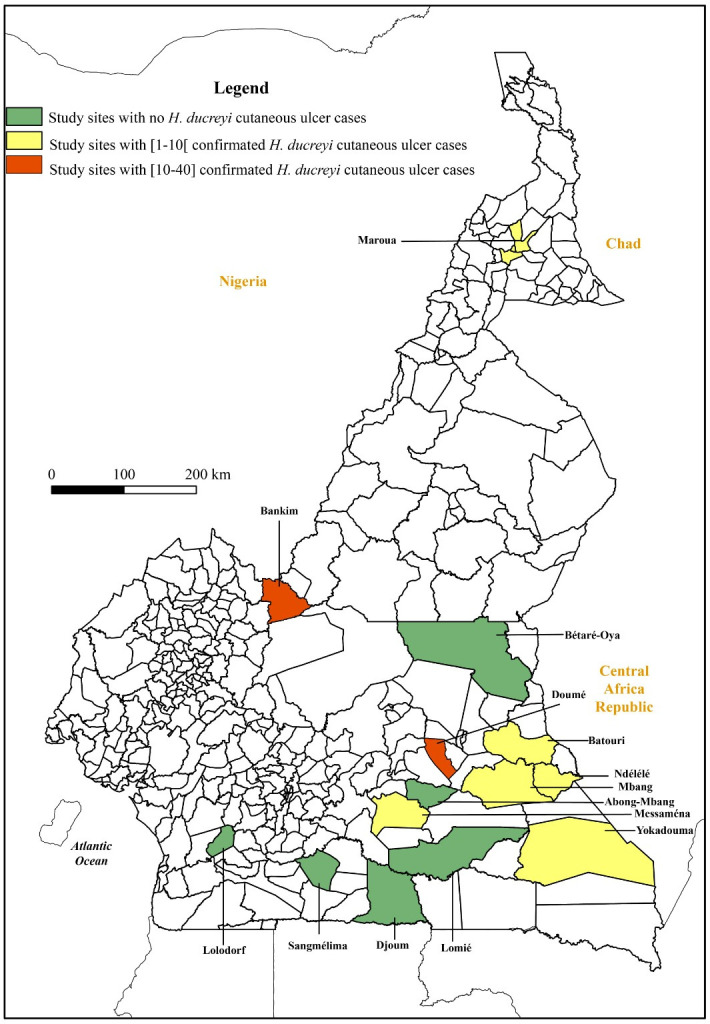
Epidemics of yaws-like cutaneous ulcers are regularly documented in children in the tropics. They occur mainly in poor and remote communities without access to health facilities. The integration of molecular tools into yaws control efforts has made it possible to describe Haemophilus ducreyi (HD) as a major cause of cutaneous ulcers. The objective of this study was to determine the prevalence of HD as cause of cutaneous ulcers, investigate its presence in asymptomatic individuals and identify associated risk factors. A cross-sectional study was conducted in yaws endemic districts of Cameroon. Participants included people presenting yaws-like ulcers and asymptomatic individuals. Swab samples were collected from each participant and tested for HD and Treponema pallidum (TP) using an established qPCR method. Additionally, demographic, habitat, proximity, and hygiene characteristics were collected using a structured questionnaire. A total of 443 individuals participated in the study, including 271 ulcer cases and 172 asymptomatic contacts. The prevalence of HD in ulcers was 30.3% (Confidence Interval (CI) 95% [24.8-35.7]) and the prevalence of asymptomatic HD carriage was 8.6% (CI95% [4.5-12.9]). TP was also detected in our sample among ulcer cases but in lower proportion (5.2% CI95% [2.5-7.8]) compared to HD. The adjusted logistic regression model showed that women were as much at risk of having HD cutaneous ulcer as men regardless of age. Physical proximity to a confirmed ulcer case was the major factor identified favouring HD transmission. HD ulcers were more likely to be present on Bantu individuals compared to Baka as well as HD colonization. These findings highlight HD as the most common cause of cutaneous ulcers in yaws-endemic communities in Cameroon. The exact implications of detecting HD on intact skin are not yet clear. Further studies are needed to understand the significance of this carriage in the spread dynamics of the disease.
在热带地区,儿童中经常有雅司病样皮肤溃疡的流行病例记录。这些溃疡主要发生在没有医疗设施的贫困和偏远社区。将分子工具纳入雅司病控制工作中,使得杜克雷嗜血杆菌(HD)成为皮肤溃疡的主要病因之一。本研究的目的是确定 HD 作为皮肤溃疡病因的流行率,调查其在无症状个体中的存在情况,并确定相关的危险因素。本研究在喀麦隆的雅司病流行地区进行了横断面研究。参与者包括出现雅司病样溃疡和无症状个体的人群。从每个参与者中采集拭子样本,并用建立的 qPCR 方法检测 HD 和梅毒螺旋体(TP)。此外,还使用结构化问卷收集人口统计学、栖息地、接近度和卫生特征。共有 443 人参与了这项研究,包括 271 例溃疡病例和 172 例无症状接触者。溃疡中 HD 的流行率为 30.3%(95%置信区间(CI)[24.8-35.7]),无症状 HD 携带率为 8.6%(95%CI [4.5-12.9])。我们的样本中也检测到了溃疡病例中的 TP,但比例较低(5.2%CI95% [2.5-7.8]),与 HD 相比。调整后的逻辑回归模型显示,无论年龄大小,女性与男性一样有感染 HD 皮肤溃疡的风险。与确诊溃疡病例的身体接近度是促进 HD 传播的主要因素。与巴卡人相比,班图人更容易出现 HD 溃疡,也更容易发生 HD 定植。这些发现突显了 HD 是喀麦隆雅司病流行社区中皮肤溃疡的最常见病因。检测到 HD 在完整皮肤上的确切影响尚不清楚。需要进一步研究以了解这种携带在疾病传播动态中的意义。