Costa E Silva Lara, Fragoso Maria Isabel, Teles Júlia
Faculty of Human Kinetics, University of Lisbon, Portugal.
CIPER, Faculty of Human Kinetics, University of Lisbon, Portugal.
Sports Health. 2017 Mar/Apr;9(2):118-125. doi: 10.1177/1941738116686964. Epub 2017 Jan 30.
Physical activity (PA) is beneficial, enhancing healthy development. However, one-third of school-age children practicing sports regularly suffer from an injury. These injuries are associated with sex, chronological age, and PA level.
To identify the importance of age, PA level, and maturity as predictors of injury in Portuguese youth.
Descriptive epidemiological study.
Level 3.
Information about injury and PA level was assessed via 2 questionnaires (LESADO RAPIL II) from 647 subjects aged 10 to 17 years. Maturity offset according to Mirwald (time before or after peak height velocity) and Tanner-Whitehouse III bone age estimates were used to evaluate maturation. Binary logistic regression and gamma regression were used to determine significant predictors of injury and injury rate.
Injury occurrence was higher for both sexes in recreational, school, and federated athletes (athletes engaged in sports that are regulated by their respective federations, with formal competition). These injuries also increased with age in boys and in the higher maturity offset group in girls. Injury rate was higher for both sexes in the no sports participation group. Early-maturing girls, with higher bone age and lower maturity offset, showed higher injury rate.
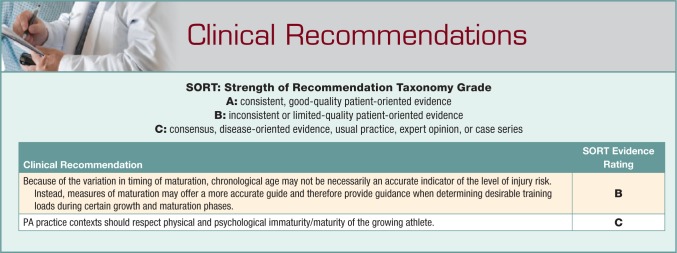
Injuries in Portuguese youth were related to PA level, age, and biological maturation. Recreational, school, and federated athletes had more injury ocurrences while subjects with no sports participation had higher injury risk. Older subjects had more injuries. Early-maturing girls that had just passed peak height velocity may be particularly vulnerable to risk of sports injury because of the growing process.
Increased knowledge about injury with specific PA exposure data is important to an overall risk management strategy. This study has deepened the association between injury and biological maturation variables.
身体活动(PA)有益,可促进健康发育。然而,三分之一经常进行体育锻炼的学龄儿童会受伤。这些损伤与性别、实足年龄和PA水平有关。
确定年龄、PA水平和成熟度作为葡萄牙青少年损伤预测因素的重要性。
描述性流行病学研究。
3级。
通过两份问卷(LESADO RAPIL II)对647名10至17岁的受试者进行损伤和PA水平信息评估。根据米尔瓦尔德法(身高速度峰值之前或之后的时间)和坦纳-怀特豪斯III型骨龄估计值计算成熟度偏移,以评估成熟度。采用二元逻辑回归和伽马回归确定损伤和损伤率的显著预测因素。
在休闲运动员、学校运动员和联合会运动员(参加各自联合会管理的有正式比赛的运动项目的运动员)中,男女的损伤发生率都较高。这些损伤在男孩中随年龄增加,在女孩中在成熟度偏移较高的组中增加。不参加体育活动组的男女损伤率都较高。骨龄较高且成熟度偏移较低的早熟女孩损伤率较高。
葡萄牙青少年的损伤与PA水平、年龄和生物成熟度有关。休闲运动员、学校运动员和联合会运动员的损伤发生率更高,而不参加体育活动的受试者损伤风险更高。年龄较大的受试者损伤更多。刚过身高速度峰值的早熟女孩由于生长过程可能特别容易受到运动损伤风险的影响。
掌握特定PA暴露数据下的损伤知识对于整体风险管理策略很重要。本研究加深了损伤与生物成熟度变量之间的关联。