Department of Laboratory Medicine, School of Medicine, Mianyang Central Hospital, University of Electronic Science and Technology of China, Mianyang, 621000, People's Republic of China.
Sci Rep. 2023 Dec 27;13(1):23004. doi: 10.1038/s41598-023-50524-3.
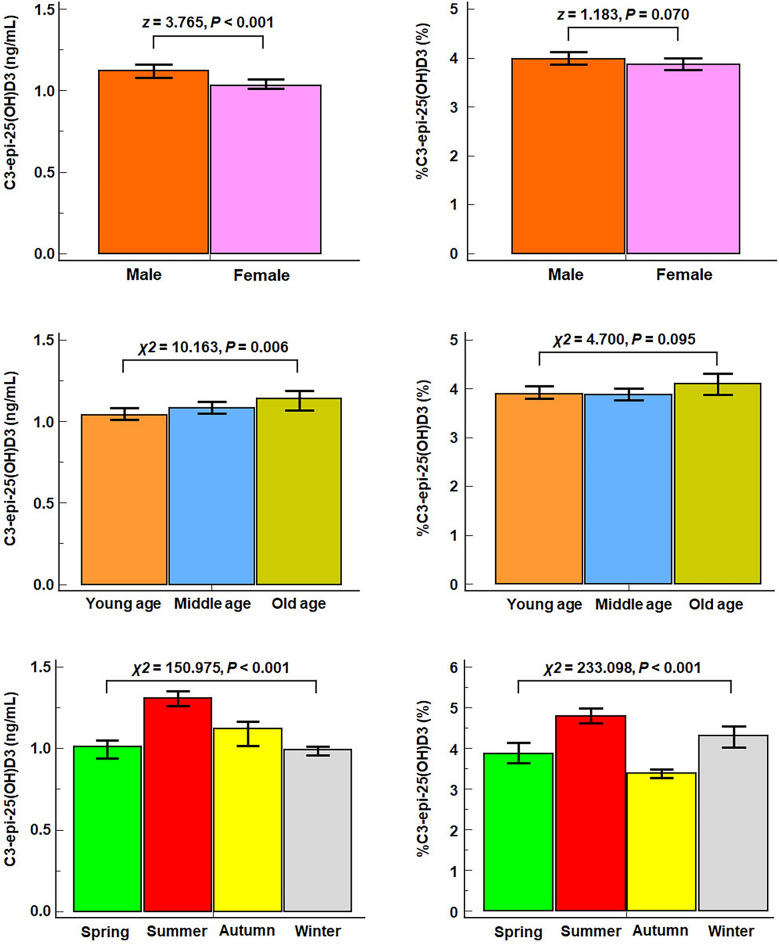
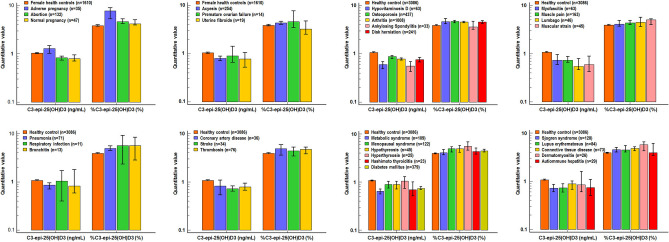
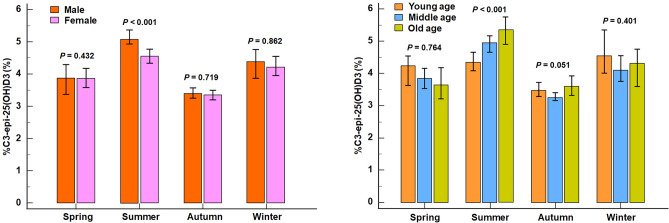
National surveys in developed countries have examined the presence of C3-epimer of 25-hydroxyvitamin D3 [C3-epi-25(OH)D3]. However, controversy remains regarding its association with disease occurrence due to its high correlation with 25-hydroxyvitamin D3 [25(OH)D3]. This study aims to investigate whether %C3-epi-25(OH)D3 can serve as an indicator for this relationship with various diseases. A total of 3086 healthy participants and 4120 patients were included in this study. We investigated the association between C3-epi-25(OH)D3 and %C3-epi-25(OH)D3 levels with gender, age, and season; compared the performance of C3-epi-25(OH)D3 and %C3-epi-25(OH)D3 across different disease conditions; and explored the correlation between %C3-epi-25(OH)D3 and various diseases. Results indicated that C3-epi-25(OH)D3 varied significantly by gender, age, and season (z/χ2 = 3.765, 10.163, and 150.975, all P < 0.01), while only season for %C3-epi-25(OH)D3 (χ2 = 233.098, P < 0.001). In contrast to the significant decrease in C3-epi-25(OH)D3, %C3-epi-25(OH)D3 showed a significant increase in 8 out of 11 disease categories (z = 3.464 ~ 11.543, all Padj < 0.05). Similar opposite changes were also observed in most of the investigated 32 specific diseases. Moreover, an elevation in %C3-epi-25(OH)D3 was found to be significantly associated with 29 specific diseases both in univariate analysis (OR = 1.16 ~ 2.10, all P < 0.05) and after adjusting for gender, age, and season (OR = 1.15 ~ 1.50, all P < 0.05). However, after further adjustment for 25(OH)D3 levels, the association remained significant only for 15 specific diseases (OR = 1.11 ~ 1.50, all P < 0.05). Seasonal stratification analysis further supports the consistent association of %C3-epi-25(OH)D3 with disease across all or nearly all four seasons. In conclusion, %C3-epi-25(OH)D3 may better reflect the production of C3-epi-25(OH)D3 in disease conditions, thereby offering a more applicable approach to investigate its association with diseases. However, the interpretation of this relationship may be confounded by 25(OH)D3 as a potential covariate.
本研究旨在探讨 C3-epi-25(OH)D3 是否可以作为与各种疾病相关的指标。研究共纳入 3086 名健康参与者和 4120 名患者。我们研究了 C3-epi-25(OH)D3 和%C3-epi-25(OH)D3 水平与性别、年龄和季节之间的关系;比较了 C3-epi-25(OH)D3 和%C3-epi-25(OH)D3 在不同疾病状态下的表现;并探讨了%C3-epi-25(OH)D3 与各种疾病之间的相关性。结果表明,C3-epi-25(OH)D3 存在显著的性别、年龄和季节差异(z/χ2=3.765、10.163 和 150.975,均 P<0.01),而%C3-epi-25(OH)D3 仅存在季节差异(χ2=233.098,P<0.001)。与 C3-epi-25(OH)D3 的显著下降相反,8 种疾病类别中的%C3-epi-25(OH)D3 显著增加(z=3.46411.543,均 Padj<0.05)。在大多数研究的 32 种特定疾病中也观察到类似的相反变化。此外,在单因素分析(OR=1.162.10,均 P<0.05)和调整性别、年龄和季节后(OR=1.151.50,均 P<0.05),发现%C3-epi-25(OH)D3 升高与 29 种特定疾病显著相关。然而,在进一步调整 25(OH)D3 水平后,这种关联仅在 15 种特定疾病中仍然显著(OR=1.111.50,均 P<0.05)。季节分层分析进一步支持%C3-epi-25(OH)D3 在所有或几乎所有四个季节与疾病的一致相关性。总之,%C3-epi-25(OH)D3 可能更好地反映疾病状态下 C3-epi-25(OH)D3 的产生,从而提供一种更适用的方法来研究其与疾病的关系。然而,这种关系的解释可能受到 25(OH)D3 作为潜在混杂因素的影响。