Department of Urology, Peking University First Hospital, Institute of Urology, Peking University, National Urological Cancer Centre, Beijing, China.
Department of Nursing, Peking University First Hospital, Peking University, Beijing, China.
Int Braz J Urol. 2024 Jan-Feb;50(1):46-57. doi: 10.1590/S1677-5538.IBJU.2023.0393.
To evaluate objective treatment efficacy and safety, and subjective patient-reported outcomes in patients with complex ureteral strictures (US) undergoing minimally invasive lingual mucosal graft ureteroplasty (LMGU).
We prospectively enrolled patients underwent robotic or laparoscopic LMGU between May 2020 and July 2022. Clinical success was defined as symptom-free and no radiographic evidence of re-obstruction. Patient-reported outcomes, including health-related quality of life (HRQoL), mental health status and oral health-related quality of life (OHRQoL), were longitudinally evaluated before surgery, 6 and 12 months postoperatively.
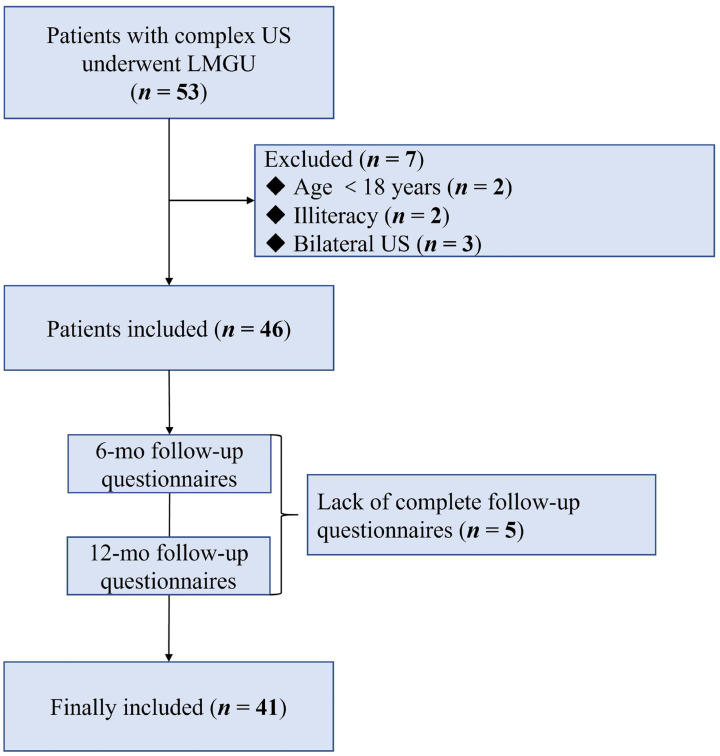
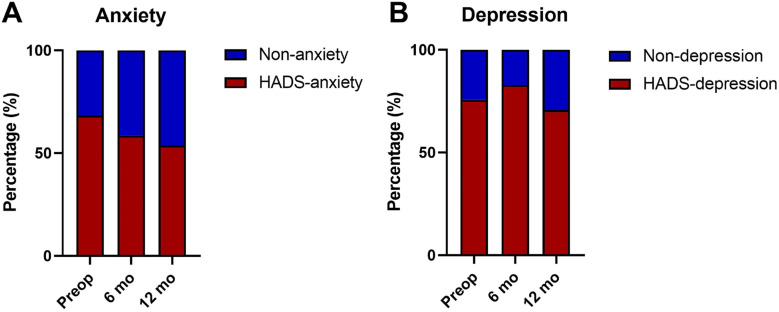
Overall, 41 consecutive patients were included. All procedures were performed successfully with 32 patients in robotic approach and 9 in laparoscopic. Forty (97.56%) patients achieved clinical success during the median follow-up of 29 (range 15-41) months. Although patients with complex US experienced poor baseline HRQoL, there was a remarkable improvement following LMGU. Specifically, the 6-month and 12-month postoperative scores were significantly improved compared to the baseline (p < 0.05) in most domains. Twenty-eight (68.3%) and 31 (75.6%) patients had anxiety and depression symptoms before surgery, respectively. However, no significant decrease in the incidence of these symptoms was observed postoperatively. Moreover, there was no significant deterioration of OHRQoL at 6 months and 12 months postoperatively when compared to the baseline.
LMGU is a safe and efficient procedure for complex ureteral reconstruction that significantly improves patient-reported HRQoL without compromising OHRQoL. Assessing patients' quality of life enables us to monitor postoperative recovery and progress, which should be considered as one of the criteria for surgical success.
评估接受微创舌黏膜移植输尿管成形术(LMGU)治疗的复杂输尿管狭窄(US)患者的客观治疗效果和安全性,以及主观的患者报告结局。
我们前瞻性地招募了 2020 年 5 月至 2022 年 7 月期间接受机器人或腹腔镜 LMGU 的患者。临床成功定义为无症状且无影像学再梗阻证据。患者报告的结局,包括健康相关生活质量(HRQoL)、心理健康状况和口腔健康相关生活质量(OHRQoL),在术前、术后 6 个月和 12 个月进行了纵向评估。
总体而言,共纳入 41 例连续患者。所有手术均成功完成,其中 32 例采用机器人入路,9 例采用腹腔镜入路。40 例(97.56%)患者在中位随访 29 个月(范围 15-41 个月)时达到临床成功。尽管复杂 US 患者的基线 HRQoL 较差,但接受 LMGU 治疗后有显著改善。具体来说,大多数领域的 6 个月和 12 个月术后评分与基线相比均显著改善(p < 0.05)。术前分别有 28 例(68.3%)和 31 例(75.6%)患者存在焦虑和抑郁症状,但术后这些症状的发生率无显著下降。此外,与基线相比,术后 6 个月和 12 个月时 OHRQoL 无明显恶化。
LMGU 是一种安全有效的复杂输尿管重建术,可显著改善患者报告的 HRQoL,同时不影响 OHRQoL。评估患者的生活质量有助于监测术后恢复和进展,应将其视为手术成功的标准之一。