Alzheimer Center Amsterdam, Neurology, Vrije Universiteit Amsterdam, Amsterdam UMC location VUmc, Boelelaan 1118, 1081, HZ, Amsterdam, The Netherlands.
Amsterdam Neuroscience, Neurodegeneration, Amsterdam, 1081, HV, The Netherlands.
Alzheimers Res Ther. 2024 Jan 2;16(1):1. doi: 10.1186/s13195-023-01364-w.
Apolipoprotein-E (APOE) genetic testing for Alzheimer's disease is becoming more important as clinical trials are increasingly targeting individuals carrying APOE-ε4 alleles. Little is known about the interest in finding out one's genetic risk for Alzheimer's disease in the general population. Our objective was to examine this in a sample of cognitively normal (CN) adults within a population-based online research registry with the goal to implement APOE-ε4 status for trial recruitment.
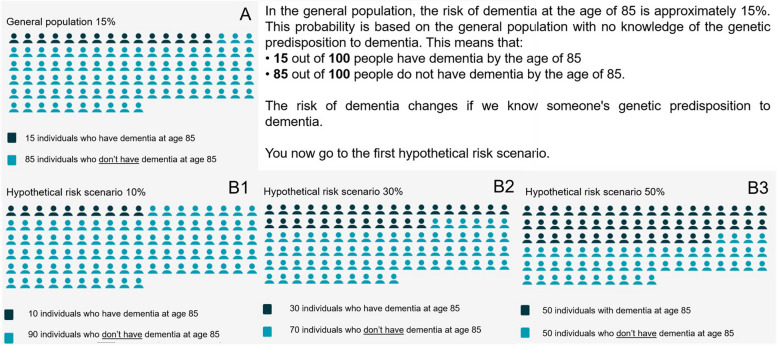
An online survey was completed by 442 CN participants between the age of 49 and 75 years (56% female) from the Dutch Brain Research Registry. The survey assessed interest in participation in research into, and disclosure of, genetic risk for dementia. The survey assessed interest in participation in research into, and disclosure of, genetic risk for dementia and knowing their genetic risk in different hypothetical risk scenarios (10%, 30%, and 50% genetic risk for dementia at age 85, corresponding to APOEε2/ε2 or ε2/ε3, APOEε3/ε4 or ε2ε4, and APOE-ε4/ε4 genotypes). Cochran's Q and post hoc McNemar tests were used to analyse differences in frequencies across scenarios.
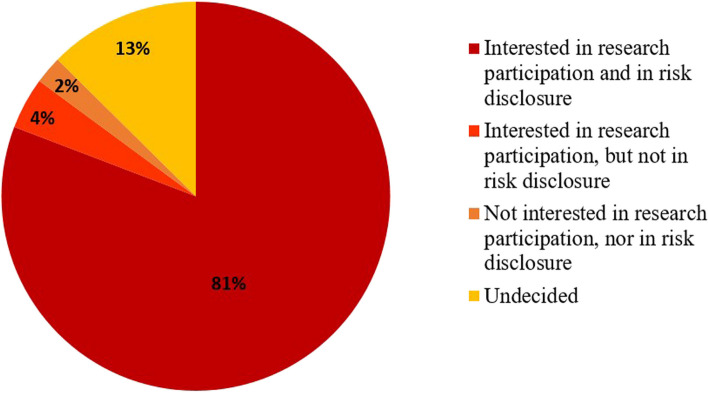
Most participants were interested in participating in research into and disclosure of their genetic risk (81%). The most reported reason was to contribute to scientific research (94%). Interest was higher in males, whilst lower-educated participants were more often undecided. When provided with different risk scenarios, interest in knowing their risk was somewhat higher in the scenarios with higher risk, i.e. in the 50% (79%) compared to the 10% scenario (73%;χ(2) = 7.98; p = .005). Most individuals expected they would share their genetic risk with close relatives (77-89%), would participate in medication trials (79-88%), and would make long-term arrangements, e.g. retirement, health care, will (69-82%), with larger proportions for scenarios with higher hypothetical genetic risk.
Our findings indicate that the vast majority of CN adults participating in a research registry expresses interest in AD genetic risk research and disclosure. Interest in genetic risk disclosure is higher in scenarios corresponding to the APOE-ε4 genotype. This suggests APOE-ε4 screening within an online research registry is potentially a well-received method to accelerate inclusion for trials.
载脂蛋白 E (APOE) 基因检测在阿尔茨海默病中的作用越来越重要,因为临床试验越来越针对携带 APOE-ε4 等位基因的个体。目前,人们对一般人群中发现自己患阿尔茨海默病遗传风险的兴趣知之甚少。我们的目的是在一个基于人群的在线研究登记处的认知正常 (CN) 成年人样本中研究这一点,目的是为试验招募实施 APOE-ε4 状态。
荷兰大脑研究登记处的 442 名年龄在 49 至 75 岁之间的 CN 参与者(56%为女性)完成了一项在线调查。该调查评估了对参与痴呆症遗传风险研究和披露的兴趣。该调查评估了对参与痴呆症遗传风险研究和披露的兴趣,以及对不同假设风险情景下了解自身遗传风险的兴趣(85 岁时痴呆症的遗传风险为 10%、30%和 50%,对应于 APOEε2/ε2 或 ε2/ε3、APOEε3/ε4 或 ε2ε4 和 APOE-ε4/ε4 基因型)。采用 Cochran Q 和事后 McNemar 检验分析不同情景下频率的差异。
大多数参与者对参与遗传风险的研究和披露感兴趣(81%)。最常报告的原因是为科学研究做出贡献(94%)。男性的兴趣较高,而受教育程度较低的参与者往往犹豫不决。当提供不同的风险情景时,对了解自己风险的兴趣在风险较高的情景中略高,即 50%(79%)的情景高于 10%(73%)的情景(χ(2) = 7.98,p = 0.005)。大多数人期望他们会与近亲分享他们的遗传风险(77-89%),会参与药物试验(79-88%),并会做出长期安排,例如退休、医疗保健、遗嘱(69-82%),在假设遗传风险较高的情况下,比例更大。
我们的研究结果表明,大多数参与研究登记处的认知正常成年人表示对 AD 遗传风险研究和披露感兴趣。遗传风险披露的兴趣在对应于 APOE-ε4 基因型的情况下更高。这表明在在线研究登记处进行 APOE-ε4 筛查可能是一种受欢迎的方法,可以加速试验的纳入。