Dutta Debashis, Liu Jianuo, Xu Enquan, Xiong Huangui
University of Nebraska Medical Center.
Res Sq. 2023 Dec 16:rs.3.rs-3707515. doi: 10.21203/rs.3.rs-3707515/v1.
Human Immunodeficiency Virus type 1 (HIV-1)-associated neurocognitive disorders (HAND) remain prevalent in HIV-1-infected individuals despite the evident success of combined antiretroviral therapy (cART). The mechanisms under HAND prevalence in the cART era remain perplexing. Ample evidence indicates that HIV-1 envelope glycoprotein protein 120 (gp120), a potent neurotoxin, plays a pivotal role in the HAND pathogenesis. Methamphetamine (Meth) abuse exacerbates HAND. How Meth exacerbates HAND is not fully understood. This study was to test the hypothesis that Meth exacerbates HAND by enhancing gp120-mediated proinflammatory responses in the brain, worsening the pathogenesis of HAND.
Experiments were carried out on primary microglial cultures prepared from neonatal SD rats. The purity of microglia was determined by staining with anti-CD11b. Meth and gp120 were applied to microglial cultures. Microglial activation was revealed by immunostaining and Iba-1 expression. The protein expression levels of Pro-IL-1β, Il-1β, Iba-1, iNOS, NLRP3, GSDMD and GSDMD-N were detected by western blotting analyses. The levels of proinflammatory cytokine and NO production in the microglia culture supernatants were assayed by ELISA and Griess reagent systems, respectively. NLRP3 activation was uncovered by fluorescent microscopy images displaying NLRP3 puncta labeled by anti-NLRP3 antibody. NLRP3 co-localization with caspase-1 was labeled with antibodies. One-way ANOVA with post hoc Tukey's multiple comparison tests was employed for statistical analyses.
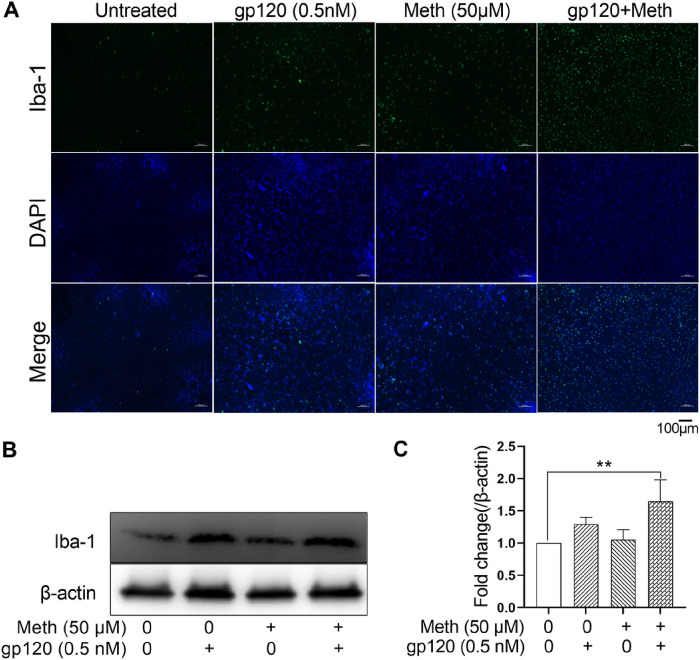
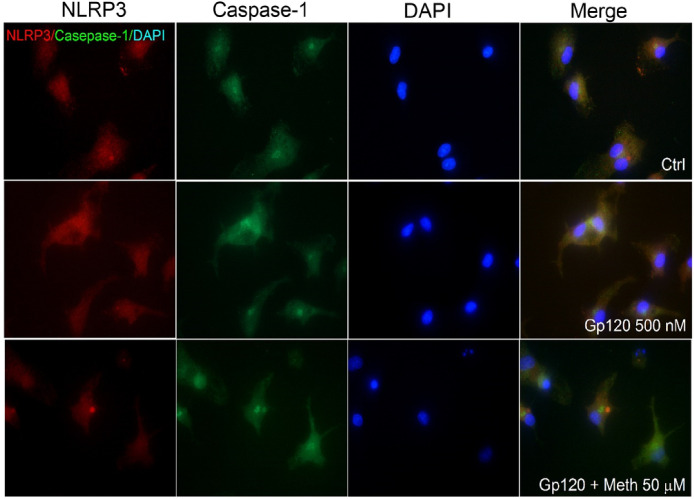
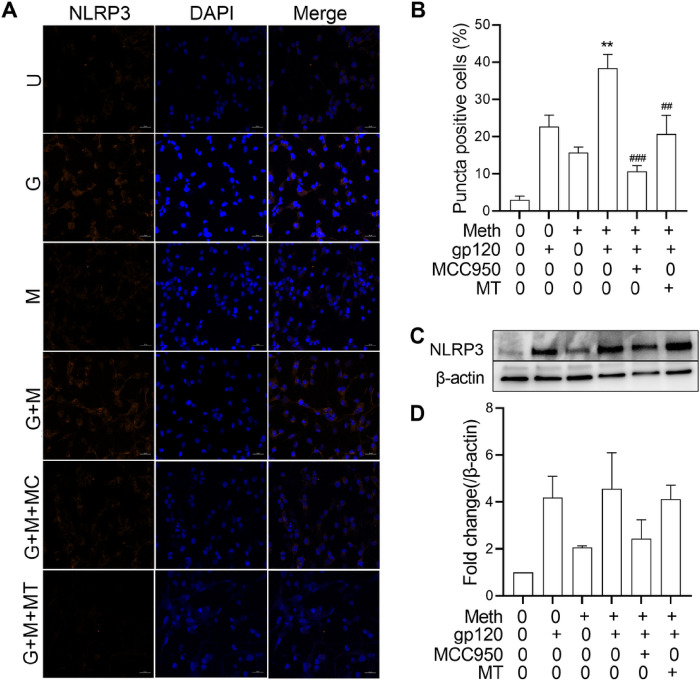
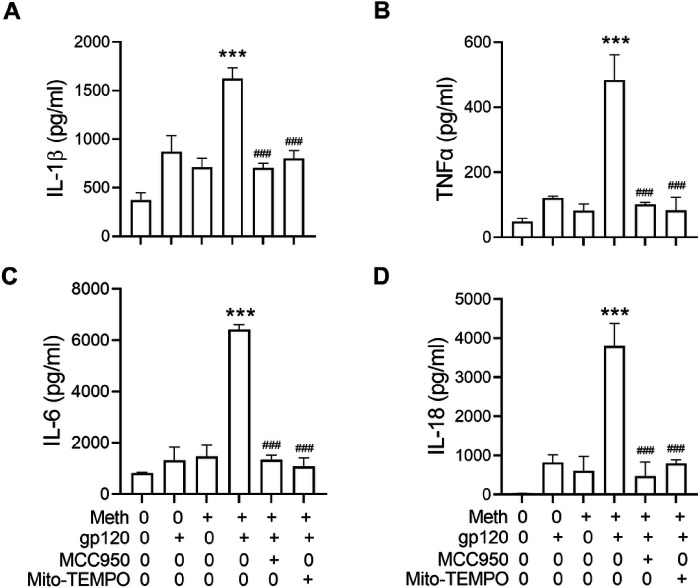
Meth enhanced gp120-induced microglia activation revealed by immunostaining and Iba-1 expression, and potentiated gp120-mediated NLRP3 expression, IL-1β processing and release assayed by immunoblot and ELISA. Meth also augmented the co-localization of NLRP3 and caspase-1, increased the numbers of NLRP3 puncta and ROS production, elevated levels of iNOS expression and NO production, and enhanced levels of cleaved gasderminD (GSDMD-N, an executor of pyroptosis) in gp120-primed microglia. The Meth-associated effects were attenuated or blocked by MCC950, an NLRP3 inhibitor, or Mito-TEMPO, a mitochondrial superoxide scavenger, indicating the involvement of mitochondria in Meth enhancement of NLRP3 inflammasome activation in gp120-primed microglia.
These results suggest that Meth enhanced gp120-associated microglial NLRP3 activation and resultant proinflammatory responses via mitochondria-dependent signaling.
尽管联合抗逆转录病毒疗法(cART)取得了显著成功,但1型人类免疫缺陷病毒(HIV-1)相关神经认知障碍(HAND)在HIV-1感染个体中仍然普遍存在。在cART时代HAND普遍存在的机制仍然令人困惑。大量证据表明,HIV-1包膜糖蛋白120(gp120)作为一种强效神经毒素,在HAND发病机制中起关键作用。甲基苯丙胺(冰毒)滥用会加剧HAND。冰毒如何加剧HAND尚不完全清楚。本研究旨在验证以下假设:冰毒通过增强大脑中gp120介导的促炎反应,恶化HAND的发病机制,从而加剧HAND。
对从新生SD大鼠制备的原代小胶质细胞培养物进行实验。通过抗CD11b染色确定小胶质细胞的纯度。将冰毒和gp120应用于小胶质细胞培养物。通过免疫染色和Iba-1表达揭示小胶质细胞活化。通过蛋白质印迹分析检测前白细胞介素-1β(Pro-IL-1β)、白细胞介素-1β(Il-1β)、Iba-1、诱导型一氧化氮合酶(iNOS)、NLRP3炎性小体、gasderminD(GSDMD)和GSDMD-N的蛋白质表达水平。分别通过酶联免疫吸附测定(ELISA)和格里斯试剂系统测定小胶质细胞培养上清液中促炎细胞因子水平和一氧化氮(NO)产生量。通过显示抗NLRP3抗体标记的NLRP3斑点的荧光显微镜图像揭示NLRP3活化。用抗体标记NLRP3与半胱天冬酶-1的共定位。采用单因素方差分析和事后Tukey多重比较检验进行统计分析。
通过免疫染色和Iba-1表达发现,冰毒增强了gp120诱导的小胶质细胞活化,并通过免疫印迹和ELISA增强了gp120介导的NLRP3表达、白细胞介素-1β加工和释放。冰毒还增加了NLRP3与半胱天冬酶-1的共定位,增加了NLRP3斑点数量和活性氧(ROS)产生,提高了iNOS表达水平和NO产生量,并增强了gp120预处理的小胶质细胞中裂解的gasderminD(GSDMD-N,一种焦亡执行者)水平。NLRP3抑制剂MCC950或线粒体超氧化物清除剂Mito-TEMPO减弱或阻断了冰毒相关效应,表明线粒体参与了冰毒增强gp120预处理的小胶质细胞中NLRP3炎性小体活化。
这些结果表明冰毒通过线粒体依赖性信号增强了gp120相关的小胶质细胞NLRP3活化及由此产生的促炎反应。