Dai Mengjia, Di Junzhen, Zhang Ting, Li Tuoda, Dong Yanrong, Bao Sihang, Fu Saiou
College of Mining, Liaoning Technical University, Fuxin, 123000, China.
College of Civil Engineering, Liaoning Technical University, Fuxin, 123000, China.
Sci Rep. 2024 Jan 2;14(1):211. doi: 10.1038/s41598-023-50070-y.
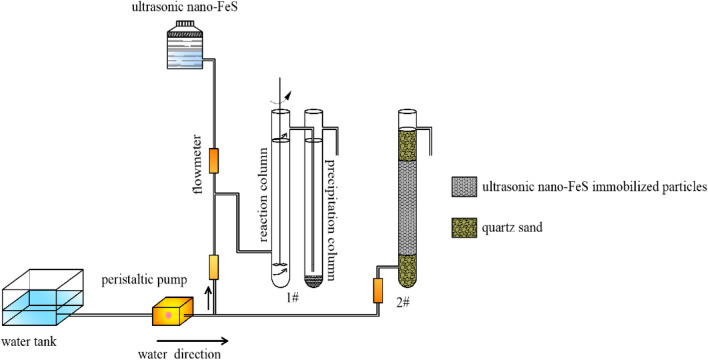
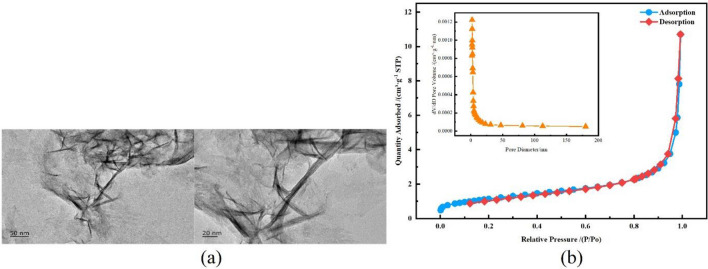
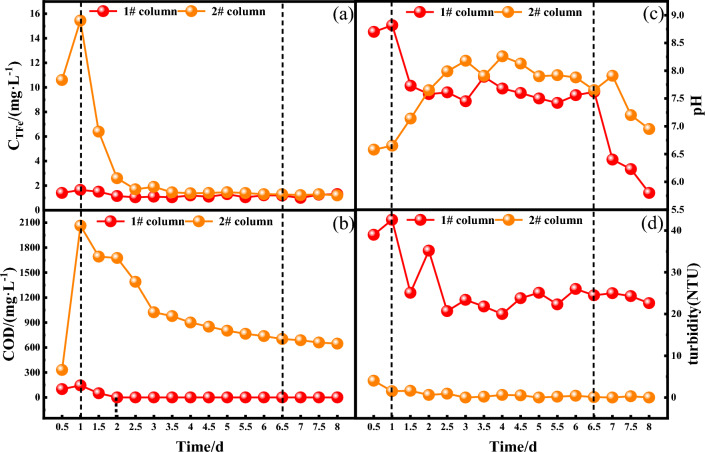
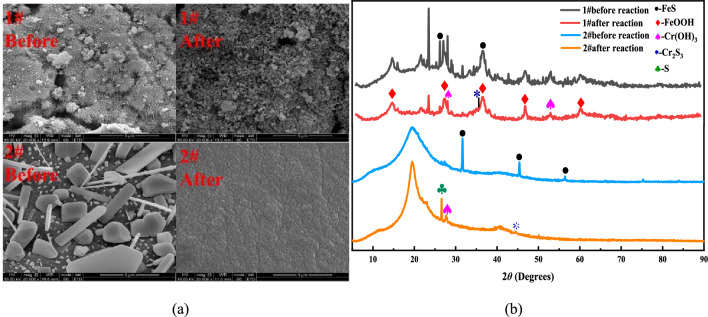
Nano-FeS is prone to agglomeration in the treatment of chromium-containing wastewater, and ultrasonic precipitation was used to synthesize nano-FeS to increase its dispersion. The optimization of the preparation method was carried out by single factor method (reaction temperature, Fe/S molar ratio and FeSO dropping flow rate) and response surface methodology. Dynamic experiments were constructed to investigate the long-term remediation effect and water column changes of nano-FeS and its solid particles. The changes of the remediation materials before and after the reaction were observed by SEM, and the mechanism of the remediation of chromium-containing wastewater by nano-FeS prepared by ultrasonication was revealed by XRD. The results showed that the reaction temperature of 12 °C, Fe/S molar ratio of 3.5 and FeSO dropping flow rate of 0.5 mL/s were the best parameters for the preparation of nano-FeS. The nano-FeS has efficient dispersion and well-defined mesoporous structure in the form of needles and whiskers of 40-80 nm. The dynamic experiments showed that the average removal of Cr(VI) and total chromium by nano-FeS and its immobilized particles were 94.97% and 63.51%, 94.93% and 45.76%, respectively. Fe and S ionized by the FeS nanoparticles rapidly reduced Cr(VI) to Cr(III). Part of S may reduce Fe to Fe, forming a small iron cycle that gradually decreases with the ion concentration. Cr(III) and Fe form Cr(OH) and FeOOH, respectively, with the change of aqueous environment. Another part of S reacts with Cr(III) to form CrS precipitate or is oxidized to singlet sulfur. The FeS nanoparticles change from short rod-shaped to spherical shape. Compared with the conventional chemical precipitation method, the method used in this study is simple, low cost, small particle size and high removal rate per unit.
纳米硫化亚铁在处理含铬废水时容易发生团聚,采用超声沉淀法合成纳米硫化亚铁以提高其分散性。通过单因素法(反应温度、铁/硫摩尔比和硫酸亚铁滴加流速)和响应面法对制备方法进行优化。构建动态实验以研究纳米硫化亚铁及其固体颗粒的长期修复效果和水柱变化。通过扫描电子显微镜观察反应前后修复材料的变化,并用X射线衍射揭示超声法制备的纳米硫化亚铁处理含铬废水的修复机理。结果表明,反应温度12℃、铁/硫摩尔比3.5、硫酸亚铁滴加流速0.5 mL/s是制备纳米硫化亚铁的最佳参数。纳米硫化亚铁具有高效的分散性,呈40 - 80 nm的针状和晶须状,具有明确的介孔结构。动态实验表明,纳米硫化亚铁及其固定化颗粒对六价铬和总铬的平均去除率分别为94.97%和63.51%、94.93%和45.76%。硫化亚铁纳米颗粒电离出的铁和硫离子迅速将六价铬还原为三价铬。部分硫可能将铁还原为亚铁,形成一个随离子浓度逐渐降低的小铁循环。随着水环境的变化,三价铬和铁分别形成氢氧化铬和氢氧化铁。另一部分硫与三价铬反应形成硫化铬沉淀或被氧化为单质硫。硫化亚铁纳米颗粒由短棒状变为球形。与传统化学沉淀法相比,本研究采用的方法简单、成本低、粒径小且单位去除率高。