Puglisi Nilo, Favez Nicolas, Rattaz Valentine, Epiney Manuella, Razurel Chantal, Tissot Hervé
Faculty of Psychology and Educational Sciences, University of Geneva, Geneva, Switzerland.
Center for Family Studies, Department of Psychiatry, Lausanne University Hospital and University of Lausanne, Lausanne, Switzerland.
Front Psychol. 2023 Dec 19;14:1299041. doi: 10.3389/fpsyg.2023.1299041. eCollection 2023.
Studies have shown that infants' emotion regulation capacities are closely linked to the quality of parent-infant interactions. However, these links have been mostly studied in mother-infant dyads and less is known about how the quality of father-infant interactions contributes to the development of emotion regulation during infancy. In this study, we aimed to investigate the links between interactive synchrony (i.e., an index of the quality of parent-infant coordination of interactive behaviors) and infants' vagal tone (i.e., a physiological index of emotion regulation). To understand the respective contributions of both parents, as well as the interrelations between the functioning of both dyads within a family, we observed mothers and fathers from 84 families interacting with their infants.
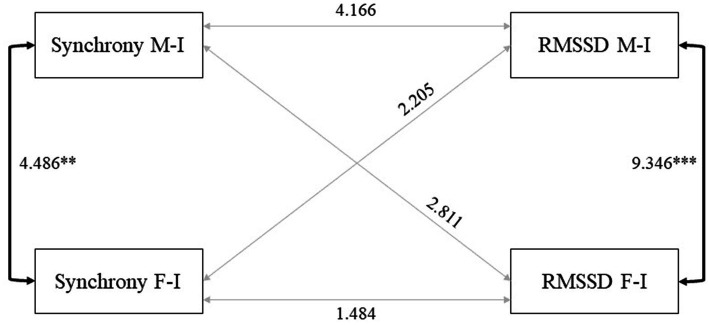
Synchrony was assessed by using the CARE-Index; infants' vagal tone was derived from the analysis of infants' electrocardiograms recorded during the interactions. Moreover, to take the play's order into account, we counterbalanced the procedure, so that approximately half of the mothers played first. We specified a first structural equation modeling (SEM) model to investigate the associations between interactive synchrony and the infants' root mean square of successive differences (RMSSD), an index of vagal regulation, in the two successive parts of the play. We conducted a multigroup analysis in a second SEM model to investigate the associations of the first SEM model in two groups based on the order of interaction.
The results of the SEM models showed that greater synchrony was related to greater infant RMSSD within mother-infant dyads and across one dyad to the other dyad in the full sample and in the group of fathers who interacted first with the infants. The associations between synchrony and infant vagal tone within father-infant dyads never appeared to be significant, nor did any associations within each dyad and across dyads when mothers interacted first.
This study highlights that the links between interactions and infants' vagal tone are sensitive to family members' interdependencies and some conditions (the order of interaction).
研究表明,婴儿的情绪调节能力与亲子互动质量密切相关。然而,这些联系大多是在母婴二元组中进行研究的,对于父亲与婴儿互动的质量如何促进婴儿期情绪调节的发展,我们了解得较少。在本研究中,我们旨在探讨互动同步性(即亲子互动行为协调质量的一个指标)与婴儿迷走神经张力(即情绪调节的生理指标)之间的联系。为了了解父母双方各自的贡献,以及家庭中两个二元组功能之间的相互关系,我们观察了84个家庭中的母亲和父亲与他们的婴儿互动的情况。
同步性通过使用CARE指数进行评估;婴儿的迷走神经张力来自于对互动期间记录的婴儿心电图的分析。此外,为了考虑游戏顺序,我们对程序进行了平衡,以便大约一半的母亲先进行游戏。我们指定了第一个结构方程模型(SEM)来研究在游戏的两个连续部分中,互动同步性与婴儿连续差异均方根(RMSSD,迷走神经调节的一个指标)之间的关联。我们在第二个SEM模型中进行了多组分析,以根据互动顺序在两组中研究第一个SEM模型的关联。
SEM模型的结果表明,在母婴二元组中,更高的同步性与更高的婴儿RMSSD相关,并且在整个样本以及首先与婴儿互动的父亲组中,从一个二元组到另一个二元组也是如此。在父子二元组中,同步性与婴儿迷走神经张力之间的关联似乎从未显著,当母亲首先互动时,每个二元组内以及二元组之间的任何关联也不显著。
本研究强调,互动与婴儿迷走神经张力之间的联系对家庭成员的相互依赖和一些条件(互动顺序)很敏感。