Williams Alex H, Kunz Erin, Kornblith Simon, Linderman Scott W
Statistics Department, Stanford University.
Electrical Engineering Department, Stanford University.
Adv Neural Inf Process Syst. 2021 Dec;34:4738-4750.
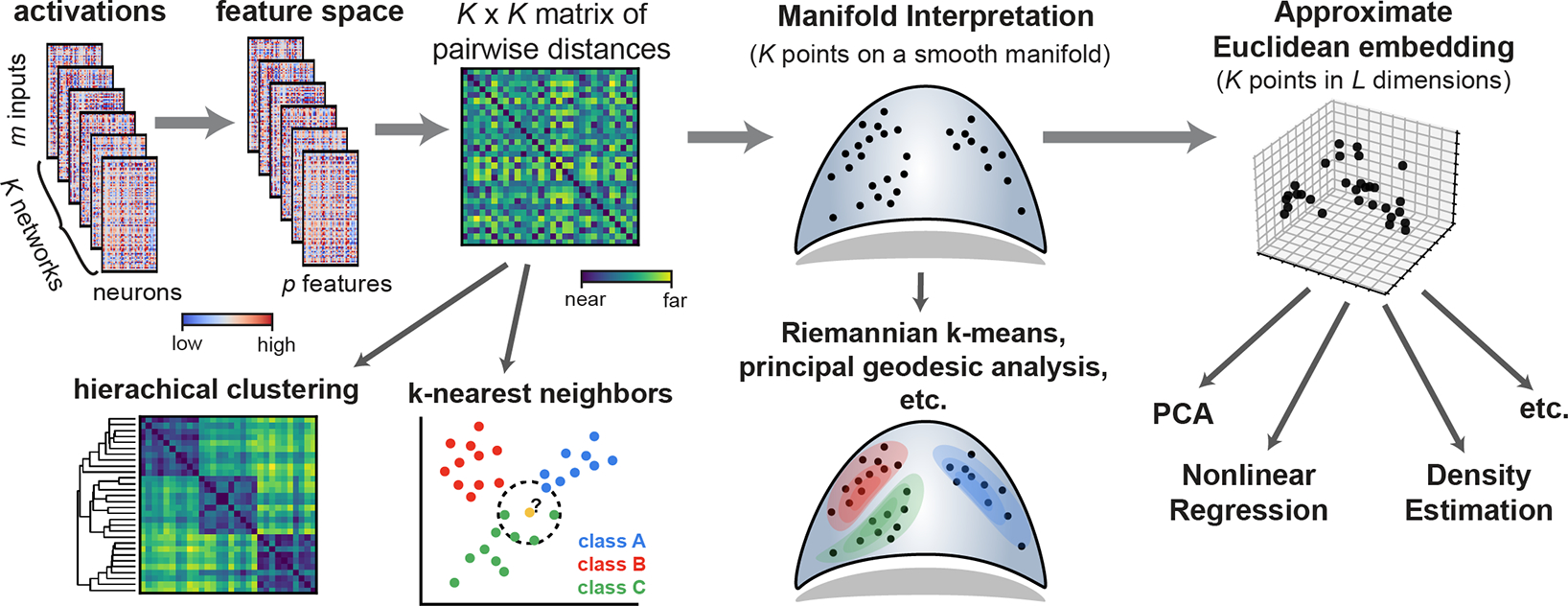
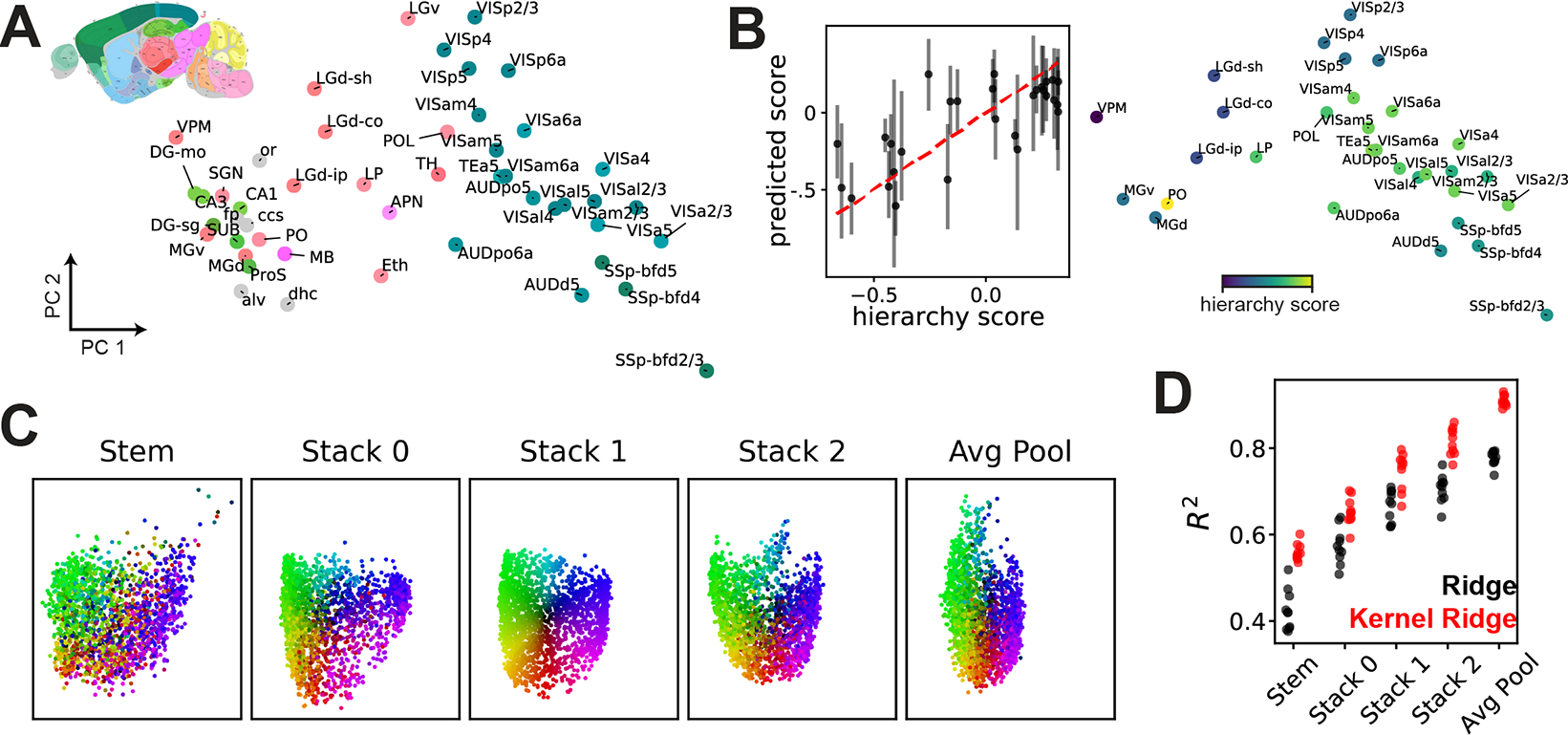
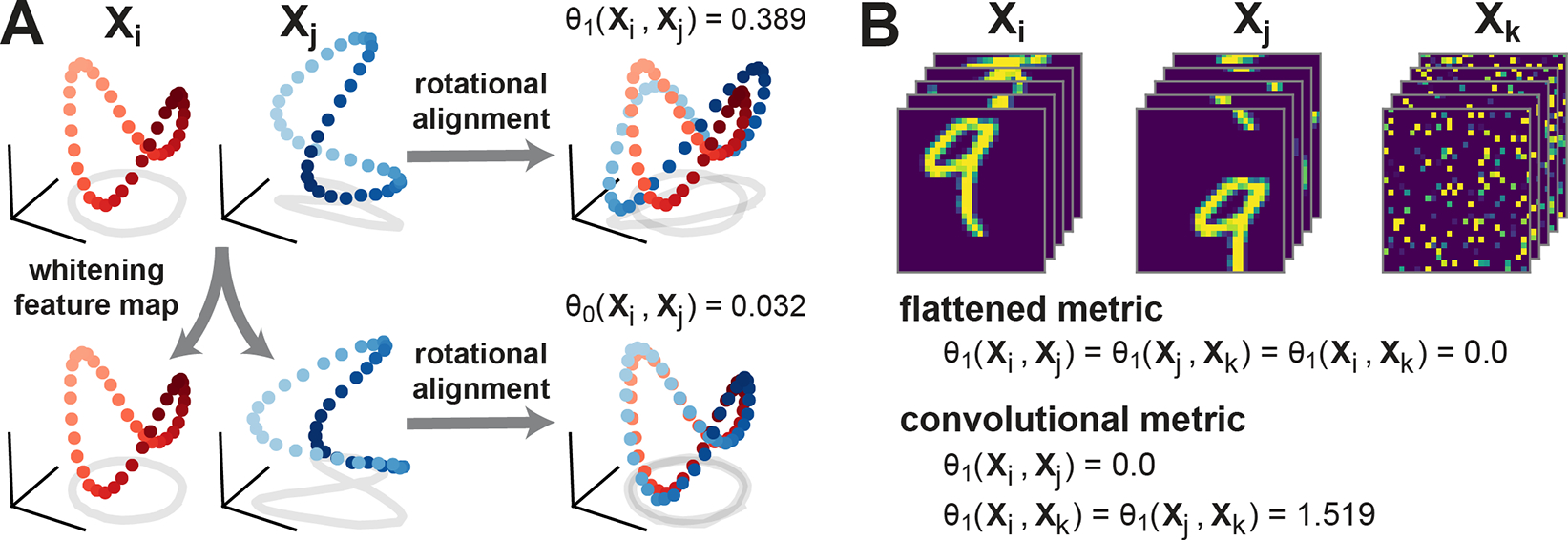
Understanding the operation of biological and artificial networks remains a difficult and important challenge. To identify general principles, researchers are increasingly interested in surveying large collections of networks that are trained on, or biologically adapted to, similar tasks. A standardized set of analysis tools is now needed to identify how network-level covariates-such as architecture, anatomical brain region, and model organism-impact neural representations (hidden layer activations). Here, we provide a rigorous foundation for these analyses by defining a broad family of metric spaces that quantify representational dissimilarity. Using this framework, we modify existing representational similarity measures based on canonical correlation analysis and centered kernel alignment to satisfy the triangle inequality, formulate a novel metric that respects the inductive biases in convolutional layers, and identify approximate Euclidean embeddings that enable network representations to be incorporated into essentially any off-the-shelf machine learning method. We demonstrate these methods on large-scale datasets from biology (Allen Institute Brain Observatory) and deep learning (NAS-Bench-101). In doing so, we identify relationships between neural representations that are interpretable in terms of anatomical features and model performance.
理解生物网络和人工网络的运行仍然是一项艰巨而重要的挑战。为了确定通用原则,研究人员越来越有兴趣对大量经过训练或在生物学上适应类似任务的网络进行调查。现在需要一套标准化的分析工具来确定网络层面的协变量(如架构、大脑解剖区域和模式生物)如何影响神经表征(隐藏层激活)。在这里,我们通过定义一个广泛的度量空间族来为这些分析提供一个严格的基础,该度量空间族量化了表征差异。使用这个框架,我们基于典型相关分析和中心核对齐修改现有的表征相似性度量,以满足三角不等式,制定一种尊重卷积层归纳偏差的新度量,并识别近似欧几里得嵌入,使网络表征能够纳入基本上任何现成的机器学习方法。我们在来自生物学(艾伦脑科学研究所脑图谱)和深度学习(NAS-Bench-101)的大规模数据集上展示了这些方法。通过这样做,我们确定了神经表征之间在解剖学特征和模型性能方面可解释的关系。