• 文献检索
  • 文档翻译
  • 深度研究
  • 学术资讯
  • Suppr Zotero 插件Zotero 插件
  • 邀请有礼
  • 套餐&价格
  • 历史记录
应用&插件
Suppr Zotero 插件Zotero 插件浏览器插件Mac 客户端Windows 客户端微信小程序
定价
高级版会员购买积分包购买API积分包
服务
文献检索文档翻译深度研究API 文档MCP 服务
关于我们
关于 Suppr公司介绍联系我们用户协议隐私条款
关注我们

Suppr 超能文献

核心技术专利:CN118964589B侵权必究
粤ICP备2023148730 号-1Suppr @ 2026

文献检索

告别复杂PubMed语法,用中文像聊天一样搜索,搜遍4000万医学文献。AI智能推荐,让科研检索更轻松。

立即免费搜索

文件翻译

保留排版,准确专业,支持PDF/Word/PPT等文件格式,支持 12+语言互译。

免费翻译文档

深度研究

AI帮你快速写综述,25分钟生成高质量综述,智能提取关键信息,辅助科研写作。

立即免费体验

三维建模与打印在儿科手术患者及家属教育中的应用:一项系统综述。

The utility of three-dimensional modeling and printing in pediatric surgical patient and family education: a systematic review.

作者信息

Yang Angela, Panchendrabose Kapilan, Leong Cameron, Raza Syed Shuja, Joharifard Shahrzad

机构信息

Office of Pediatric Surgical Evaluation and Innovation, British Columbia Children's Hospital, University of British Columbia, Vancouver, BC, Canada.

Max Rady College of Medicine, University of Manitoba, Winnipeg, MB, Canada.

出版信息

3D Print Med. 2024 Jan 3;10(1):1. doi: 10.1186/s41205-023-00198-4.

DOI:10.1186/s41205-023-00198-4
PMID:38170262
原文链接:https://pmc.ncbi.nlm.nih.gov/articles/PMC10762981/
Abstract

BACKGROUND

Three-dimensional (3D) modeling and printing are increasingly being used in surgical settings. This technology has several applications including pre-operative surgical planning, inter-team communication, and patient education and counseling. The majority of research on 3D technology has focused on adult populations, where it has been found to be a useful tool for educating patients across various surgical specialties. There is a dearth, however, of research on the utility of 3D modeling and printing for patient and family education in pediatric populations. Our objective was to systematically review the current literature on how this modality is being utilized in pediatric surgical settings for patient and family education and counselling.

METHODS

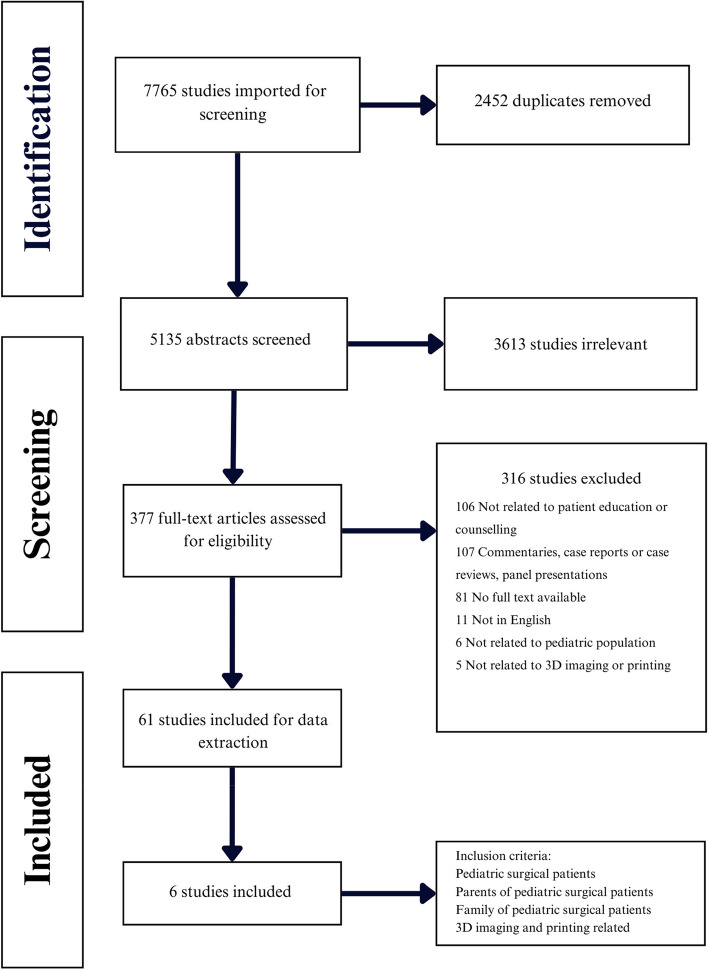
We conducted a systematic review in accordance with PRISMA and CASP guidelines. The MEDLINE, CINAHL, Embase, and Web of Science databases were searched from inception to October 21, 2023, with no restrictions on language or geographical location. Citation chaining was used to ensure relevant papers were included. Articles were doubly screened and data was extracted independently by two authors. In the case of disagreement, a third author was consulted. Any articles pertaining to 3D modeling and printing in pediatric surgical settings for patient and family education and counseling were included.

RESULTS

Six articles met inclusion criteria and were used for qualitative analysis. Two involved questionnaires given to parents of children to assess their understanding of relevant anatomy, surgical procedure, and risks after viewing conventional CT images and again after viewing a 3D-printed model. One involved a quasi-experimental study to assess young patients' pre-operative surgical understanding and anxiety after undergoing conventional teaching as compared to after viewing a 3D storybook. One involved questionnaires given to parents of children in control and study groups to assess the usefulness of 3D printed models compared to conventional CT images in their understanding of relevant anatomy and the surgical procedure. Another study looked at the usefulness of 3D printed models compared to 2D and 3D CT images in providing caregiver understanding during the pre-operative consent process. The last article involved studying the impact of using 3D printing to help patients understand their disease and participate in decision-making processes during surgical consultations. In all six studies, utilizing 3D technology improved transfer of information between surgical team members and their patients and families.

CONCLUSION

Our systematic review suggests that 3D modeling and printing is a useful tool for patient and family education and counselling in pediatric surgical populations. Given the very small number of published studies, further research is needed to better define the utility of this technology in pediatric settings.
https://cdn.ncbi.nlm.nih.gov/pmc/blobs/519a/10762981/47f0c78e0322/41205_2023_198_Fig1_HTML.jpg
摘要

背景

三维(3D)建模和打印在手术场景中的应用越来越广泛。这项技术有多种用途,包括术前手术规划、团队间沟通以及患者教育与咨询。大多数关于3D技术的研究都集中在成人人群,发现它是跨多个外科专业教育患者的有用工具。然而,关于3D建模和打印在儿科人群患者及家庭教育中的效用研究却很匮乏。我们的目的是系统回顾当前关于这种方式如何在儿科手术场景中用于患者及家庭教育与咨询的文献。

方法

我们按照PRISMA和CASP指南进行了系统回顾。检索了MEDLINE、CINAHL、Embase和Web of Science数据库,时间跨度从建库至2023年10月21日,对语言和地理位置均无限制。采用引文链确保纳入相关论文。文章进行了两轮筛选,数据由两位作者独立提取。如有分歧,则咨询第三位作者。纳入所有与儿科手术场景中用于患者及家庭教育与咨询的3D建模和打印相关的文章。

结果

六篇文章符合纳入标准并用于定性分析。两篇文章涉及向儿童家长发放问卷,以评估他们在观看传统CT图像后以及观看3D打印模型后对相关解剖结构、手术过程和风险的理解。一篇文章涉及一项准实验研究,以评估与观看3D故事书后相比,年轻患者在接受传统教学后术前对手术的理解和焦虑程度。一篇文章涉及向对照组和研究组儿童的家长发放问卷,以评估3D打印模型与传统CT图像相比在他们理解相关解剖结构和手术过程方面的有用性。另一项研究探讨了3D打印模型与二维和三维CT图像相比在术前同意过程中帮助护理人员理解方面的有用性。最后一篇文章涉及研究使用3D打印帮助患者理解其疾病并参与手术咨询期间决策过程的影响。在所有六项研究中,利用3D技术改善了手术团队成员与其患者及家属之间的信息传递。

结论

我们的系统回顾表明,3D建模和打印是儿科手术人群患者及家庭教育与咨询的有用工具。鉴于已发表的研究数量非常少,需要进一步研究以更好地确定该技术在儿科环境中的效用。

相似文献

1
The utility of three-dimensional modeling and printing in pediatric surgical patient and family education: a systematic review.三维建模与打印在儿科手术患者及家属教育中的应用:一项系统综述。
3D Print Med. 2024 Jan 3;10(1):1. doi: 10.1186/s41205-023-00198-4.
2
Folic acid supplementation and malaria susceptibility and severity among people taking antifolate antimalarial drugs in endemic areas.在流行地区,服用抗叶酸抗疟药物的人群中,叶酸补充剂与疟疾易感性和严重程度的关系。
Cochrane Database Syst Rev. 2022 Feb 1;2(2022):CD014217. doi: 10.1002/14651858.CD014217.
3
Beyond the black stump: rapid reviews of health research issues affecting regional, rural and remote Australia.超越黑木树:影响澳大利亚地区、农村和偏远地区的健康研究问题的快速综述。
Med J Aust. 2020 Dec;213 Suppl 11:S3-S32.e1. doi: 10.5694/mja2.50881.
4
Utility of Three-Dimensional Printing for Preoperative Assessment of Children with Extra-Cranial Solid Tumors: A Systematic Review.三维打印在儿童颅外实体肿瘤术前评估中的应用:一项系统综述
Pediatr Rep. 2022 Jan 11;14(1):32-39. doi: 10.3390/pediatric14010006.
5
Student and educator experiences of maternal-child simulation-based learning: a systematic review of qualitative evidence protocol.基于母婴模拟学习的学生和教育工作者体验:定性证据协议的系统评价
JBI Database System Rev Implement Rep. 2015 Jan;13(1):14-26. doi: 10.11124/jbisrir-2015-1694.
6
Current and future role of three-dimensional modelling technology in rectal cancer surgery: A systematic review.三维建模技术在直肠癌手术中的当前及未来作用:一项系统综述。
World J Gastrointest Surg. 2021 Dec 27;13(12):1754-1769. doi: 10.4240/wjgs.v13.i12.1754.
7
Impact of Three-dimensional Printing in Urology: State of the Art and Future Perspectives. A Systematic Review by ESUT-YAUWP Group.三维打印技术在泌尿外科的应用:现状和未来展望。ESUT-YAUWP 小组的系统综述。
Eur Urol. 2019 Aug;76(2):209-221. doi: 10.1016/j.eururo.2019.04.044. Epub 2019 May 18.
8
3D printing as surgical planning and training in pediatric endoscopic skull base surgery - Systematic review and practical example.3D打印在小儿内镜颅底手术中的手术规划与培训——系统评价及实例
Int J Pediatr Otorhinolaryngol. 2023 May;168:111543. doi: 10.1016/j.ijporl.2023.111543. Epub 2023 Apr 5.
9
Low-Cost Desktop-Based Three-Dimensional-Printed Patient-Specific Craniofacial Models in Surgical Counseling, Consent Taking, and Education of Parent of Craniosynostosis Patients: A Comparison With Conventional Visual Explanation Modalities.低成本桌面式三维打印颅面部特定患者模型在手术咨询、同意书签署及颅缝早闭症患者家长教育中的应用:与传统视觉解释方式的比较
J Craniofac Surg. 2019 Sep;30(6):1652-1656. doi: 10.1097/SCS.0000000000005401.
10
Three-dimensional printing in congenital heart disease: A systematic review.先天性心脏病中的三维打印:一项系统综述。
J Med Radiat Sci. 2018 Sep;65(3):226-236. doi: 10.1002/jmrs.268. Epub 2018 Feb 17.

引用本文的文献

1
Three-Dimensional-Printed Models and Shared Decision-Making: A Cluster Randomized Clinical Trial.三维打印模型与共同决策:一项整群随机临床试验
JAMA Netw Open. 2025 Jun 2;8(6):e2513187. doi: 10.1001/jamanetworkopen.2025.13187.
2
Pixels to precision: Neuroradiology's leap into 3D printing for personalized medicine.从像素到精准:神经放射学迈向3D打印用于个性化医疗的飞跃。
J Clin Imaging Sci. 2024 Dec 17;14:49. doi: 10.25259/JCIS_119_2024. eCollection 2024.

本文引用的文献

1
Application of 3D printing technology for pre-operative evaluation, education and informed consent in pediatric retroperitoneal tumors.3D 打印技术在小儿腹膜后肿瘤术前评估、教育及知情同意中的应用。
Sci Rep. 2023 Jan 30;13(1):1671. doi: 10.1038/s41598-023-28423-4.
2
3D printing in spine care: A review of current applications.脊柱护理中的3D打印:当前应用综述
J Clin Orthop Trauma. 2022 Oct 20;35:102044. doi: 10.1016/j.jcot.2022.102044. eCollection 2022 Dec.
3
A workflow to generate patient-specific three-dimensional augmented reality models from medical imaging data and example applications in urologic oncology.
一种从医学影像数据生成患者特异性三维增强现实模型的工作流程及在泌尿外科肿瘤学中的示例应用。
3D Print Med. 2021 Oct 28;7(1):34. doi: 10.1186/s41205-021-00125-5.
4
A three-dimensional printed model in preoperative consent for ventricular septal defect repair.术前同意书里的三维打印模型在室间隔缺损修复中的应用。
J Cardiothorac Surg. 2021 Aug 11;16(1):229. doi: 10.1186/s13019-021-01604-w.
5
Low-Cost Desktop-Based Three-Dimensional-Printed Patient-Specific Craniofacial Models in Surgical Counseling, Consent Taking, and Education of Parent of Craniosynostosis Patients: A Comparison With Conventional Visual Explanation Modalities.低成本桌面式三维打印颅面部特定患者模型在手术咨询、同意书签署及颅缝早闭症患者家长教育中的应用:与传统视觉解释方式的比较
J Craniofac Surg. 2019 Sep;30(6):1652-1656. doi: 10.1097/SCS.0000000000005401.
6
The clinical use of 3D printing in surgery.3D打印技术在外科手术中的临床应用。
Updates Surg. 2018 Sep;70(3):381-388. doi: 10.1007/s13304-018-0586-5. Epub 2018 Aug 30.
7
The impact of using three-dimensional printed liver models for patient education.使用三维打印肝脏模型用于患者教育的影响。
J Int Med Res. 2018 Apr;46(4):1570-1578. doi: 10.1177/0300060518755267. Epub 2018 Feb 13.
8
3-D Storybook: Effects on Surgical Knowledge and Anxiety Among Four- to Six-Year-Old Surgical Patients.3D故事书:对4至6岁外科手术患儿手术知识及焦虑情绪的影响
AORN J. 2015 Jul;102(1):62.e1-10. doi: 10.1016/j.aorn.2015.05.018.
9
Beyond consent--improving understanding in surgical patients.超越同意——增进手术患者的理解。
Am J Surg. 2012 Jan;203(1):112-20. doi: 10.1016/j.amjsurg.2010.12.010. Epub 2011 Jun 8.
10
Volumetric assessment of results of treatment of vascular malformations of the head and neck regions treated with a minimally invasive surgical technique after embolization procedure.栓塞术后采用微创外科技术治疗头颈部血管畸形的治疗结果的容积评估。
J Craniofac Surg. 2009 Mar;20(2):402-5. doi: 10.1097/SCS.0b013e31819b9400.