Department of Neurology, Hope Center for Neurological Disorders, Knight Alzheimer's Disease Research Center, Washington University School of Medicine, St. Louis, MO, 63110, USA.
Exp Mol Med. 2024 Feb;56(1):86-94. doi: 10.1038/s12276-023-01146-2. Epub 2024 Jan 4.
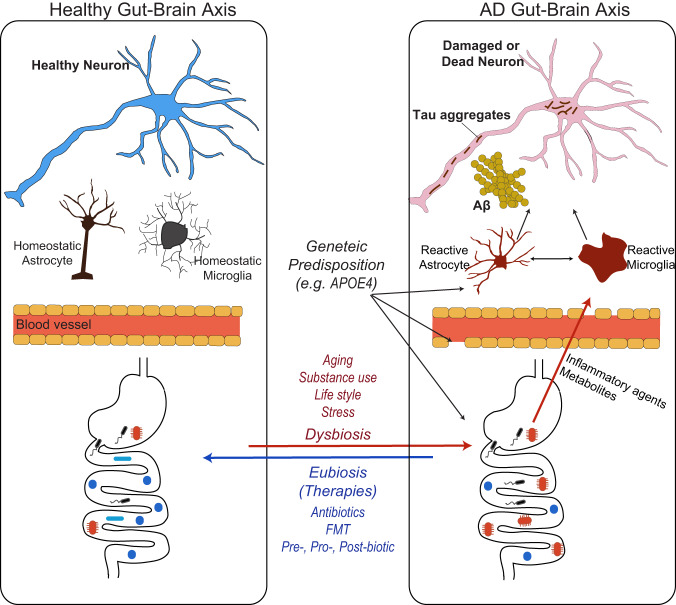
Alzheimer's disease (AD) is a fatal progressive neurodegenerative disease. Despite tremendous research efforts to understand this complex disease, the exact pathophysiology of the disease is not completely clear. Recently, anti-Aβ antibodies have been shown to remove amyloid from the brain and slow the clinical progression of mild dementia by ~30%. However, exploring alternative strategies is crucial to understanding and developing more effective therapeutic interventions. In recent years, the microbiota-gut-brain axis has received significant attention in the AD field. Numerous studies have suggested that alterations in the gut microbiota composition are associated with the progression of AD, and several underlying mechanisms have been proposed. However, studies in this area are still in their infancy, and many aspects of this field are just beginning to be explored and understood. Gaining a deeper understanding of the intricate interactions and signaling pathways involved in the microbiota-AD interaction is crucial for optimizing therapeutic strategies targeting gut microbiota to positively impact AD. In this review, we aim to summarize the current understanding of the microbiota-gut-brain axis in AD. We will discuss the existing evidence regarding the role of gut microbiota in AD pathogenesis, suggested underlying mechanisms, biological factors influencing the microbiome-gut-brain axis in AD, and remaining questions in the field. Last, we will discuss potential therapeutic approaches to recondition the community of gut microbiota to alleviate disease progression. An ongoing exploration of the gut-brain axis and the development of microbiota-based therapies hold the potential for advancing AD management in the future.
阿尔茨海默病(AD)是一种致命的进行性神经退行性疾病。尽管为了理解这种复杂的疾病做出了巨大的研究努力,但该疾病的确切病理生理学仍不完全清楚。最近,抗 Aβ 抗体已被证明可以从大脑中清除淀粉样蛋白,并将轻度痴呆的临床进展减缓约 30%。然而,探索替代策略对于理解和开发更有效的治疗干预措施至关重要。近年来,微生物群-肠道-大脑轴在 AD 领域受到了极大的关注。许多研究表明,肠道微生物群组成的改变与 AD 的进展有关,并且提出了几种潜在的机制。然而,该领域的研究仍处于起步阶段,该领域的许多方面才刚刚开始探索和理解。深入了解微生物群-AD 相互作用中涉及的复杂相互作用和信号通路对于优化针对肠道微生物群的治疗策略以积极影响 AD 至关重要。在这篇综述中,我们旨在总结 AD 中微生物群-肠道-大脑轴的现有认识。我们将讨论关于肠道微生物群在 AD 发病机制中的作用、提出的潜在机制、影响 AD 中微生物组-肠道-大脑轴的生物学因素以及该领域的遗留问题的现有证据。最后,我们将讨论恢复肠道微生物群群落以减轻疾病进展的潜在治疗方法。对肠道-大脑轴的持续探索和基于微生物组的治疗方法的开发有可能在未来推进 AD 的管理。