Department of Neurology, University of Virginia Comprehensive Cancer Center, University of Virginia Health System, Charlottesville, VA, 22903, USA.
Medical Scientist Training Program, School of Medicine, University of Virginia, Charlottesville, VA, 22908, USA.
J Neurooncol. 2024 Jan;166(2):213-229. doi: 10.1007/s11060-023-04536-8. Epub 2024 Jan 5.
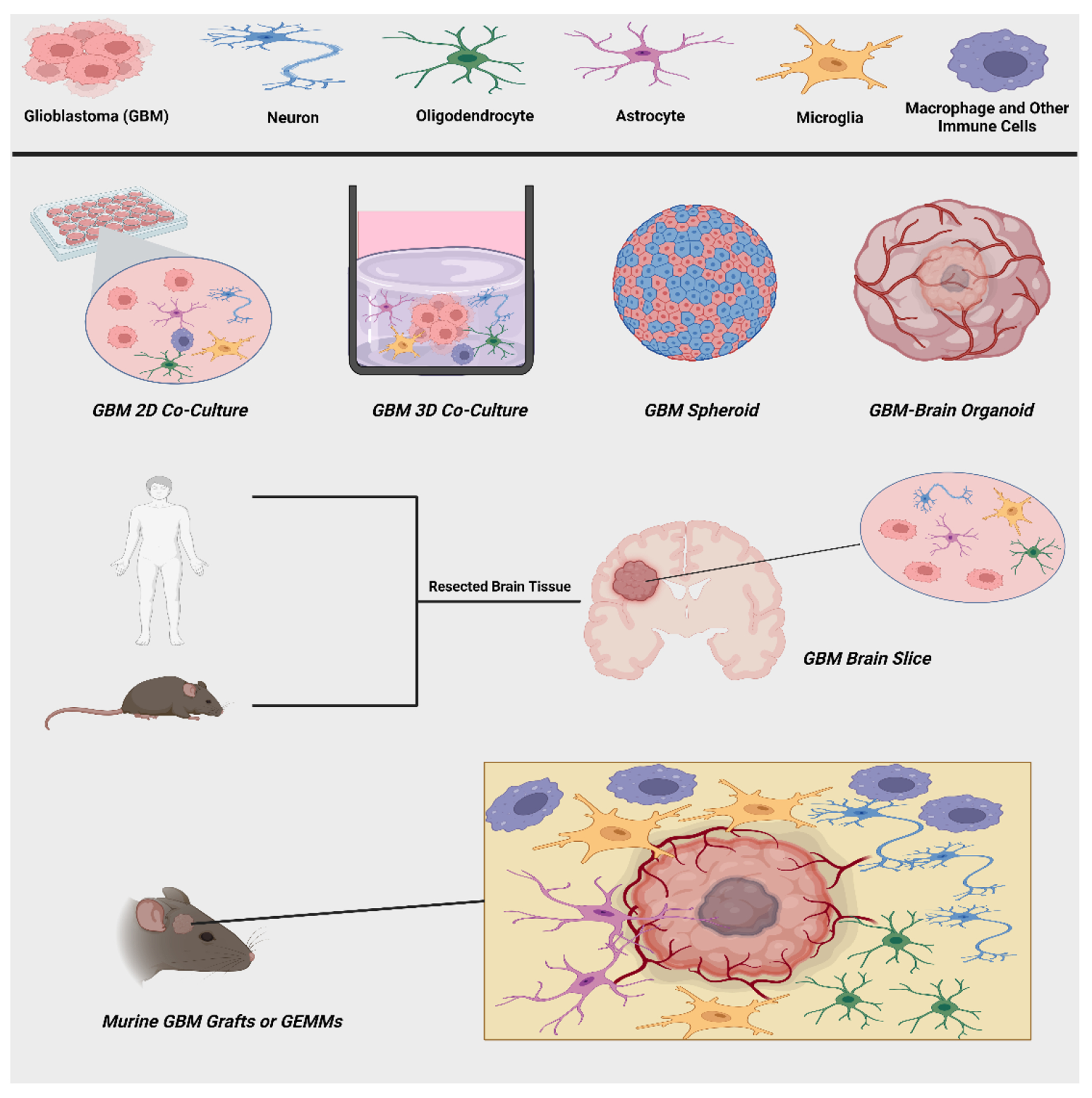
Glioblastoma (GBM) is a common and devastating primary brain tumor, with median survival of 16-18 months after diagnosis in the setting of substantial resistance to standard-of-care and inevitable tumor recurrence. Recent work has implicated the brain microenvironment as being critical for GBM proliferation, invasion, and resistance to treatment. GBM does not operate in isolation, with neurons, astrocytes, and multiple immune populations being implicated in GBM tumor progression and invasiveness. The goal of this review article is to provide an overview of the available in vitro, ex vivo, and in vivo experimental models for assessing GBM-brain interactions, as well as discuss each model's relative strengths and limitations. Current in vitro models discussed will include 2D and 3D co-culture platforms with various cells of the brain microenvironment, as well as spheroids, whole organoids, and models of fluid dynamics, such as interstitial flow. An overview of in vitro and ex vivo organotypic GBM brain slices is also provided. Finally, we conclude with a discussion of the various in vivo rodent models of GBM, including xenografts, syngeneic grafts, and genetically-engineered models of GBM.
胶质母细胞瘤(GBM)是一种常见且具有破坏性的原发性脑肿瘤,在标准治疗方法存在显著耐药性且肿瘤不可避免复发的情况下,诊断后的中位生存期为 16-18 个月。最近的研究表明,脑微环境对于 GBM 的增殖、侵袭和对治疗的耐药性至关重要。GBM 并非孤立存在,神经元、星形胶质细胞和多种免疫群体都与 GBM 肿瘤的进展和侵袭有关。本文综述的目的是提供评估 GBM-脑相互作用的体外、离体和体内实验模型的概述,并讨论每种模型的相对优势和局限性。目前讨论的体外模型将包括具有各种脑微环境细胞的 2D 和 3D 共培养平台,以及球体、全器官样和间质流动等流体动力学模型。还概述了体外和离体脑切片的器官型 GBM。最后,我们讨论了 GBM 的各种体内啮齿动物模型,包括异种移植物、同基因移植物和 GBM 的基因工程模型。