Department of Urology, The First Affiliated Hospital of Dalian Medical University, Dalian 116011, Liaoning, China.
Aging (Albany NY). 2024 Jan 4;16(1):246-266. doi: 10.18632/aging.205364.
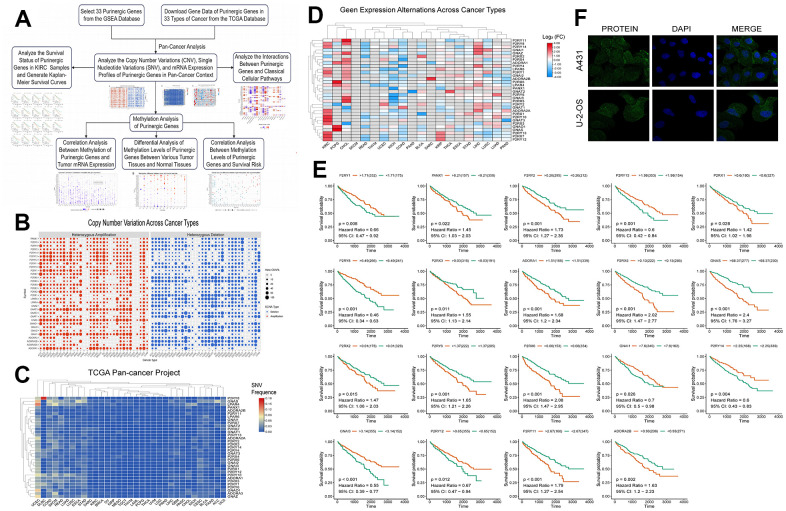
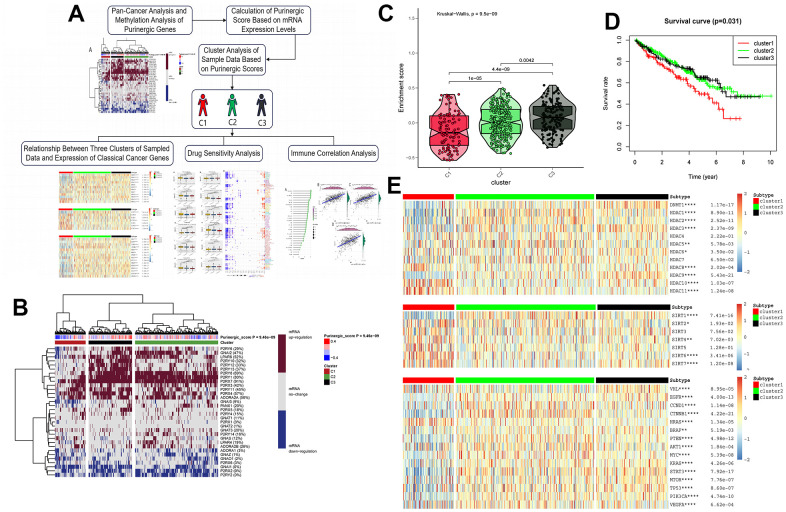
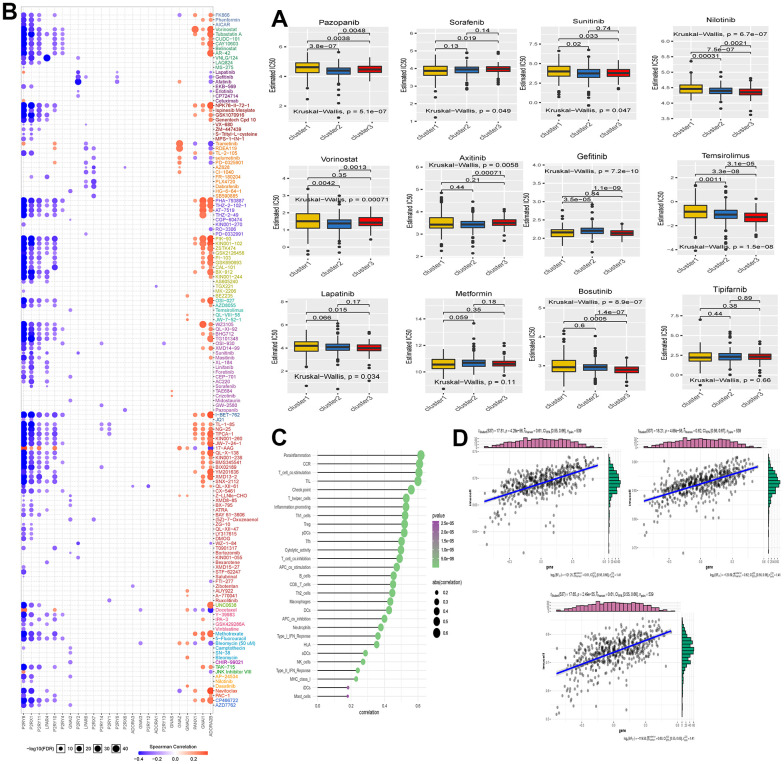
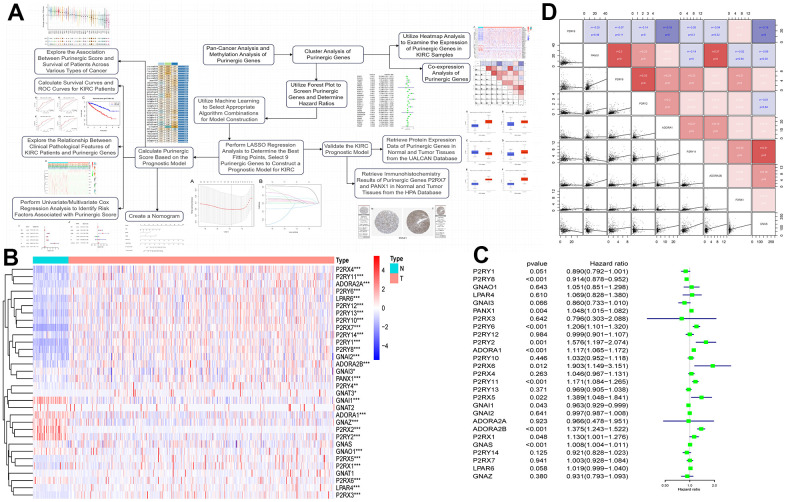
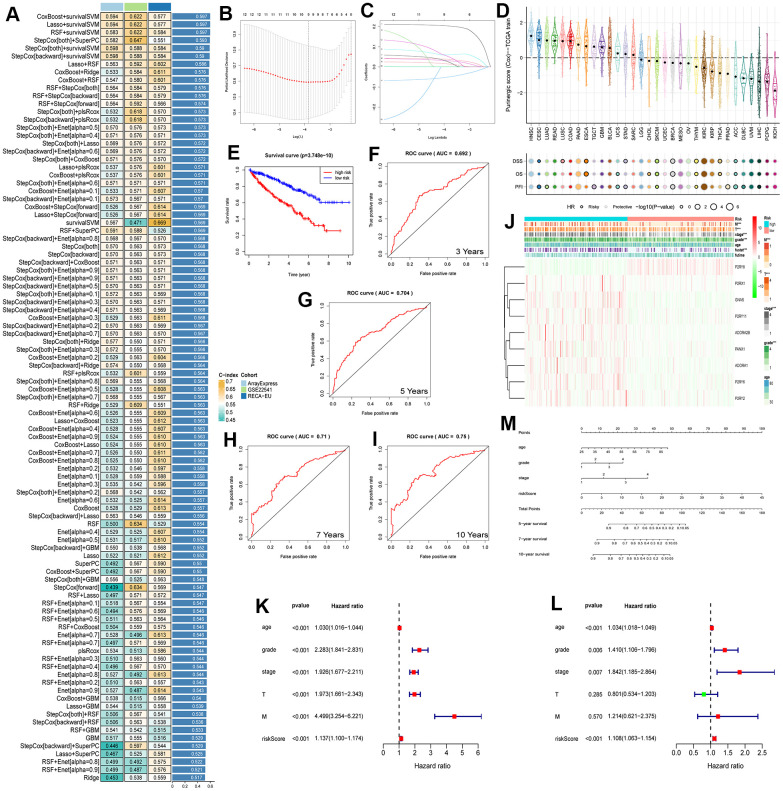
The Purinergic pathway is involved in a variety of important physiological processes in living organisms, and previous studies have shown that aberrant expression of the Purinergic pathway may contribute to the development of a variety of cancers, including kidney renal clear cell carcinoma (KIRC). The aim of this study was to delve into the Purinergic pathway in KIRC and to investigate its potential significance in prognostic assessment and clinical treatment. 33 genes associated with the Purinergic pathway were selected for pan-cancer analysis. Cluster analysis, targeted drug sensitivity analysis and immune cell infiltration analysis were applied to explore the mechanism of Purinergic pathway in KIRC. Using the machine learning process, we found that combining the Lasso+survivalSVM algorithm worked well for predicting survival accuracy in KIRC. We used LASSO regression to pinpoint nine Purinergic genes closely linked to KIRC, using them to create a survival model for KIRC. ROC survival curve was analyzed, and this survival model could effectively predict the survival rate of KIRC patients in the next 5, 7 and 10 years. Further univariate and multivariate Cox regression analyses revealed that age, grading, staging, and risk scores of KIRC patients were significantly associated with their prognostic survival and were identified as independent risk factors for prognosis. The nomogram tool developed through this study can help physicians accurately assess patient prognosis and provide guidance for developing treatment plans. The results of this study may bring new ideas for optimizing the prognostic assessment and therapeutic approaches for KIRC patients.
嘌呤能通路参与生物体的多种重要生理过程,先前的研究表明,嘌呤能通路的异常表达可能导致多种癌症的发生,包括肾透明细胞癌(KIRC)。本研究旨在深入探讨 KIRC 中的嘌呤能通路,并研究其在预后评估和临床治疗中的潜在意义。选择了 33 个与嘌呤能通路相关的基因进行泛癌症分析。通过聚类分析、靶向药物敏感性分析和免疫细胞浸润分析,探讨了嘌呤能通路在 KIRC 中的作用机制。利用机器学习过程,我们发现结合 Lasso+survivalSVM 算法可以很好地预测 KIRC 的生存准确性。我们使用 LASSO 回归筛选出 9 个与 KIRC 密切相关的嘌呤能基因,并用它们构建了 KIRC 的生存模型。进行了 ROC 生存曲线分析,该生存模型能够有效预测 KIRC 患者未来 5、7 和 10 年的生存率。进一步的单因素和多因素 Cox 回归分析表明,KIRC 患者的年龄、分级、分期和风险评分与预后生存显著相关,是预后的独立危险因素。通过本研究开发的列线图工具可以帮助医生准确评估患者的预后,并为制定治疗计划提供指导。本研究的结果可能为优化 KIRC 患者的预后评估和治疗方法带来新的思路。