Climate and Space Sciences and Engineering, University of Michigan, Ann Arbor, Michigan 48109, United States.
Energy Science and Engineering, Stanford University, Stanford, California 94305, United States.
Environ Sci Technol. 2024 Jan 23;58(3):1509-1517. doi: 10.1021/acs.est.3c08095. Epub 2024 Jan 8.
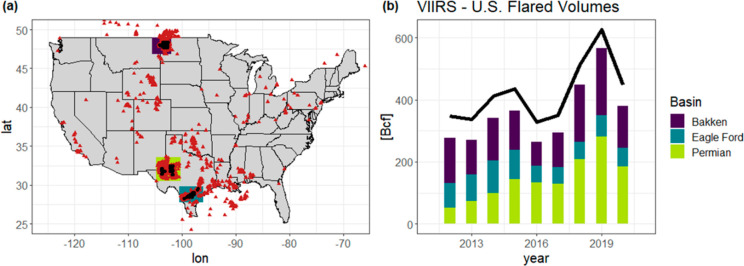
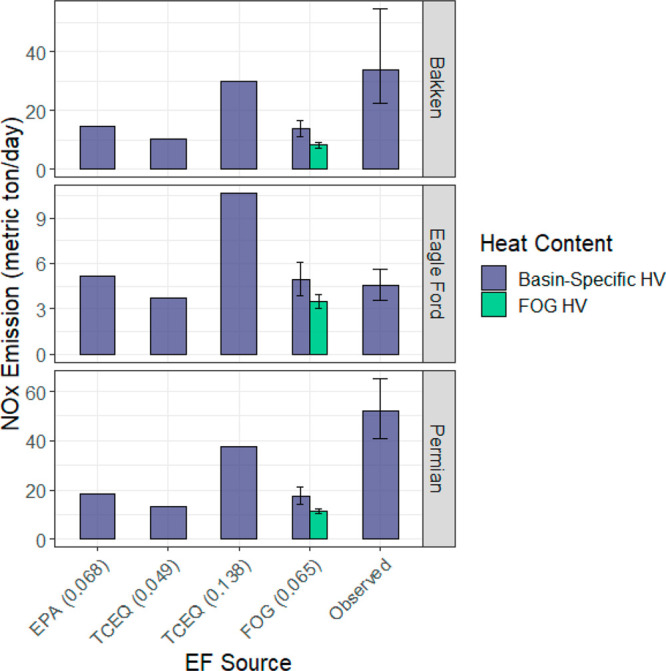
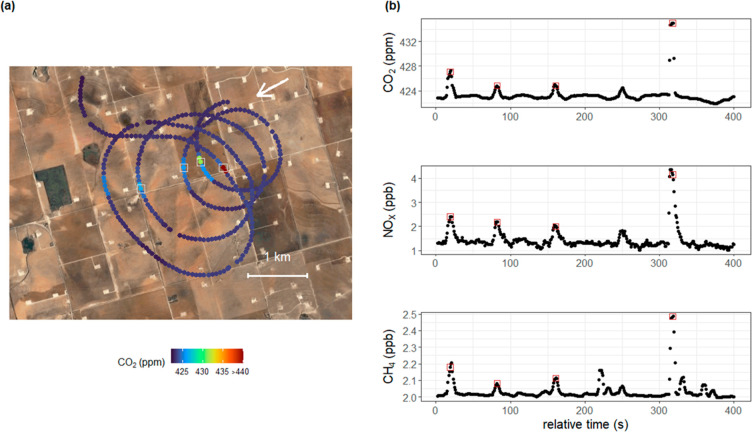
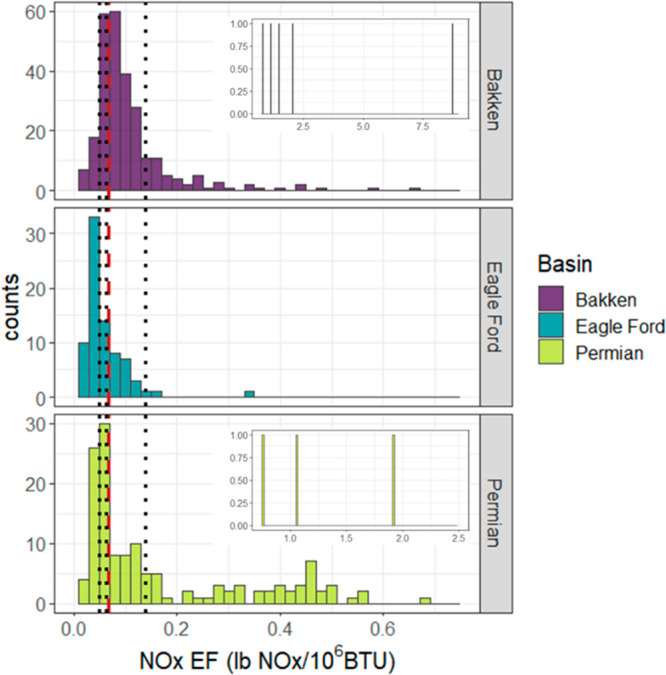
Natural gas flaring is a common practice employed in many United States (U.S.) oil and gas regions to dispose of gas associated with oil production. Combustion of predominantly hydrocarbon gas results in the production of nitrogen oxides (NOx). Here, we present a large field data set of in situ sampling of real world flares, quantifying flaring NOx production in major U.S. oil production regions: the Bakken, Eagle Ford, and Permian. We find that a single emission factor does not capture the range of the observed NOx emission factors within these regions. For all three regions, the median emission factors fall within the range of four emission factors used by the Texas Commission for Environmental Quality. In the Bakken and Permian, the distribution of emission factors exhibits a heavy tail such that basin-average emission factors are 2-3 times larger than the value employed by the U.S. Environmental Protection Agency. Extrapolation to basin scale emissions using auxiliary satellite assessments of flare volumes indicates that NOx emissions from flares are skewed, with 20%-30% of the flares responsible for 80% of basin-wide flaring NOx emissions. Efforts to reduce flaring volume through alternative gas capture methods would have a larger impact on the NOx oil and gas budget than current inventories indicate.
天然气燃烧是美国许多石油和天然气地区常见的处理与石油生产相关的伴生气的方法。主要由碳氢化合物气体燃烧产生氮氧化物 (NOx)。在这里,我们提供了一个大型实地采样数据集,对真实世界的燃烧火炬进行了原位采样,量化了美国主要石油生产地区的燃烧火炬氮氧化物排放:Bakken、Eagle Ford 和 Permian。我们发现,单一排放因子无法捕捉到这些地区观察到的氮氧化物排放因子的范围。对于所有三个地区,中值排放因子都在德克萨斯州环境质量委员会使用的四个排放因子范围内。在 Bakken 和 Permian,排放因子的分布呈重尾分布,使得盆地平均排放因子是美国环境保护署使用值的 2-3 倍。利用辅助卫星评估燃烧火炬体积对盆地规模排放的外推表明,燃烧火炬的氮氧化物排放存在偏倚,20%-30%的燃烧火炬负责 80%的盆地范围内燃烧火炬氮氧化物排放。通过替代天然气捕获方法减少燃烧火炬体积的努力对石油和天然气行业氮氧化物预算的影响将大于当前清单所表明的。