Laboratory of Immunology, Institute for Life and Medical Sciences, Kyoto University, Kyoto 606-8507, Japan.
Laboratory of Regenerative Immunology, International Center for Cell and Gene Therapy, Fujita Health University, Toyoake 470-1192, Japan.
Int Immunol. 2024 Feb 14;36(2):65-73. doi: 10.1093/intimm/dxad051.
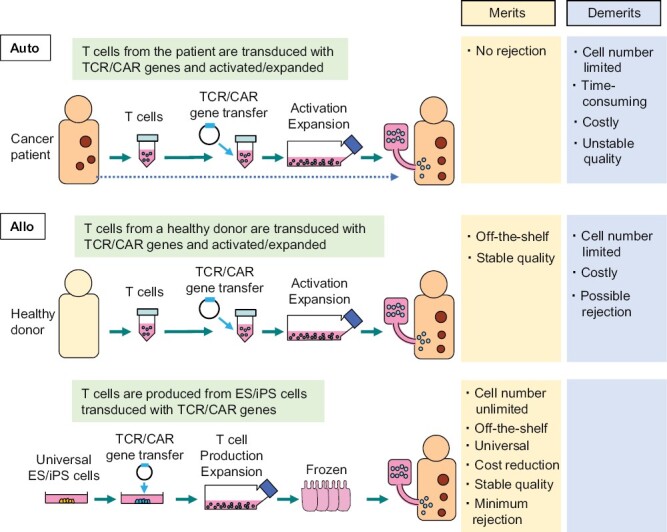
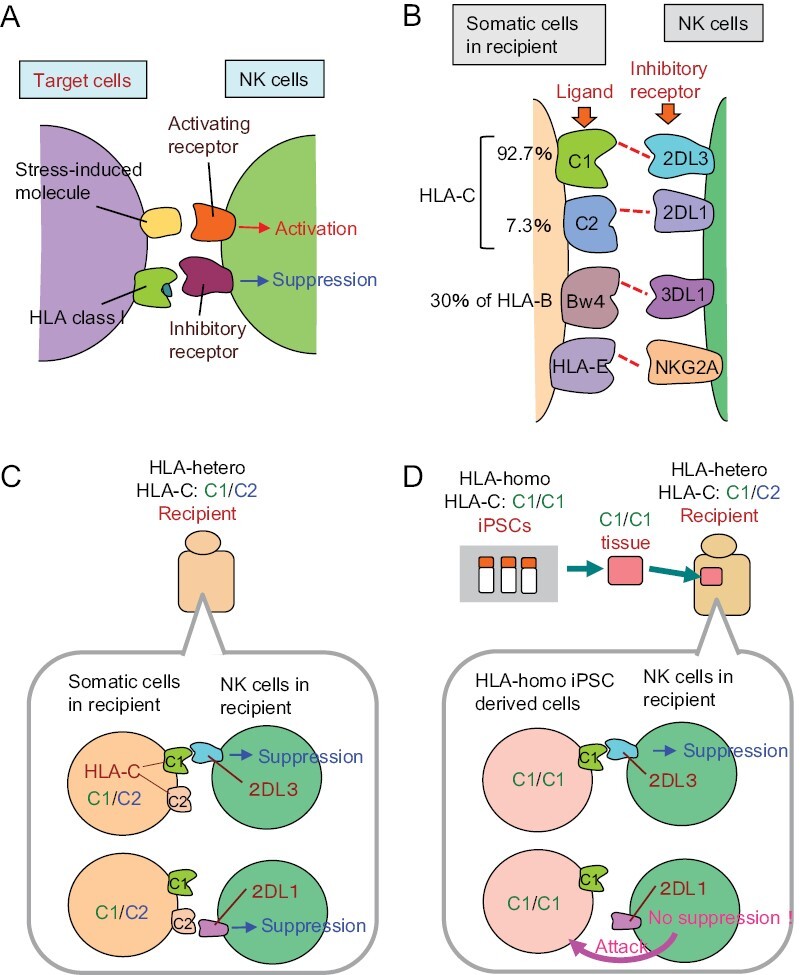
In currently ongoing adoptive T-cell therapies, T cells collected from patients are given back to them after ex vivo activation and expansion. In some cases, T cells are transduced with chimeric antigen receptor (CAR) or T-cell receptor (TCR) genes during the ex vivo culture period in order to endow T cells with the desired antigen specificity. Although such strategies are effective in some types of cancer, there remain issues to be solved: (i) the limited number of cells, (ii) it is time-consuming, (iii) it is costly, and (iv) the quality can be unstable. Points (ii) and (iv) can be solved by preparing allogeneic T cells and cryopreserving them in advance and methods are being developed using healthy donor-derived T cells or pluripotent stem cells as materials. Whereas it is difficult to solve (i) and (iii) in the former case, all the issues can be cleared in the latter case. However, in either case, a new problem arises: rejection by the patient's immune system. Deletion of human leukocyte antigen (HLA) avoids rejection by recipient T cells, but causes rejection by NK cells, which can recognize loss of HLA class I. Various countermeasures have been developed, but no definitive solution is yet available. Therefore, further research and development are necessary.
在目前正在进行的过继性 T 细胞疗法中,从患者体内采集的 T 细胞在体外激活和扩增后再回输给他们。在某些情况下,T 细胞在体外培养期间会转导嵌合抗原受体(CAR)或 T 细胞受体(TCR)基因,以使 T 细胞具有所需的抗原特异性。虽然这些策略在某些类型的癌症中是有效的,但仍存在需要解决的问题:(i)细胞数量有限,(ii)耗时,(iii)成本高,以及(iv)质量不稳定。(ii)和(iv)可以通过预先制备同种异体 T 细胞并冷冻保存来解决,并且正在开发使用健康供体来源的 T 细胞或多能干细胞作为材料的方法。虽然在前一种情况下难以解决(i)和(iii),但在后一种情况下可以清除所有问题。然而,在任何一种情况下,都会出现新的问题:患者免疫系统的排斥。人白细胞抗原(HLA)的缺失可避免受者 T 细胞的排斥,但会引起 NK 细胞的排斥,NK 细胞可识别 HLA Ⅰ类的缺失。已经开发了各种对策,但尚无明确的解决方案。因此,需要进一步的研究和开发。