Olsen Abby, Locascio Joseph, Tuncali Idil, Laroussi Nada, Abatzis Elena, Kamenskaya Polina, Kuras Yuliya, Yi Tom, Videnovic Aleks, Hayes Michael, Ho Gary, Paulson Jordan, Khurana Vikram, Herrington Todd, Hyman Bradley, Selkoe Dennis, Growdon John, Gomperts Stephen, Riise Trond, Schwarzschild Michael, Hung Albert, Wills Anne, Scherzer Clemens
University of Pittsburgh.
Center for Advanced Parkinson Research, Harvard Medical School, Brigham & Women's Hospital.
Res Sq. 2023 Dec 22:rs.3.rs-3683455. doi: 10.21203/rs.3.rs-3683455/v1.
Associations between phenotypic traits, environmental exposures, and Parkinson's disease have largely been evaluated one-by-one, piecemeal, and pre-selections. A comprehensive picture of comorbidities, phenotypes, exposures, and polypharmacy characterizing the complexity and heterogeneity of real-world patients presenting to academic movement disorders clinics in the US is missing.
To portrait the complexity of features associated with patients with Parkinson's disease in a study of 933 cases and 291 controls enrolled in the Harvard Biomarkers Study.
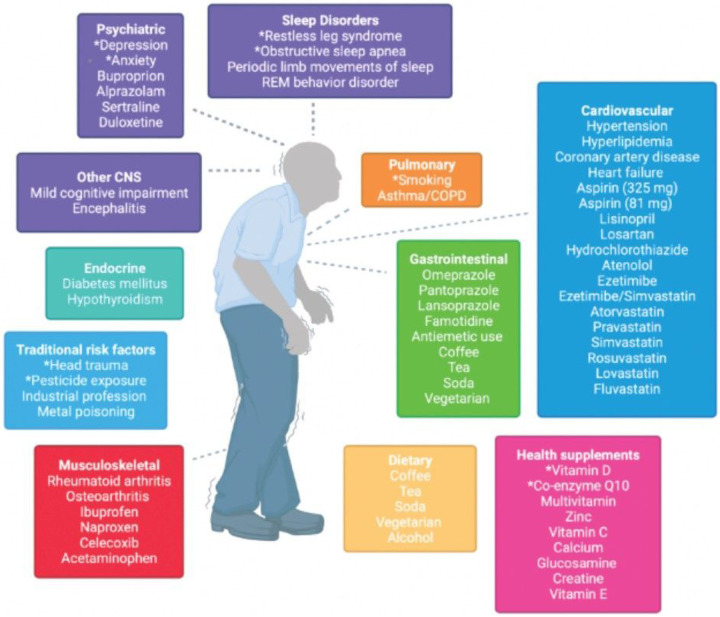
The primary analysis evaluated 64 health features for associations with Parkinson's using logistic regression adjusting for age and sex. We adjusted for multiple testing using the false discovery rate (FDR) with £ 0.05 indicating statistical significance. Exploratory analyses examined feature correlation clusters and feature combinations.
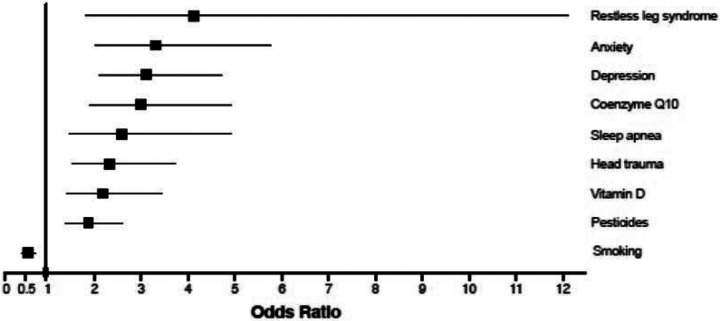
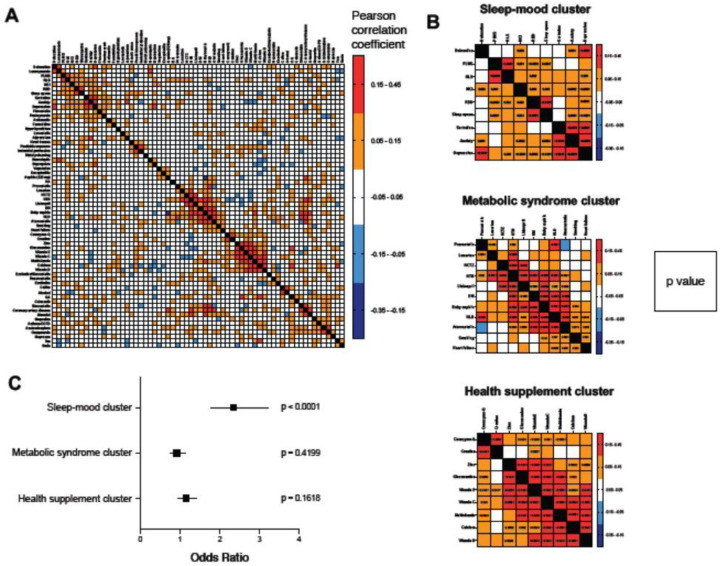
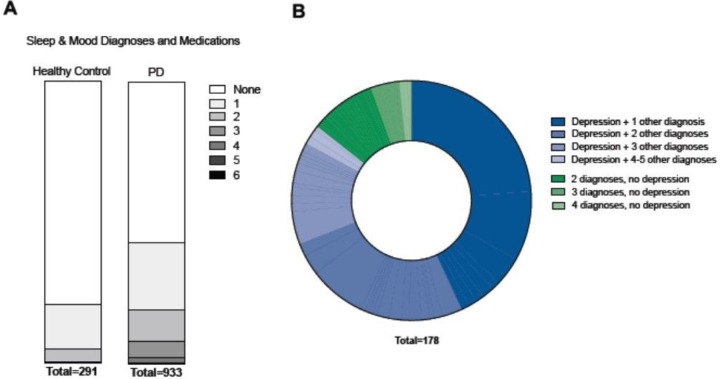
Depression (OR = 3.11, 95% CI 2.1 to 4.71), anxiety (OR = 3.31, 95% CI 2.01-5.75), sleep apnea (OR 2.58, 95% CI 1.47-4.92), and restless leg syndrome (RLS; OR 4.12, 95% CI 1.81-12.1) were significantly more common in patients with Parkinson's than in controls adjusting for age and sex with FDR £ 0.05. The prevalence of depression, anxiety, sleep apnea, and RLS were correlated, and these diseases formed part of a larger cluster of mood traits and sleep traits linked to PD. Exposures to pesticides (OR 1.87, 95% CI 1.37-2.6), head trauma (OR 2.33, 95% CI 1.51-3.73), and smoking (OR 0.57, 95% CI 0.43-0.75) were significantly associated with the disease consistent with previous studies. Vitamin supplementation with cholecalciferol (OR 2.18, 95% CI 1.4-3.45) and coenzyme Q10 (OR 2.98, 95% CI 1.89-4.92) was more commonly used by patients than controls. Cumulatively, 43% (398 of 933) of Parkinson's patients had at least one psychiatric or sleep disorder, compared to 21% (60 of 291) of healthy controls.
43% of Parkinson's patients seen at Harvard-affiliated teaching hospitals have depression, anxiety, and disordered sleep. This syndromic cluster of mood and sleep traits may be pathophysiologically linked and clinically important.
表型特征、环境暴露与帕金森病之间的关联大多是逐一、零碎且经过预先选择进行评估的。目前尚缺乏对共病、表型、暴露因素和联合用药情况的全面描述,这些因素体现了在美国学术性运动障碍诊所就诊的真实患者的复杂性和异质性。
在一项纳入933例帕金森病患者和291名对照的哈佛生物标志物研究中,描绘与帕金森病患者相关的特征复杂性。
主要分析采用逻辑回归评估64项健康特征与帕金森病的关联,并对年龄和性别进行校正。我们使用错误发现率(FDR)对多重检验进行校正,FDR≤0.05表示具有统计学意义。探索性分析检查特征相关簇和特征组合。
在校正年龄和性别且FDR≤0.05的情况下,帕金森病患者中抑郁(OR = 3.11,95%CI 2.1至4.71)、焦虑(OR = 3.31,95%CI 2.01 - 5.75)、睡眠呼吸暂停(OR 2.58,95%CI 1.47 - 4.92)和不安腿综合征(RLS;OR 4.12,95%CI 1.81 - 12.1)显著比对照组更常见。抑郁、焦虑、睡眠呼吸暂停和RLS的患病率相互关联,这些疾病构成了与帕金森病相关的更大的情绪特征和睡眠特征簇的一部分。与先前研究一致,接触杀虫剂(OR 1.87,95%CI 1.37 - 2.6)、头部外伤(OR 2.33,95%CI 1.51 - 3.73)和吸烟(OR 0.57,95%CI 0.43 - 0.75)与该疾病显著相关。帕金森病患者比对照组更常使用维生素胆钙化醇(OR 2.18,95%CI 1.4 - 3.45)和辅酶Q10(OR 2.98,95%CI 1.89 - 4.92)进行补充。累积来看,43%(933例中的398例)的帕金森病患者至少有一种精神或睡眠障碍,而健康对照组为21%(291例中的60例)。
在哈佛附属教学医院就诊的帕金森病患者中,43%有抑郁、焦虑和睡眠障碍。这种情绪和睡眠特征的综合征簇可能在病理生理上存在关联且具有临床重要性。