Centre for Mental Health and Brain Sciences, Swinburne University of Technology, Hawthorn Campus, PO Box 218, Hawthorn, VIC, 3122, Australia.
Centre for Youth Mental Health, The University of Melbourne, Melbourne, Australia.
Eat Weight Disord. 2024 Jan 10;29(1):6. doi: 10.1007/s40519-023-01629-1.
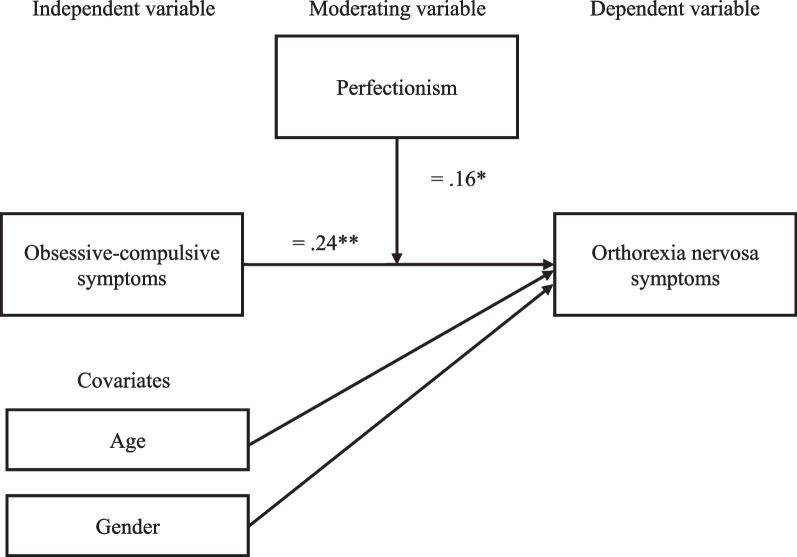
Orthorexia nervosa (ON), a proposed disorder describing an obsessive focus on "healthy" eating, is characterised as having overlapping symptoms with obsessive-compulsive disorder. However, ON/obsessive-compulsive (OC) symptom relationships are inconsistently reported. The current study aimed to investigate if the contribution of OC symptoms and beliefs explain variability in ON symptoms and determine if perfectionism, a transdiagnostic factor, moderates the ON/OC symptom relationship.
The study comprised 190 participants (M = 28.63, SD = 9.88; 80% female) recruited via an undergraduate research programme, social media, advocacy organisations, and a participant registry. Participants completed an online questionnaire assessing ON, OC, and perfectionism symptoms.
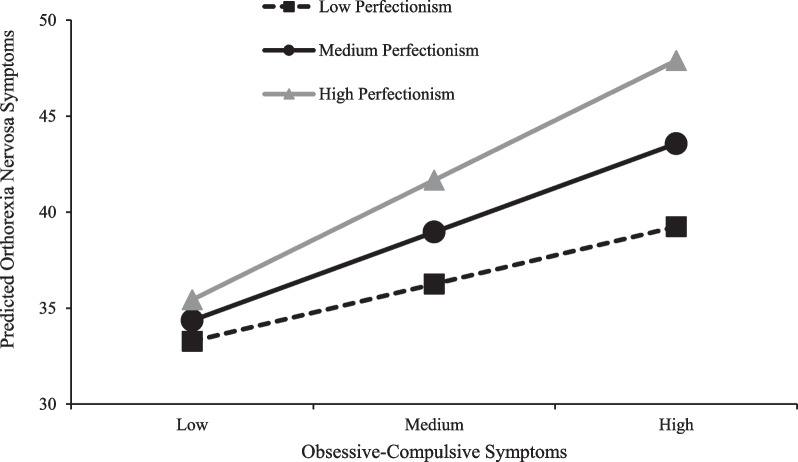
A linear regression analysis found OC symptoms and beliefs explained 22.9% variability in ON symptoms (p < 0.001, f = 0.38) and perfectionism moderated the ON/OC symptom relationship, where higher levels of perfectionism with higher levels of OC symptoms was associated with higher levels of ON symptoms, explaining 2.2% variability (p = .01, f = 0.03).
OC symptoms appear more common in ON than previous studies indicate. However, the interaction between perfectionism and OC symptoms may drive obsessions in ON. Findings help refine our current understanding of ON phenomenology with implications for ON treatment development. Future research should further explore perfectionism in ON phenomenology.
Level V (Opinions of respected authorities, based on descriptive studies, narrative reviews, clinical experience, or reports of expert committees).
神经强迫症(ON)是一种描述对“健康”饮食过度关注的拟议障碍,其特征是与强迫症有重叠的症状。然而,ON/强迫性(OC)症状之间的关系报道不一致。本研究旨在调查 OC 症状和信念是否能解释 ON 症状的可变性,并确定完美主义(一种跨诊断因素)是否调节 ON/OC 症状关系。
该研究包括 190 名参与者(M=28.63,SD=9.88;80%为女性),通过本科研究项目、社交媒体、宣传组织和参与者登记处招募。参与者完成了一项在线问卷,评估 ON、OC 和完美主义症状。
线性回归分析发现,OC 症状和信念解释了 22.9%的 ON 症状的可变性(p<0.001,f=0.38),而完美主义调节了 ON/OC 症状关系,其中较高的 OC 症状与较高的完美主义水平与较高的 ON 症状相关,解释了 2.2%的可变性(p=0.01,f=0.03)。
OC 症状在 ON 中比以前的研究表明的更为常见。然而,完美主义和 OC 症状之间的相互作用可能会导致 ON 中的强迫观念。研究结果有助于完善我们对 ON 现象学的当前理解,并对 ON 治疗的发展有影响。未来的研究应进一步探索 ON 现象学中的完美主义。
V 级(基于描述性研究、叙述性综述、临床经验或专家委员会报告的权威意见)。