Department of Biomechatronics Engineering, National Taiwan University.
Department of Medical Research, China Medical University Hospital, China Medical University.
Proc Jpn Acad Ser B Phys Biol Sci. 2024;100(1):68-85. doi: 10.2183/pjab.100.008.
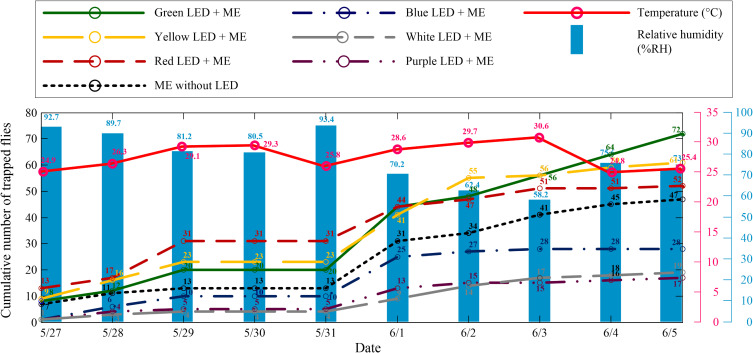
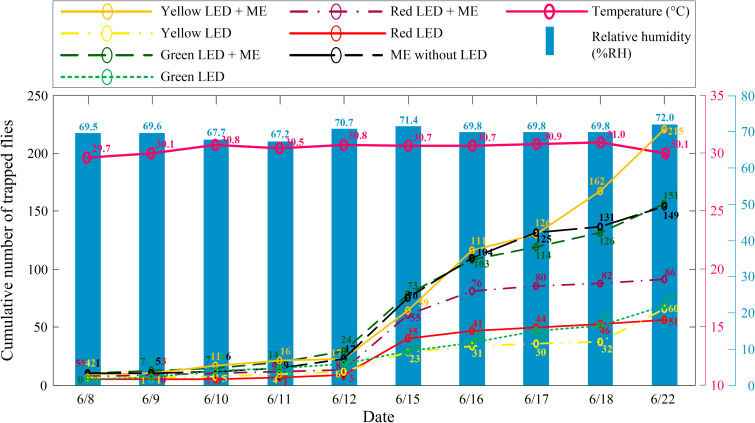
This study examined the effect of combining visual and olfactory cues to attract oriental fruit flies (OFFs). Six different colored light-emitting diodes (LEDs) served as a visual attractant and methyl eugenol served as olfactory bait to lure male flies. An internet of things (IoT)-based pest monitoring system, consisting of sensor nodes, a gateway, and automatic counting traps, was deployed in the field to automatically collect environmental data and pest counts. The results of the calibrated experiments indicated that green, yellow, or red LEDs exhibited better performance in attracting flies than white, purple, or blue LEDs or no LEDs. With an accurate combination of visual and olfactory cues, the proposed IoT-based pest monitoring system may be an effective tool in agricultural pest management, given its advantages for efficiently capturing OFFs in a labor and time saving manner, providing accurate information regarding increases in pest populations, and enabling long-term, real-time data collection.
本研究探讨了结合视觉和嗅觉线索来吸引东方果实蝇(OFFs)的效果。六种不同颜色的发光二极管(LED)用作视觉引诱剂,而甲基丁香酚则用作嗅觉诱饵来吸引雄性苍蝇。一个基于物联网(IoT)的害虫监测系统,由传感器节点、网关和自动计数陷阱组成,被部署在现场以自动收集环境数据和害虫计数。经过校准的实验结果表明,与白色、紫色或蓝色 LED 或无 LED 相比,绿色、黄色或红色 LED 在吸引苍蝇方面表现更好。通过准确结合视觉和嗅觉线索,所提出的基于物联网的害虫监测系统可能是农业害虫管理的有效工具,因为它具有高效捕捉 OFFs 的优势,节省劳动力和时间,提供有关害虫种群增加的准确信息,并实现长期实时数据收集。