Departments of Radiation Oncology, Chongqing University Cancer Hospital, No. 181, Han Yu Road, Shapingba District, Chongqing, 400030, People's Republic of China.
Apodibot Medical, Beijing, People's Republic of China.
BMC Cancer. 2024 Jan 10;24(1):59. doi: 10.1186/s12885-024-11844-3.
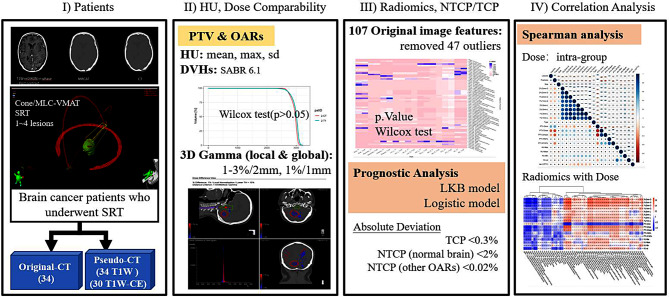
Pseudo-computed tomography (pCT) quality is a crucial issue in magnetic resonance image (MRI)-only brain stereotactic radiotherapy (SRT), so this study systematically evaluated it from the multi-modal radiomics perspective.
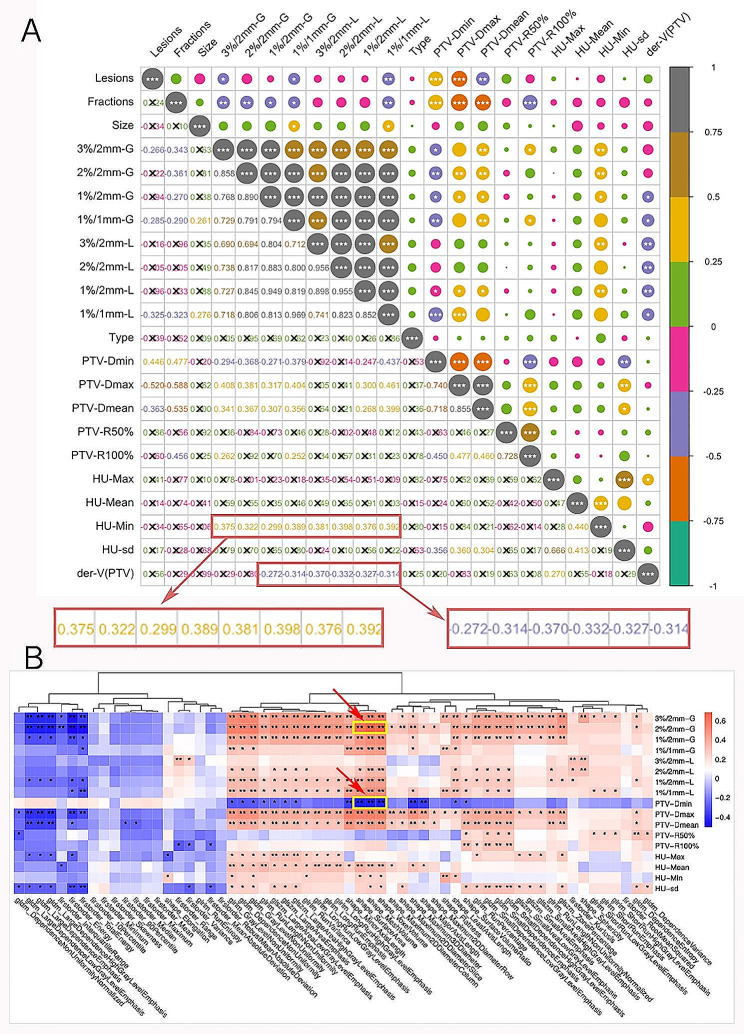
34 cases (< 30 cm³) were retrospectively included (2021.9-2022.10). For each case, both CT and MRI scans were performed at simulation, and pCT was generated by a convolutional neural network (CNN) from planning MRI. Conformal arc or volumetric modulated arc technique was used to optimize the dose distribution. The SRT dose was compared between pCT and planning CT with dose volume histogram (DVH) metrics and gamma index. Wilcoxon test and Spearman analysis were used to identify key factors associated with dose deviations. Additionally, original image features were extracted for radiomic analysis. Tumor control probability (TCP) and normal tissue complication probability (NTCP) were employed for efficacy evaluation.
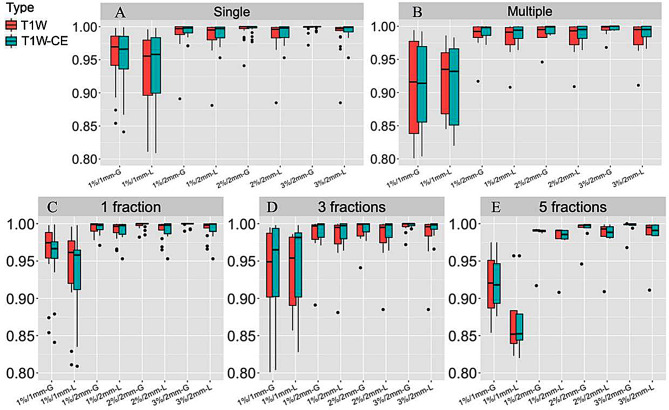
There was no significant difference between pCT and planning CT except for radiomics. The mean value of Hounsfield unit of the planning CT was slightly higher than that of pCT. The Gadolinium-based agents in planning MRI could increase DVH metrics deviation slightly. The median local gamma passing rates (1%/1 mm) between planning CTs and pCTs (non-contrast) was 92.6% (range 63.5-99.6%). Also, differences were observed in more than 85% of original radiomic features. The mean absolute deviation in TCP was 0.03%, and the NTCP difference was below 0.02%, except for the normal brain, which had a 0.16% difference. In addition, the number of SRT fractions and lesions, and lesion morphology could influence dose deviation.
This is the first multi-modal radiomics analysis of CNN-based pCT from planning MRI for SRT of small brain lesions, covering dosiomics and radiomics. The findings suggest the potential of pCT in SRT plan design and efficacy prediction, but caution needs to be taken for radiomic analysis.
在仅行磁共振成像(MRI)的脑立体定向放射治疗(SRT)中,伪 CT(pCT)质量是一个关键问题,因此本研究从多模态放射组学的角度对此进行了系统评估。
回顾性纳入 34 例(<30cm³)患者(2021.9-2022.10)。对每例患者,在模拟时均行 CT 和 MRI 扫描,并由规划 MRI 的卷积神经网络(CNN)生成 pCT。采用适形弧或容积调强弧形技术优化剂量分布。通过剂量体积直方图(DVH)指标和伽马指数比较 pCT 与计划 CT 之间的 SRT 剂量。采用 Wilcoxon 检验和 Spearman 分析来识别与剂量偏差相关的关键因素。此外,还对原始图像特征进行了放射组学分析。采用肿瘤控制概率(TCP)和正常组织并发症概率(NTCP)进行疗效评估。
除了放射组学之外,pCT 与计划 CT 之间无显著差异。计划 CT 的平均 CT 值略高于 pCT。规划 MRI 中的钆基造影剂可使 DVH 指标偏差略有增加。计划 CT 与 pCT(非对比)之间的中位局部伽马通过率(1%/1mm)为 92.6%(范围 63.5-99.6%)。此外,超过 85%的原始放射组学特征也存在差异。TCP 的平均绝对偏差为 0.03%,NTCP 的差异低于 0.02%,除正常脑外,差异为 0.16%。此外,SRT 分割次数、病变数量和病变形态也会影响剂量偏差。
这是首例基于规划 MRI 的 CNN 生成的 pCT 用于小脑部病变 SRT 的多模态放射组学分析,涵盖了 dosiomics 和 radiomics。研究结果表明,pCT 有望用于 SRT 计划设计和疗效预测,但在进行放射组学分析时需谨慎。