Bourbonne Vincent, Jaouen Vincent, Hognon Clément, Boussion Nicolas, Lucia François, Pradier Olivier, Bert Julien, Visvikis Dimitris, Schick Ulrike
Radiation Oncology Department, CHRU Brest, 2 Avenue Foch, 29200 Brest, France.
Laboratoire de Traitement de l'Information Médicale, Unité Mixte de Recherche 1101, Institut National de la Santé et de la Recherche, Université de Bretagne Occidentale, 29200 Brest, France.
Cancers (Basel). 2021 Mar 3;13(5):1082. doi: 10.3390/cancers13051082.
Stereotactic radiotherapy (SRT) has become widely accepted as a treatment of choice for patients with a small number of brain metastases that are of an acceptable size, allowing for better target dose conformity, resulting in high local control rates and better sparing of organs at risk. An MRI-only workflow could reduce the risk of misalignment between magnetic resonance imaging (MRI) brain studies and computed tomography (CT) scanning for SRT planning, while shortening delays in planning. Given the absence of a calibrated electronic density in MRI, we aimed to assess the equivalence of synthetic CTs generated by a generative adversarial network (GAN) for planning in the brain SRT setting.
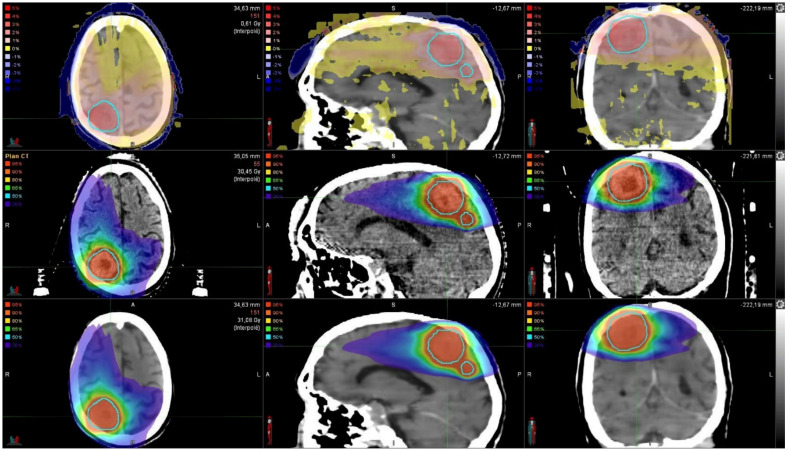
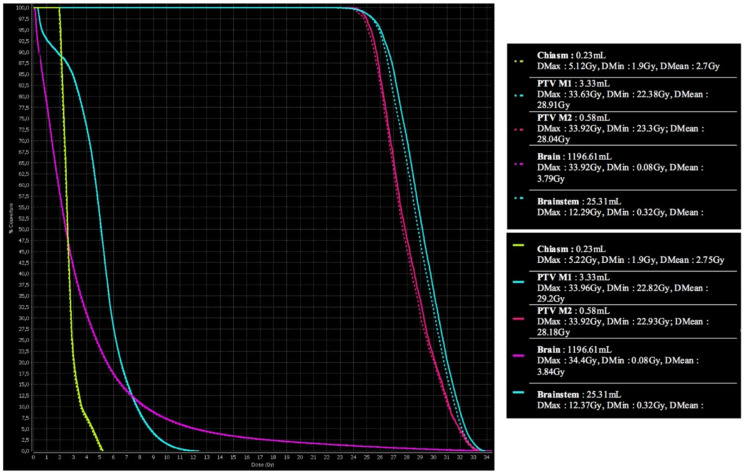
All patients with available MRIs and treated with intra-cranial SRT for brain metastases from 2014 to 2018 in our institution were included. After co-registration between the diagnostic MRI and the planning CT, a synthetic CT was generated using a 2D-GAN (2D U-Net). Using the initial treatment plan (Pinnacle v9.10, Philips Healthcare), dosimetric comparison was performed using main dose-volume histogram (DVH) endpoints in respect to ICRU 91 guidelines (Dmax, Dmean, D2%, D50%, D98%) as well as local and global gamma analysis with 1%/1 mm, 2%/1 mm and 2%/2 mm criteria and a 10% threshold to the maximum dose. -test analysis was used for comparison between the two cohorts (initial and synthetic dose maps).
184 patients were included, with 290 treated brain metastases. The mean number of treated lesions per patient was 1 (range 1-6) and the median planning target volume (PTV) was 6.44 cc (range 0.12-45.41). Local and global gamma passing rates (2%/2 mm) were 99.1 CI95% (98.1-99.4) and 99.7 CI95% (99.6-99.7) respectively (CI: confidence interval). DVHs were comparable, with no significant statistical differences regarding ICRU 91's endpoints.
Our study is the first to compare GAN-generated CT scans from diagnostic brain MRIs with initial CT scans for the planning of brain stereotactic radiotherapy. We found high similarity between the planning CT and the synthetic CT for both the organs at risk and the target volumes. Prospective validation is under investigation at our institution.
立体定向放射治疗(SRT)已被广泛接受为治疗少量脑转移瘤患者的首选方法,这些脑转移瘤大小合适,可实现更好的靶区剂量适形性,从而获得较高的局部控制率,并更好地保护危及器官。仅使用磁共振成像(MRI)的工作流程可以降低磁共振成像(MRI)脑部检查与用于SRT计划的计算机断层扫描(CT)之间的对准误差风险,同时缩短计划延迟。鉴于MRI中缺乏校准的电子密度,我们旨在评估生成对抗网络(GAN)生成的合成CT在脑SRT设置中进行计划的等效性。
纳入2014年至2018年在我们机构接受颅内SRT治疗脑转移瘤且有可用MRI的所有患者。在诊断性MRI与计划CT进行配准后,使用二维GAN(二维U-Net)生成合成CT。使用初始治疗计划(Pinnacle v9.10,飞利浦医疗保健公司),根据ICRU 91指南(Dmax、Dmean、D2%、D50%、D98%)的主要剂量体积直方图(DVH)终点以及1%/1mm、2%/1mm和2%/2mm标准和最大剂量10%阈值的局部和全局伽马分析进行剂量学比较。采用t检验分析对两个队列(初始剂量图和合成剂量图)进行比较。
纳入184例患者,共治疗290个脑转移瘤。每位患者治疗病变的平均数量为1个(范围1-6个),计划靶体积(PTV)中位数为6.44cc(范围0.12-45.41)。局部和全局伽马通过率(2%/2mm)分别为99.1 CI95%(98.1-99.4)和99.7 CI95%(99.6-99.7)(CI:置信区间)。DVH具有可比性,在ICRU 91终点方面无显著统计学差异。
我们的研究首次将诊断性脑MRI的GAN生成的CT扫描与用于脑立体定向放射治疗计划的初始CT扫描进行比较。我们发现计划CT与合成CT在危及器官和靶区体积方面具有高度相似性。我们机构正在进行前瞻性验证。