Postgraduate Program in Health Sciences, Faculty of Medicine of Jundiaí, 13202-550, Jundiaí, Brazil.
Department of Implant Dentistry, Faculdade São Leopoldo Mandic, 13045-755, Campinas, Brazil.
BMC Med Educ. 2024 Jan 10;24(1):47. doi: 10.1186/s12909-024-05028-7.
Medical education has evolved based on the application of pedagogical actions that place the student as the protagonist of the learning process through the use of active teaching methodologies. Within this context, higher education teachers should use strategies that focus on the student and his/her context and avoid traditional teaching methods. Specifically in medical schools, there is an even greater challenge since the teaching methods of medical curricula differ from those used in previous schooling. Consequently, students acquire their own style of processing information that is often incompatible with the profile of medical schools. This may be one of the factors responsible for the lack of motivation among undergraduates.
The aim of this study was to characterize the learning styles of students enrolled in a Brazilian medical school using the Felder-Soloman Index of Learning Styles (ILS).
This was a cross-sectional, descriptive, quantitative study that included students from the 1st to the 6th year of a Brazilian medical school. The students participating in this study voluntarily answered 44 questions about learning styles of the Felder-Silverman instrument validated in Brazil. The instrument was divided so that each domain consisted of 11 questions with two response options in which only one could be selected. For each domain, a score (1 point) was assigned to the selected option (a, b) of the question and the learning style category was determined as the difference between these values. For data collection and tabulation, we used the Learning Syle Platform (EdA Platform) developed based on Felder's studies since this system processes information about the dimension analyzed, the preferred style, and the most striking characteristics of each style.
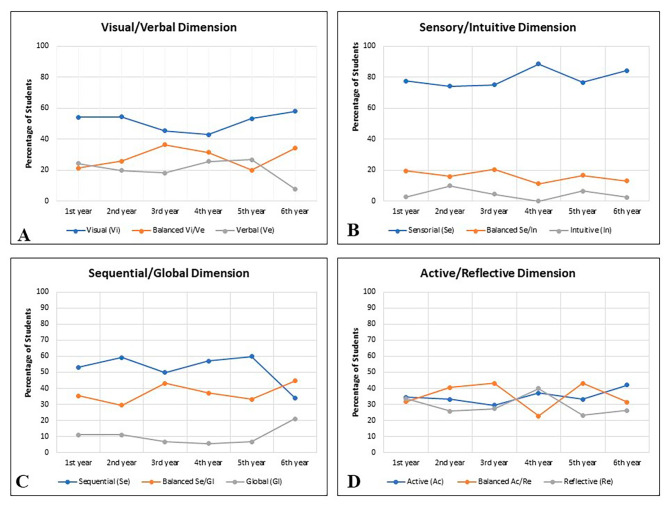
The results showed that sensing was the preferred learning style of the students, followed by the sequential and visual styles. It was not possible to determine whether gender or age influences the choice of learning methods because of the homogeneity of the results.
The present data will enable teachers of the institution involved in this study to plan pedagogical actions that improve the students' self-awareness, as well as their teaching-learning skills, by choosing the most adequate active methodologies for the medical education programs considering the individuality of each student and class.
医学教育的发展是基于教学行为的应用,这些教学行为通过使用主动教学方法将学生置于学习过程的主体地位。在这种背景下,高等教育教师应该使用关注学生及其背景的策略,避免传统的教学方法。具体在医学院校,由于医学课程的教学方法与之前的学校教育不同,因此面临更大的挑战。因此,学生获得了自己的信息处理方式,而这种方式往往与医学院校的模式不兼容。这可能是导致本科生缺乏学习动机的因素之一。
本研究旨在使用 Felder-Soloman 学习风格量表(ILS)对巴西某医学院的学生学习风格进行特征描述。
这是一项横断面、描述性、定量研究,纳入了巴西某医学院 1 至 6 年级的学生。参与本研究的学生自愿回答了 44 个关于巴西验证的 Felder-Silverman 工具学习风格的问题。该工具分为 4 个领域,每个领域由 11 个问题组成,每个问题有两个回答选项,只能选择其中一个。对于每个领域,为所选问题(a、b)的答案分配 1 分,并根据这些值确定学习风格类别。为了数据收集和制表,我们使用了基于 Felder 研究开发的学习风格平台(EdA 平台),因为该系统处理有关分析维度、首选风格和每种风格最突出特征的信息。
结果表明,感觉是学生首选的学习风格,其次是序列和视觉风格。由于结果的同质性,无法确定性别或年龄是否会影响学习方法的选择。
本研究的数据将使参与该研究的机构的教师能够通过选择最适合医学教育计划的主动教学方法来规划教学活动,从而提高学生的自我意识以及他们的教与学技能,同时考虑到每个学生和班级的个体性。