Chisato Kyoko, Yamazaki Takerou, Kayasaki Shuji, Fukumori Rika, Oikawa Shin
Veterinary Herd Health, Department of Veterinary Medicine, School of Veterinary Medicine, Rakuno Gakuen University, 582 Bunkyodai-Midorimachi, Ebetsu, Hokkaido 069-8501, Japan.
Memanbetsu Livestock Clinic, Ozora Central Branch, Okhotsk Regional Center, Hokkaido Agricultural Mutual Aid Association, 149-10 Memanbetsu Syouwa, Ozora-cho, Abashiri-gun, Hokkaido 099-2356, Japan.
Animals (Basel). 2023 Dec 31;14(1):144. doi: 10.3390/ani14010144.
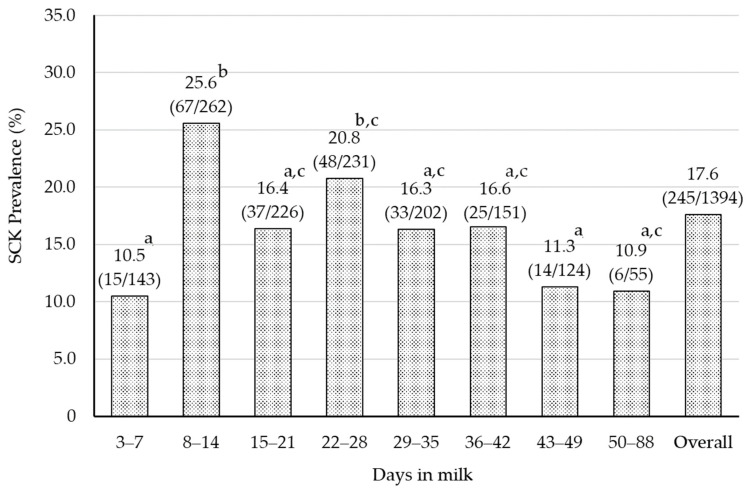
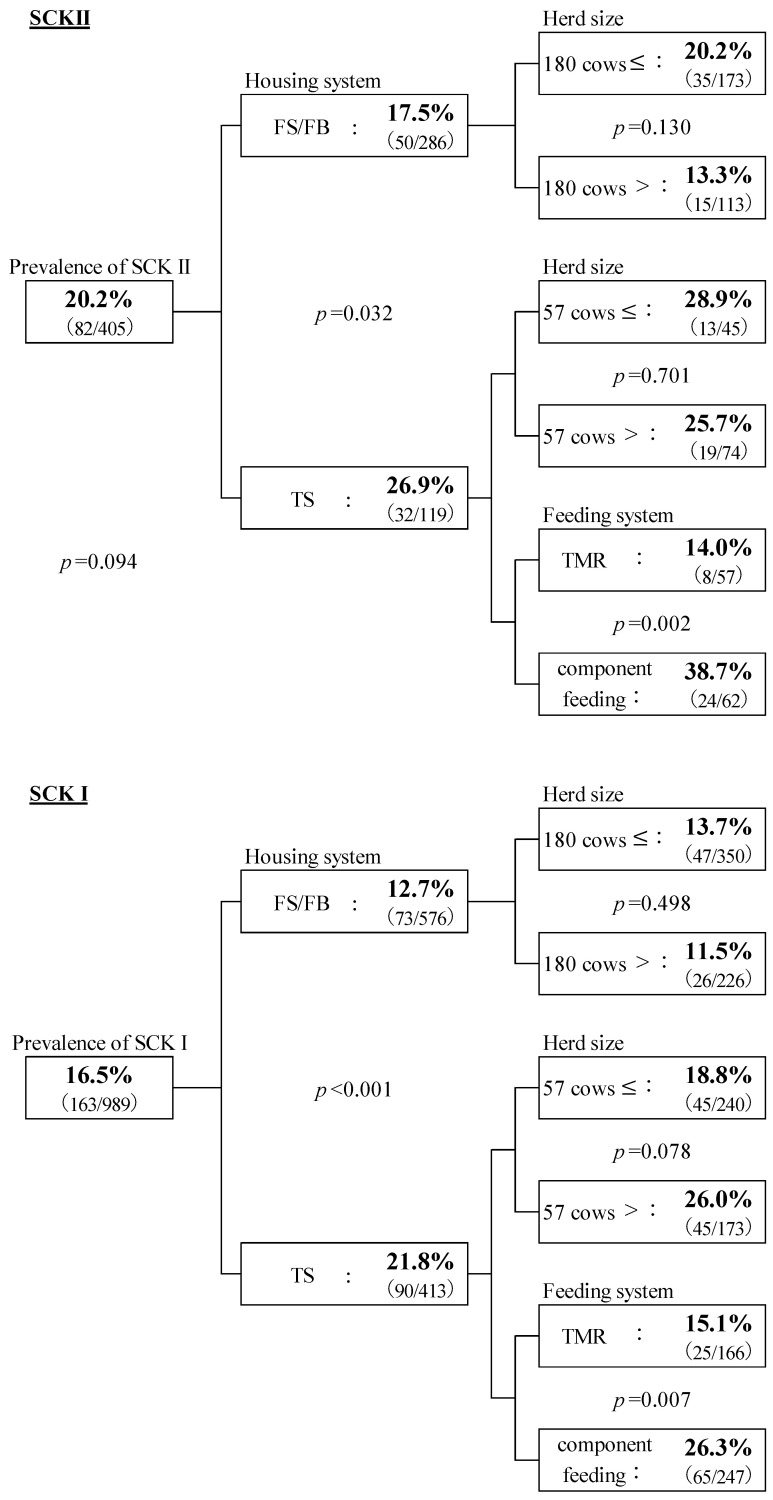
This study was carried out as an observational study in order to determine the prevalence of postpartum subclinical ketosis (SCK) in dairy herds in Hokkaido, Japan. From April 2012 to March 2014, blood β-hydroxybutyrate (BHBA) concentration was measured once within 3-88 days in milk (DIM) in 1394 apparently healthy cows from 108 farms to diagnose SCK (≥1.2 mM). In cows within 14 DIM, this was classified as SCK II, and from 15 DIM, this was classified as SCK I. Herds with a combined percentage of SCK I and SCK II of less than 10% were classified as SCK-negative herds, those with percentages of 10-25%, were classified as alert herds, and those with one of 25% or more, we classified as positive herds. The prevalence of SCK in the entire DIM was 17.6%. The prevalence of SCK II (20.2%) tended to occur more frequently than SCK I (16.5%, = 0.094). The frequency of SCK I was higher at the fourth parity. The number of milking cows in SCK-positive herds was significantly smaller than those of the other two types of herds ( = 0.004). The frequency of SCK-positive herds in tie stalls and with component feeding was higher than for free stall or free barn and with total mixed ration ( = 0.054 and = 0.002). This study reveals the prevalence of SCK in Hokkaido, Japan, and shows that SCK is associated with parity and the management system.
本研究作为一项观察性研究开展,旨在确定日本北海道奶牛场产后亚临床酮病(SCK)的患病率。2012年4月至2014年3月,对来自108个农场的1394头表面健康的奶牛在产奶3 - 88天内测量一次血液β-羟丁酸(BHBA)浓度,以诊断SCK(≥1.2 mM)。产奶14天内的奶牛,此情况被归类为SCK II,15天及以后的则归类为SCK I。SCK I和SCK II合并百分比低于10%的牛群被归类为SCK阴性牛群,百分比为10 - 25%的为警戒牛群,25%及以上的为阳性牛群。整个产奶期内SCK的患病率为17.6%。SCK II的患病率(20.2%)往往比SCK I(16.5%,P = 0.094)更频繁出现。SCK I在第四胎次时频率更高。SCK阳性牛群中的泌乳奶牛数量显著少于其他两种类型的牛群(P = 0.004)。拴系牛舍且采用分成分饲喂的牛群中SCK阳性牛群的频率高于自由牛舍或开放式牛舍且采用全混合日粮的牛群(P = 0.054和P = 0.002)。本研究揭示了日本北海道SCK的患病率,并表明SCK与胎次和管理制度有关。