Princess Margaret Cancer Centre, University Health Network, Toronto, ON M5G 2C1, Canada.
School of Cancer Sciences, University of Glasgow, Glasgow G61 1BD, UK.
Cells. 2023 Dec 20;13(1):19. doi: 10.3390/cells13010019.
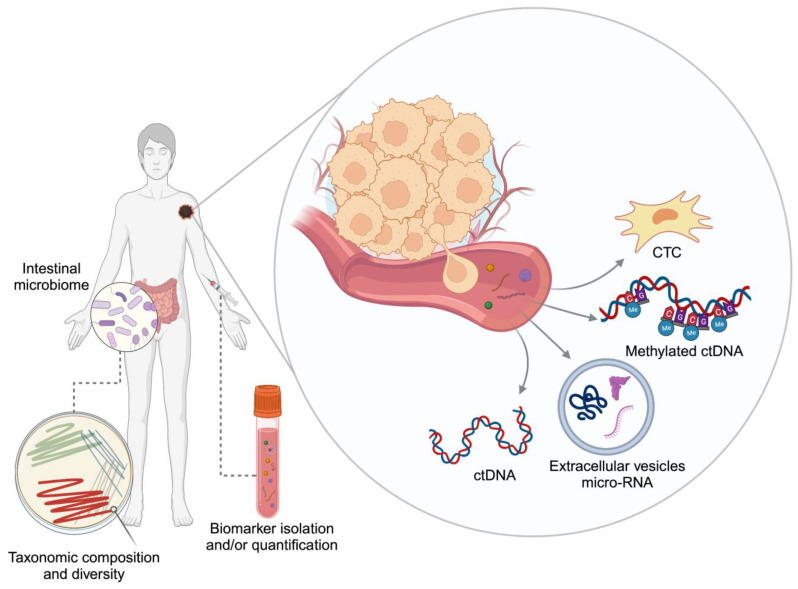
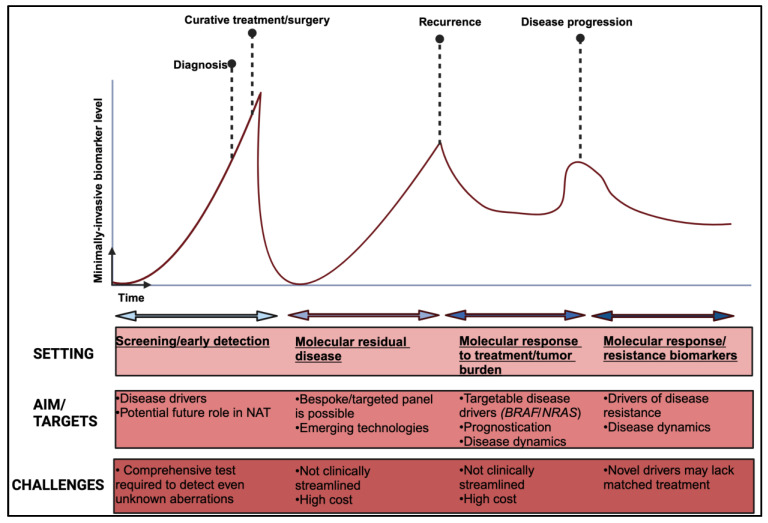
The therapeutic landscape of malignant melanoma has been radically reformed in recent years, with novel treatments emerging in both the field of cancer immunotherapy and signalling pathway inhibition. Large-scale tumour genomic characterization has accurately classified malignant melanoma into four different genomic subtypes so far. Despite this, only somatic mutations in oncogene, as assessed in tumour biopsies, has so far become a validated predictive biomarker of treatment with small molecule inhibitors. The biology of tumour evolution and heterogeneity has uncovered the current limitations associated with decoding genomic drivers based only on a single-site tumour biopsy. There is an urgent need to develop minimally invasive biomarkers that accurately reflect the real-time evolution of melanoma and that allow for streamlined collection, analysis, and interpretation. These will enable us to face challenges with tumour tissue attainment and process and will fulfil the vision of utilizing "" to guide clinical decisions, in a manner akin to how it is used in the management of haematological malignancies. In this review, we will summarize the most recent published evidence on the role of minimally invasive biomarkers in melanoma, commenting on their future potential to lead to practice-changing discoveries.
近年来,恶性黑色素瘤的治疗领域发生了重大变革,癌症免疫疗法和信号通路抑制领域都出现了新的治疗方法。迄今为止,大规模的肿瘤基因组特征分析已经将恶性黑色素瘤准确地分为四个不同的基因组亚型。尽管如此,只有肿瘤活检中评估的致癌基因突变,迄今为止已成为小分子抑制剂治疗的验证性预测生物标志物。肿瘤进化和异质性的生物学揭示了目前仅基于单点肿瘤活检解码基因组驱动因素所存在的局限性。迫切需要开发微创生物标志物,这些标志物能准确反映黑色素瘤的实时演变,并能简化采集、分析和解释。这将使我们能够应对肿瘤组织获取和处理方面的挑战,并实现利用“液体活检”指导临床决策的愿景,就像它在血液恶性肿瘤管理中的应用一样。在这篇综述中,我们将总结微创生物标志物在黑色素瘤中的最新研究证据,并对其未来在推动变革性发现方面的潜力进行评论。