Asante Diana M, Sreekumar Amritha, Nathani Sandip, Lee Tae Jin, Sharma Ashok, Patel Nikhil, Simmons Matthew N, Saini Sharanjot
Department of Biochemistry and Molecular Biology, Augusta University, Augusta, GA 30912, USA.
Department of Center for Biotechnology and Genomic Medicine, Augusta University, Augusta, GA 30912, USA.
Cancers (Basel). 2023 Dec 21;16(1):48. doi: 10.3390/cancers16010048.
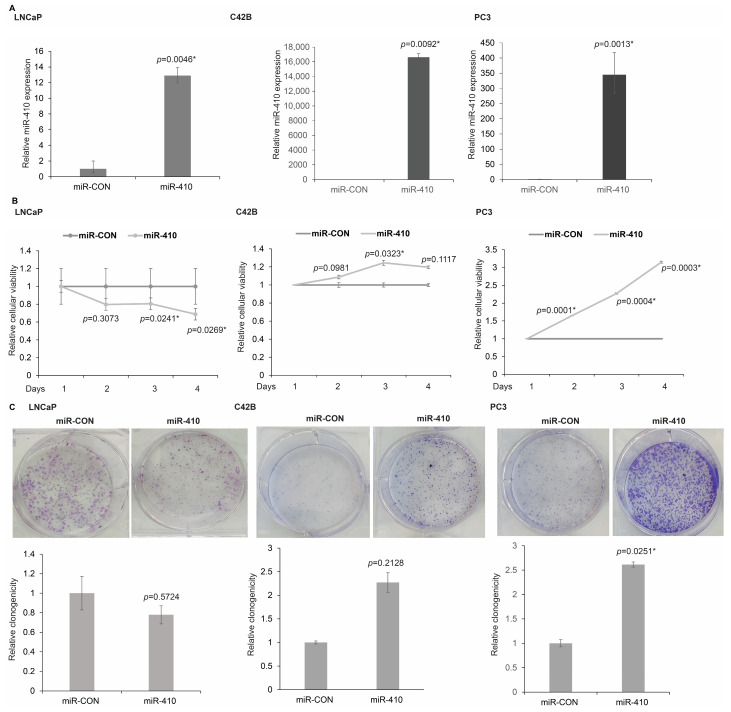
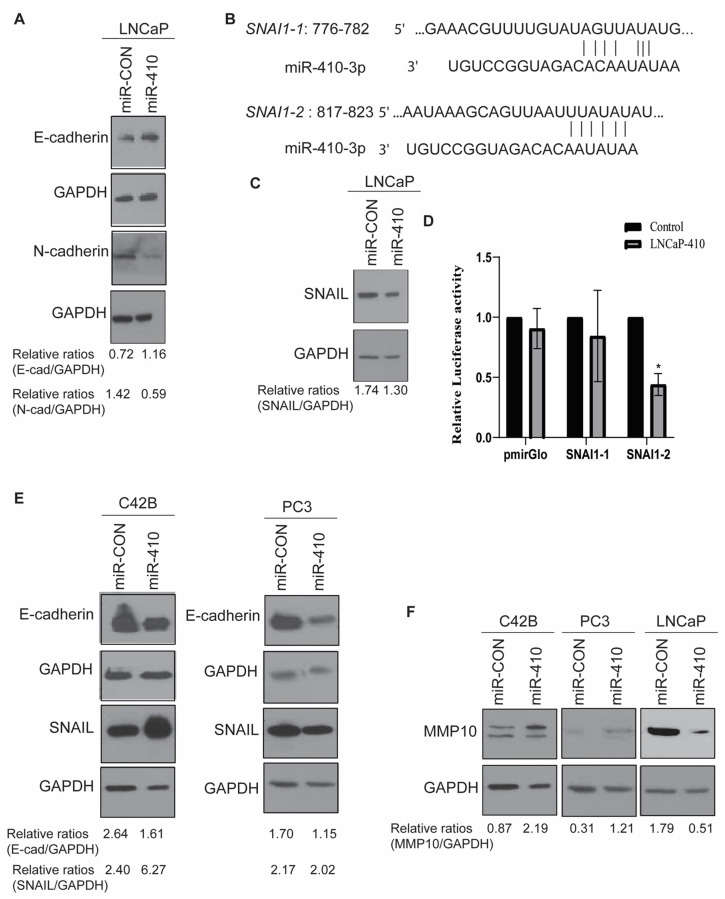
The molecular basis of prostate cancer (PCa) progression from the primary disease to metastatic castration-resistant prostate cancer (CRPC) followed by therapy-induced neuroendocrine prostate cancer is not fully understood. In this study, we elucidate the role of miR-410, a little-studied microRNA located on chromosome 14q32.31 within the DLK1-DIO3 cluster, in PCa. miR-410 expression analyses in primary and metastatic PCa tissues and cell lines show that its levels are decreased in initial stages and increased in advanced PCa. Functional studies were performed in a series of PCa cell lines. In LNCaP cells, miR-410 overexpression led to decreases in cellular viability, proliferation, invasiveness, and migration. On the other hand, miR-410 overexpression in PC3 and C42B cells led to increased viability, proliferation, and invasiveness. Our data suggest that miR-410 represses epithelial-to-mesenchymal transition (EMT) in LNCaP cells by directly repressing SNAIL. However, it promotes EMT and upregulates PI3K/Akt signaling in PC3 and C42B cells. In vivo studies with PC3 xenografts support an oncogenic role of miR-410. These data suggest that miR-410 acts as a tumor suppressor in the initial stages of PCa and play an oncogenic role in advanced PCa. Our findings have important implications in understanding the molecular basis of PCa progression with potential translational implications.
前列腺癌(PCa)从原发性疾病进展为转移性去势抵抗性前列腺癌(CRPC),随后发展为治疗诱导的神经内分泌前列腺癌的分子基础尚未完全明确。在本研究中,我们阐明了miR-410在PCa中的作用,miR-410是位于14q32.31染色体上DLK1-DIO3簇内一个研究较少的微小RNA。对原发性和转移性PCa组织及细胞系进行的miR-410表达分析表明,其水平在PCa初期降低,在晚期升高。在一系列PCa细胞系中进行了功能研究。在LNCaP细胞中,miR-410过表达导致细胞活力、增殖、侵袭和迁移能力下降。另一方面,PC3和C42B细胞中miR-410过表达导致活力、增殖和侵袭能力增强。我们的数据表明,miR-410通过直接抑制SNAIL来抑制LNCaP细胞中的上皮-间质转化(EMT)。然而,它在PC3和C42B细胞中促进EMT并上调PI3K/Akt信号通路。对PC3异种移植瘤的体内研究支持了miR-410的致癌作用。这些数据表明,miR-410在PCa初期起肿瘤抑制作用,而在晚期PCa中发挥致癌作用。我们的研究结果对于理解PCa进展的分子基础具有重要意义,并具有潜在的转化意义。