Department of Gastroenterology, Dietetics and Internal Diseases, Poznan University of Medical Sciences, 61-701 Poznan, Poland.
Poland Doctoral School, Poznan University of Medical Sciences, 61-701 Poznan, Poland.
Nutrients. 2023 Dec 19;16(1):6. doi: 10.3390/nu16010006.
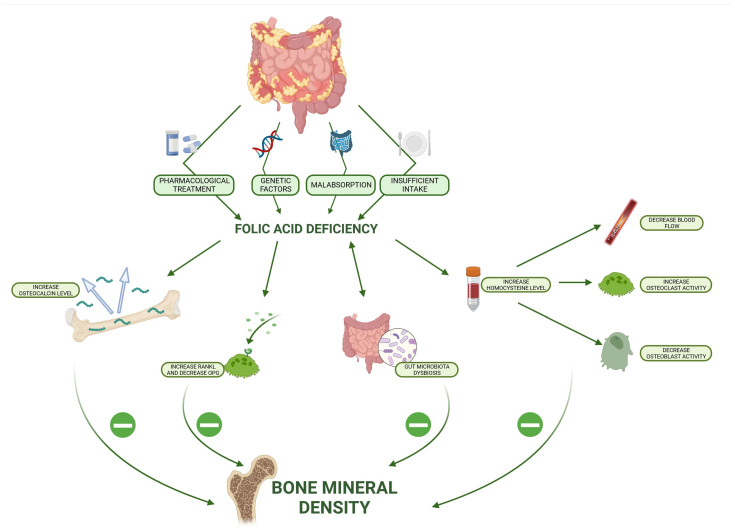
Decreased bone mineral density (BMD) is a common problem among patients with inflammatory bowel disease (IBD). We hypothesised that an insufficient intake of folate might affect BMD.
The study subjects included 26 with Crohn's disease-CD, 30 with ulcerative colitis-UC, and 31 healthy adults (control group-CG) aged 18-50 years. Participants were asked to follow their usual diet, and dietary intake was assessed by a 4-day, 24 h dietary recall. All the participants filled in a questionnaire referring to folic acid supplementation. The BMD, T-score, and Z-score of the lumbar spine (L1-L4) and femoral neck (FN) were assessed.
We found significant differences in the body mass, BMI (body mass index), CRP (C-reactive protein), BMD, Z-score, and T-score of the L1-L4 and FN between groups. There were no differences in energy and folate intake or the percentage coverage of recommended dietary allowances (RDA) of folate in all groups. Moreover, 70% of patients with UC, 92% of patients with CD, and 77% of CG patients showed insufficient folate intake. Folic acid was supplemented with a similar frequency in patients covering and not covering the RDA of folate. The intake of folate per 1000 kcal correlated positively with the CD group's BMD and T-score of L1-L4.
Insufficient folate intake is common in patients with IBD and healthy individuals. The impact of folate on BMD in IBD is not clear. We need more studies on the association between folate intake, folic acid concentration, and BMD in IBD.
炎症性肠病(IBD)患者常存在骨密度(BMD)降低的问题。我们假设叶酸摄入不足可能会影响 BMD。
研究对象包括 26 例克罗恩病(CD)患者、30 例溃疡性结肠炎(UC)患者和 31 名年龄在 18-50 岁的健康成年人(对照组-CG)。参与者被要求遵循他们的日常饮食,通过 4 天 24 小时饮食回忆法来评估饮食摄入量。所有参与者填写了一份关于叶酸补充剂的问卷。评估了腰椎(L1-L4)和股骨颈(FN)的 BMD、T 评分和 Z 评分。
我们发现组间的体重、BMI(体重指数)、CRP(C 反应蛋白)、BMD、Z 评分和 L1-L4 和 FN 的 T 评分存在显著差异。在所有组中,能量和叶酸摄入量或叶酸推荐膳食摄入量(RDA)的百分比覆盖率均无差异。此外,70%的 UC 患者、92%的 CD 患者和 77%的 CG 患者叶酸摄入不足。补充叶酸的频率在覆盖和未覆盖 RDA 的叶酸的患者中相似。每 1000 千卡的叶酸摄入量与 CD 组的 BMD 和 L1-L4 的 T 评分呈正相关。
IBD 患者和健康个体普遍存在叶酸摄入不足的情况。叶酸对 IBD 患者 BMD 的影响尚不清楚。我们需要更多关于 IBD 中叶酸摄入量、叶酸浓度和 BMD 之间关联的研究。