School of Pharmacy and Food Engineering, Wuyi University, Jiangmen 529020, China.
International Healthcare Innovation Institute (Jiangmen), Jiangmen 529040, China.
Nutrients. 2023 Dec 24;16(1):58. doi: 10.3390/nu16010058.
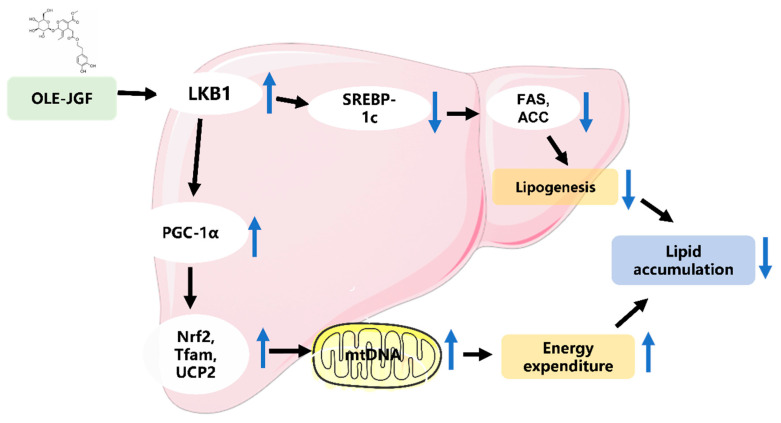
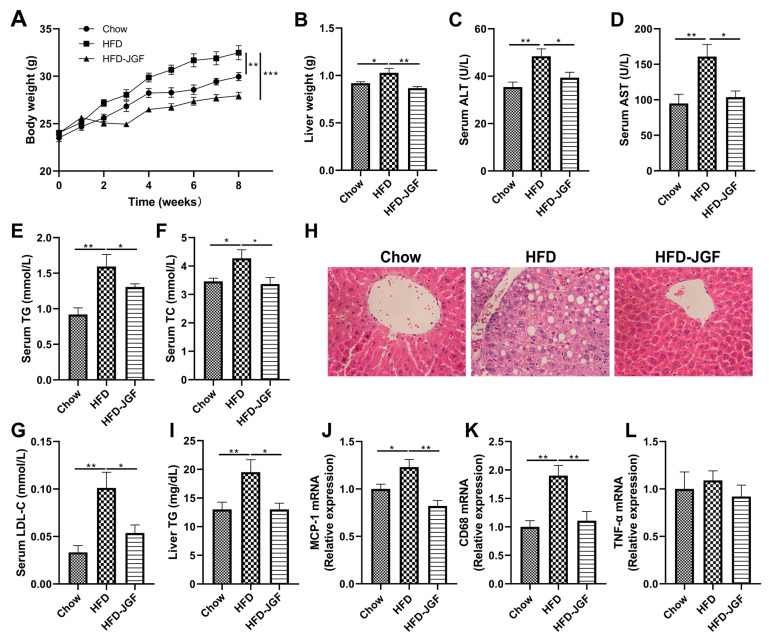
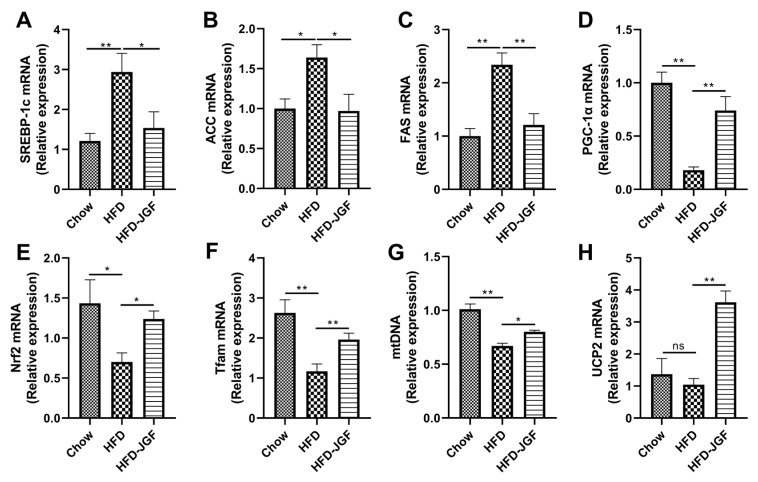
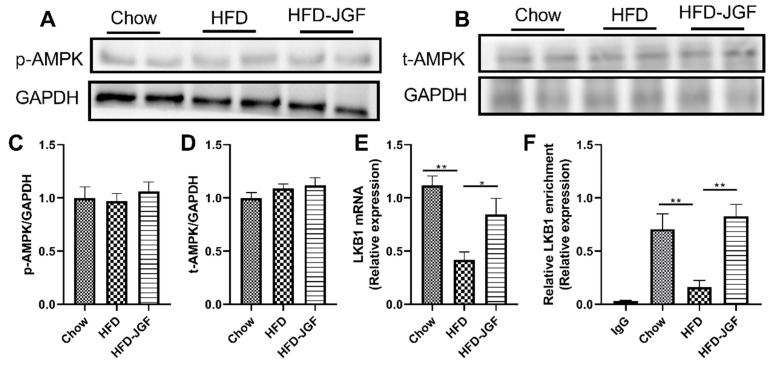
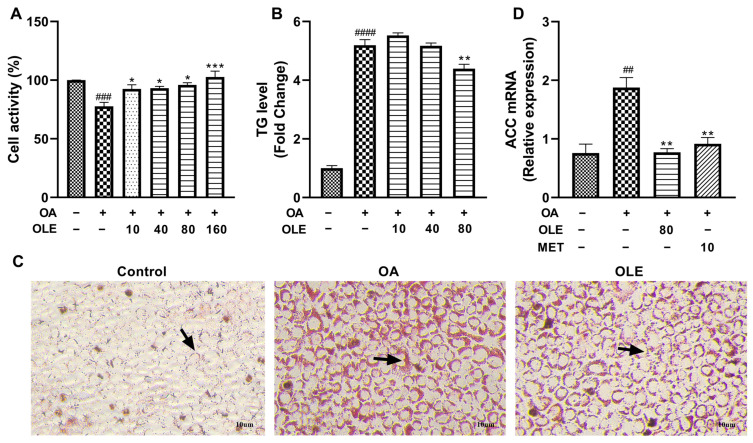
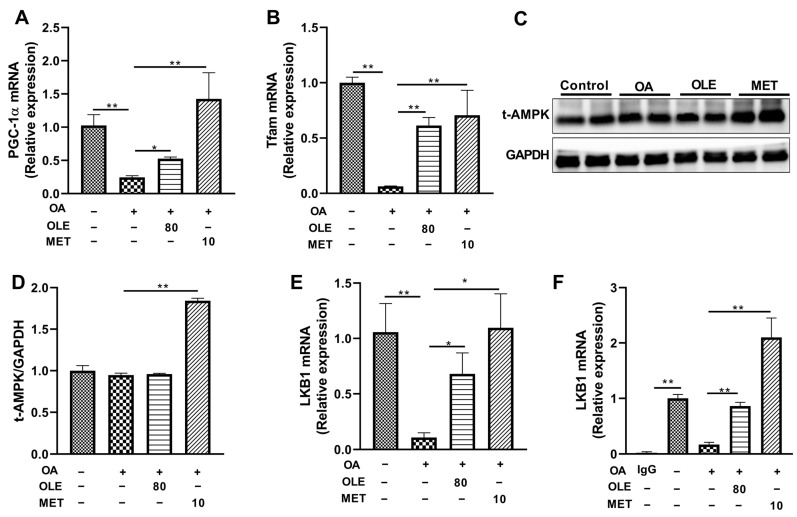
Diets() rich in fat are a major() cause() of metabolic disease(), and nutritional() food has been widely() used() to counteract the metabolic disorders such() as obesity() and fatty() liver(). The present study investigated the effects of oleuropein-enriched extract() from L. flowers (OLE-JGF) in high-fat diet() (HFD)-fed mice and oleic acid() (OA)-treated AML-12 cells. Treatment() of HFD-fed mice with 0.6% OLE-JGF for 8 weeks significantly reduced body and liver() weights, as well as attenuating lipid dysmetabolism and hepatic steatosis. OLE-JGF administration() prominently suppressed the mRNA expressions() of monocyte chemoattractant protein()-1 (MCP-1) and cluster of differentiation 68 (CD68), and it also downregulated acetyl-CoA carboxylase (ACC) and fatty() acid() synthase (FAS) as well as sterol-regulatory-element()-binding protein() (SREBP-1c) in the liver(). Meanwhile, mitochondrial DNA and uncoupling protein() 2 (UCP2) were upregulated along with the increased expression() of mitochondrial biogenic promoters including liver() kinase B1 (LKB1), peroxisome proliferator-activated receptor-γ coactivator-1α (PGC-1α), nuclear() factor()-erythroid-derived 2-like 2 (Nrf2), and mitochondrial transcription factor() A (Tfam), but did not change AMP-activated protein() kinase (AMPK) in liver(). The lipid droplets were decreased significantly after treatment() with 80 μM oleuropein for 24 h in OA-induced AML-12 cells. Furthermore, oleuropein significantly inhibited ACC mRNA expression() and upregulated LKB1, PGC-1α, and Tfam mRNA levels, as well as increasing the binding level of LKB1 to PGC-1α promoter in OA-induced cells. These findings indicate() that OLE-JGF reduces hepatic lipid deposition in HFD-fed mice, as well as the fact that OA-induced liver() cells may be partly() attributed to upregulation of the LKB1-PGC-1α axis, which mediates hepatic lipogenesis and mitochondrial biogenesis. Our study provides a scientific() basis() for the benefits and potential() use() of the flower as a food supplement() for the prevention() and treatment() of metabolic disease().
富含脂肪的饮食是代谢性疾病的主要原因,营养食品已被广泛用于对抗肥胖和脂肪肝等代谢紊乱。本研究调查了橄榄苦苷富集提取物(OLE-JGF)对高脂肪饮食(HFD)喂养小鼠和油酸(OA)处理的 AML-12 细胞的影响。用 0.6%OLE-JGF 处理 HFD 喂养的小鼠 8 周,显著降低了体重和肝脏重量,同时减轻了脂质代谢紊乱和肝脂肪变性。OLE-JGF 给药显著抑制了单核细胞趋化蛋白-1(MCP-1)和分化群 68(CD68)的 mRNA 表达,并下调了乙酰辅酶 A 羧化酶(ACC)和脂肪酸合成酶(FAS)以及固醇调节元件结合蛋白(SREBP-1c)在肝脏中的表达。同时,线粒体 DNA 和解偶联蛋白 2(UCP2)上调,同时包括肝激酶 B1(LKB1)、过氧化物酶体增殖物激活受体-γ共激活因子-1α(PGC-1α)、核因子-红细胞衍生 2 样 2(Nrf2)和线粒体转录因子 A(Tfam)在内的线粒体生物发生启动子的表达增加,但肝内 AMP 激活蛋白激酶(AMPK)没有变化。在 OA 诱导的 AML-12 细胞中用 80μM 橄榄苦苷处理 24 小时后,脂质滴明显减少。此外,橄榄苦苷显著抑制 ACC mRNA 表达,并上调 LKB1、PGC-1α 和 Tfam mRNA 水平,同时增加 OA 诱导细胞中 LKB1 与 PGC-1α 启动子的结合水平。这些发现表明,OLE-JGF 可减少 HFD 喂养小鼠肝脏中的脂质沉积,而 OA 诱导的肝细胞可能部分归因于 LKB1-PGC-1α 轴的上调,该轴介导肝内脂肪生成和线粒体生物发生。我们的研究为该花作为预防和治疗代谢性疾病的食品补充剂的益处和潜在用途提供了科学依据。