Kriege Marc, Demare Tim, Ruemmler Robert, Schmidtmann Irene, Wojciechowski Janosh, Busch Anneke, Ott Thomas
Department of Anaesthesiology, University Medical Centre, Johannes Gutenberg-University Mainz, 55131 Mainz, Germany.
Institute for Medical Biostatistics, Epidemiology and Informatics, University Medical Centre, Johannes Gutenberg-University Mainz, 55131 Mainz, Germany.
J Clin Med. 2023 Dec 19;13(1):16. doi: 10.3390/jcm13010016.
The swapping of a supraglottic airway device or a tracheal tube in anaesthetised adult patients is a challenging procedure because potential complications through hypoxemia and loss of airway may occur, with life-threatening implications. This study aims to evaluate which airway technique offers the highest success rate concerning a secure airway in established supraglottic airway and tracheal tube airway exchange scenarios.
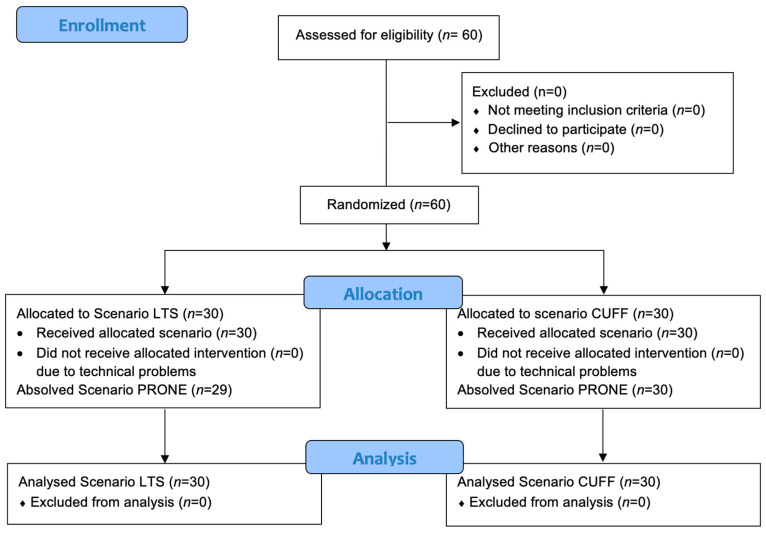
After ethical approval, anaesthesiologists were randomised 1:1 into simulated scenarios: an LTS group (malpositioned laryngeal tube) and a Cuff group (relevant cuff leakage of a placed tracheal tube). After that, both groups completed a common scenario consisting of a partially obstructed tracheal tube lumen in a fixed prone position with a Mayfield clamp. The primary endpoint was a successful tracheal airway exchange within ten minutes after the start of the scenario and before severe hypoxemia (SpO < 80%) arose. Secondary endpoints were the evaluation of factors influencing success after 10 min.
In total, 60 anaesthesiologists (LTS group = 30; Cuff group = 30) with a median experience of 7 years (IQR 4-11) were observed. Within 10 min, a malpositioned laryngeal tube was successfully exchanged by 27/30 (90%) participants, compared to the exchange of a tracheal tube with a relevant cuff leakage by 29/30 (97%; > 0.05). An airway exchange in an obstructed tube scenario occurred in 22/59 (37%). Loss of airway maintenance showed an obvious association with failure in the common scenario ( = 0.02).
The results of this simulation-based study reflect that the exchange of an existing but insufficient airway device in clinical practice is a high-risk procedure. Especially in a fixed prone position, the deliberate evaluation of the existing airway patency and well-conceived airway management in the case of the accidental loss of the airway or obstructed airway access are crucial.
在麻醉的成年患者中更换声门上气道装置或气管导管是一项具有挑战性的操作,因为可能会因低氧血症和气道丧失而出现潜在并发症,甚至危及生命。本研究旨在评估在已建立的声门上气道和气管导管气道交换场景中,哪种气道技术在确保气道安全方面成功率最高。
经伦理批准后,麻醉医生按1:1随机分组进入模拟场景:LTS组(喉管位置不当)和袖带组(已放置的气管导管存在相关袖带漏气)。之后,两组完成一个共同场景,即在固定俯卧位用梅菲尔德夹模拟气管导管管腔部分阻塞。主要终点是在场景开始后10分钟内且在严重低氧血症(SpO<80%)出现之前成功进行气管气道交换。次要终点是评估10分钟后影响成功的因素。
共观察了60名麻醉医生(LTS组=30名;袖带组=30名),中位经验为7年(四分位间距4 - 11年)。在10分钟内,27/30(90%)的参与者成功更换了位置不当的喉管,相比之下,29/30(97%)的参与者成功更换了存在相关袖带漏气的气管导管(P>0.05)。在阻塞导管场景中进行气道交换的有22/59(37%)。气道维持失败与共同场景中的失败明显相关(P=0.02)。
这项基于模拟的研究结果表明,在临床实践中更换现有的但不合适的气道装置是一项高风险操作。特别是在固定俯卧位时,对现有气道通畅性进行审慎评估以及在气道意外丧失或气道通路受阻情况下精心设计气道管理至关重要。