García-Sancho Alejandro Martín, Cabero Almudena, Gutiérrez Norma C
Hematology Department, University Hospital of Salamanca, IBSAL (Instituto de Investigación Biomédica de Salamanca), CIBERONC (Centro de Investigación Biomédica en Red en Cáncer ), University of Salamanca, 37007 Salamanca, Spain.
J Clin Med. 2023 Dec 22;13(1):70. doi: 10.3390/jcm13010070.
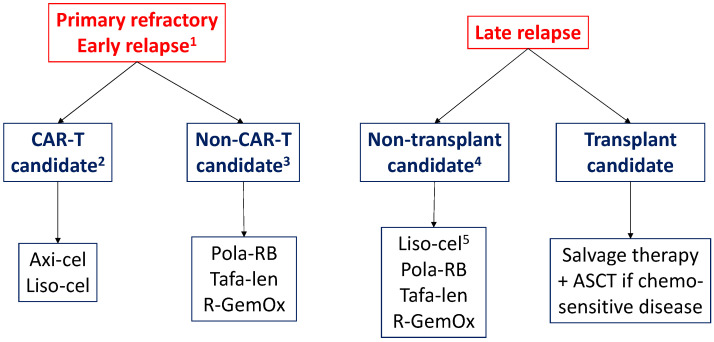
Overall, around 40% of patients with diffuse large B-cell lymphoma (DLBCL) have refractory disease or relapse after the first line of treatment. Until relatively recently, the prognosis of patients with relapsed or refractory DLBCL was very poor and treatment options were very limited. In recent years, several novel therapies have been approved that provide more effective options than conventional chemotherapy and that have manageable toxicity profiles. CAR-T cell therapy has become the new standard treatment for patients with refractory or early relapsed DLBCL, based on the positive results of the phase 3 ZUMA-7 and TRANSFORM clinical trials. This review addresses the role of CAR-T therapy and autologous stem cell transplantation in the treatment of these patients and other approved options for patients who are not candidates for transplant, such as the combinations of polatuzumab vedotin with bendamustine and rituximab, and tafasitamab with lenalidomide.
总体而言,约40%的弥漫性大B细胞淋巴瘤(DLBCL)患者在一线治疗后出现难治性疾病或复发。直到最近,复发或难治性DLBCL患者的预后仍然很差,治疗选择非常有限。近年来,几种新型疗法已获批准,这些疗法比传统化疗更有效,且毒性特征可控。基于3期ZUMA-7和TRANSFORM临床试验的阳性结果,CAR-T细胞疗法已成为难治性或早期复发DLBCL患者的新标准治疗方法。本综述探讨了CAR-T疗法和自体干细胞移植在这些患者治疗中的作用,以及针对不适合移植的患者的其他已批准选择,如泊洛妥珠单抗维达汀与苯达莫司汀和利妥昔单抗的联合使用,以及塔法西他单抗与来那度胺的联合使用。