
日本住院患者中分离的世界卫生组织优先病原体的抗菌药物耐药模式:一项三级中心观察性研究。
Antimicrobial resistance patterns of WHO priority pathogens isolated in hospitalized patients in Japan: A tertiary center observational study.
机构信息
Department of Global and Innovative Medicine, Osaka University Graduate School of Medicine, Yamadaoka, Suita, Osaka, Japan.
Department of Medical Informatics, Osaka University Graduate School of Medicine, Yamadaoka, Suita, Osaka, Japan.
出版信息
PLoS One. 2024 Jan 11;19(1):e0294229. doi: 10.1371/journal.pone.0294229. eCollection 2024.
BACKGROUND
After issuing the "Global action plan on antimicrobial resistance" in 2015, the World Health Organization (WHO) established a priority pathogens list for supporting research and development of novel antimicrobials. We conducted a comprehensive analysis of the WHO priority organisms in a Japanese tertiary hospital to apprehend the local AMR epidemiology.
METHODS
Data were obtained from electrical medical records in Osaka University Hospital between January 2010 and March 2021. The critical, high, and medium "priority pathogens list" categories of the WHO were used to compare results between the early (2010-2015) and late (2016-2021) phases.
RESULTS
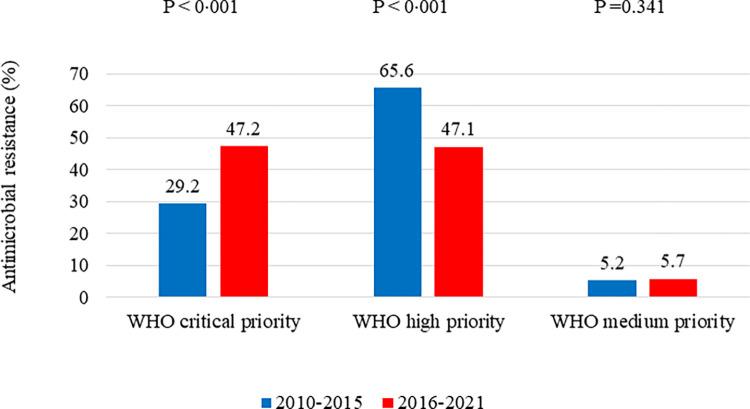
Out of 52,130 culture-positive specimens, a total of 9,872 (18.9%) contained WHO priority isolates. In comparison to early phases, late phases were likely to have higher rates of carbapenem resistance in Pseudomonas aeruginosa (15.7% vs 25.0%, P<0.001), 3rd generation cephalosporin resistance in Escherichia coli (11.5% vs 17.8%, P<0.001) as well as Klebsiella pneumoniae (1.6% vs 4.4%, P<0.001), and ampicillin resistance in Haemophilus influenzae (2.4% vs 3.9%, P<0.001). After 2015, however, the proportion of methicillin-resistant and vancomycin-intermediate Staphylococcus aureus was low. In this study, in-hospital mortality was comparable among patients with resistance to the three WHO priority pathogen types: critical (5.9%), high (3.9%), and medium (3.8%), and no significant change was observed between two phases in each category. However, significant interactions for in-hospital mortality were observed in subgroup analyses between "critical priority" AMR and the presence of comorbid conditions, such as chronic kidney disease or diabetes mellitus.
CONCLUSIONS
To implement better antimicrobial stewardship policies and practices, local priority pathogens and "high-risk" patients for in-hospital death need to be acknowledged and evaluated periodically.
背景
2015 年发布《全球抗菌素耐药行动计划》后,世界卫生组织(WHO)为支持新型抗菌素研发制定了优先病原体清单。我们对日本一家三级医院的 WHO 优先病原体进行了全面分析,以了解当地抗菌素耐药流行病学情况。
方法
数据来源于大阪大学医院 2010 年 1 月至 2021 年 3 月期间的电子病历。采用 WHO 的关键、高和中“优先病原体清单”类别对早期(2010-2015 年)和晚期(2016-2021 年)阶段的结果进行比较。
结果
在 52130 份培养阳性标本中,共有 9872 份(18.9%)含有 WHO 优先分离株。与早期阶段相比,晚期阶段铜绿假单胞菌(15.7% vs 25.0%,P<0.001)、大肠埃希菌(11.5% vs 17.8%,P<0.001)和肺炎克雷伯菌(1.6% vs 4.4%,P<0.001)对碳青霉烯类的耐药率以及流感嗜血杆菌(2.4% vs 3.9%,P<0.001)对氨苄西林的耐药率更高。然而,2015 年之后,耐甲氧西林和万古霉素中介金黄色葡萄球菌的比例较低。在本研究中,对三种 WHO 优先病原体类型(关键型、高型和中型)耐药的患者的院内死亡率相当:关键型(5.9%)、高型(3.9%)和中型(3.8%),并且在每个类别中,两个阶段之间没有观察到显著变化。然而,在关键优先抗菌素耐药与慢性肾脏病或糖尿病等合并症存在的亚组分析中,观察到院内死亡率的显著交互作用。
结论
为实施更好的抗菌素管理政策和实践,需要定期了解和评估当地的优先病原体和院内死亡“高危”患者。

 Zotero 插件